




























Views
Downloads



Complete Cell Membrane Worksheet | Grades 7–12 Science

Paste this activity's link or code into your existing LMS (Google Classroom, Canvas, Teams, Schoology, Moodle, etc.).
Students can open and work on the activity right away, with no student login required.
You'll still be able to track student progress and results from your teacher account.
This comprehensive science assessment evaluates secondary students on the structure and function of the cell membrane. Across 22 rigorous items, learners analyze phospholipid models, interpret transport flow charts, evaluate osmotic laboratory data, and write scientific explanations. The resource delivers reliable data on student mastery before summative unit exams.
At a Glance
- Grade: 7–12 · Subject: Science
- Standard: Life Science — Model membrane structure and explain selective transport mechanisms
- Skill Focus: Plasma membrane structure, diffusion, osmosis, and active transport
- Format: 4 pages · 22 problems · Answer key included · PDF
- Best For: End-of-unit review or benchmark assessment
- Time: 45–60 minutes
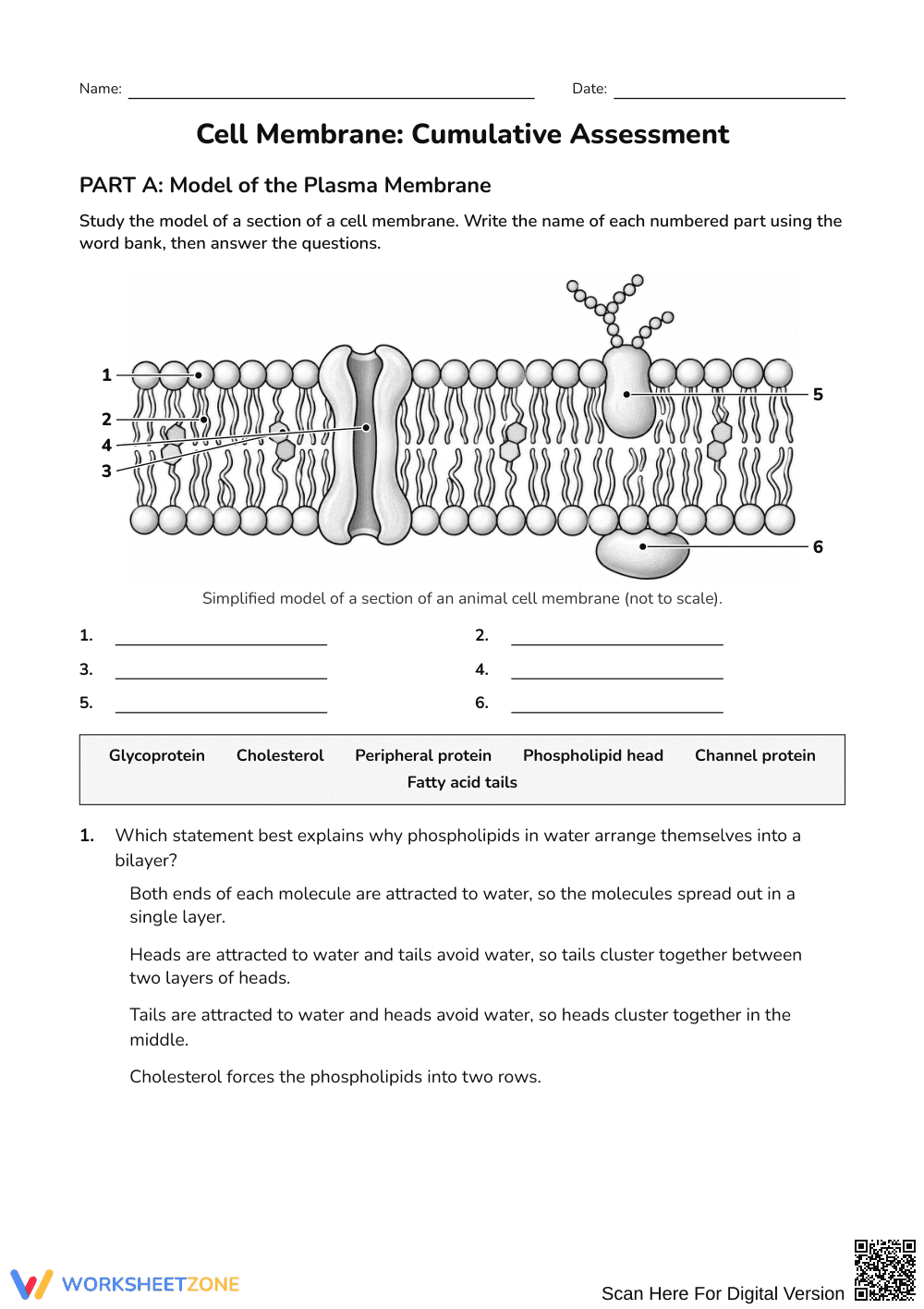
The 4-page student packet contains 22 questions organized into four sections: diagram labeling with a word bank, flow chart analysis of carrier proteins, quantitative osmosis data analysis, and short-answer applications. A matching 4-page teacher answer key provides complete model explanations, labeled diagrams, and sample student responses.
Skill Progression
- Guided Practice (Part A): Students label six membrane structures using a word bank before analyzing bilayer orientation and surface markers.
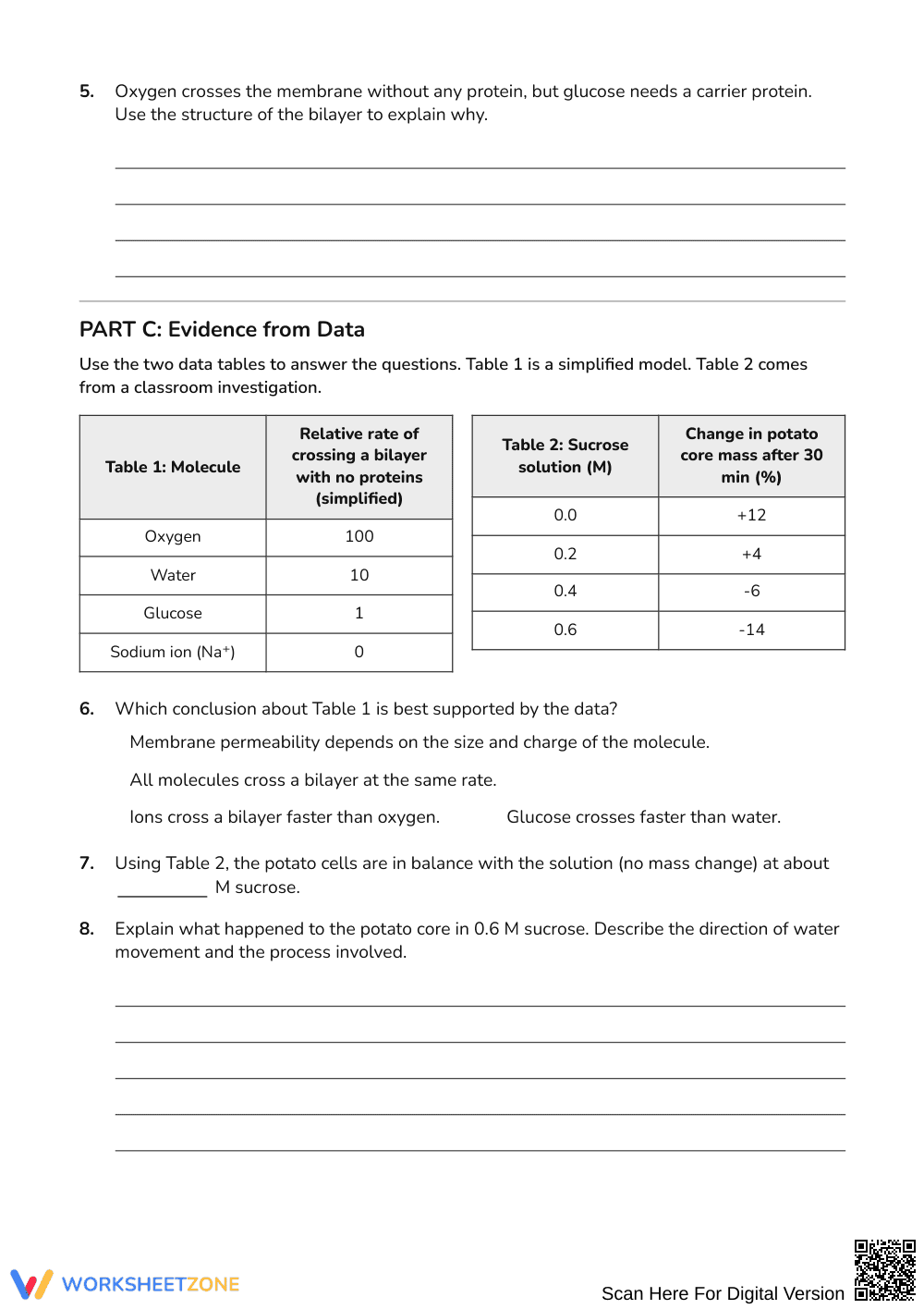
- Supported Practice (Parts B & C): Learners analyze glucose transport flow charts and potato core mass data to deduce permeability principles.
- Independent Practice (Part D): Students evaluate active transport criteria, analyze cystic fibrosis channel defects, and refute a common membrane misconception.
This sequence follows gradual release principles, shifting students from visual recall to empirical data synthesis.
Standards Alignment
This worksheet aligns with secondary Life Science standards addressing cellular structure and membrane transport. Students use models and laboratory evidence to explain how cell membranes regulate internal environments through passive and active transport. Both standard codes can be copied directly into lesson plans, IEP goals, or district curriculum mapping tools.
How to Use It
Administer this 4-page worksheet following direct instruction on cellular transport, or use it as a unit review. During classwork, check Part C first; errors explaining potato core mass loss indicate a need for osmosis remediation before students complete the open-response items. Expected completion time is 45 to 60 minutes.
Who It's For
Designed for middle and high school biology classes, this resource supports general education students and honors cohorts. Visual diagrams and word banks assist multilingual learners, while Part D offers analytical depth for advanced students. Pair this printable worksheet with a hands-on dialysis tubing or potato core lab investigation.
Secondary life science frameworks require students to model how the selectively permeable cell membrane maintains cellular homeostasis through passive and active transport mechanisms. Research by Fisher & Frey (2014) on the gradual release of responsibility confirms that student understanding of complex biological systems improves when instructional tasks progress systematically from visual identification to evidence-based analysis. This 4-page worksheet provides 22 structured tasks requiring learners to evaluate empirical data tables, calculate osmotic mass differentials, and apply structural transport concepts to physiological conditions such as cystic fibrosis. By combining diagram labeling, flow chart interpretation, and claim-evidence-reasoning prompts, this assessment tool enables educators to measure foundational recall alongside higher-order analytical reasoning. The comprehensive structure ensures teachers obtain reliable formative data regarding student mastery of diffusion, channel-mediated transport, and energy-requiring pumps across living membranes.


