































Complete Cell Labeling Worksheet | Grades 7-12 Science

Paste this activity's link or code into your existing LMS (Google Classroom, Canvas, Teams, Schoology, Moodle, etc.).
Students can open and work on the activity right away, with no student login required.
You'll still be able to track student progress and results from your teacher account.
This comprehensive cell labeling worksheet strengthens student understanding of cellular anatomy and organelle functions across plant and animal cells. Through visual identification, structural classification, and data analysis, students build conceptual models that connect microscopic parts to living systems. The resource provides 48 targeted tasks designed to solidify foundational biology concepts for secondary learners.
At a Glance
- Grade: Grades 7–12 · Subject: Science
- Standard: Model cell structure, organelle functions, and cellular physiological processes
- Skill Focus: Organelle labeling, structural classification, and system relationships
- Format: 4 pages · 48 problems · Answer key included · PDF
- Best For: Biology unit practice, lab reinforcement, and exam prep
- Time: 45–60 minutes
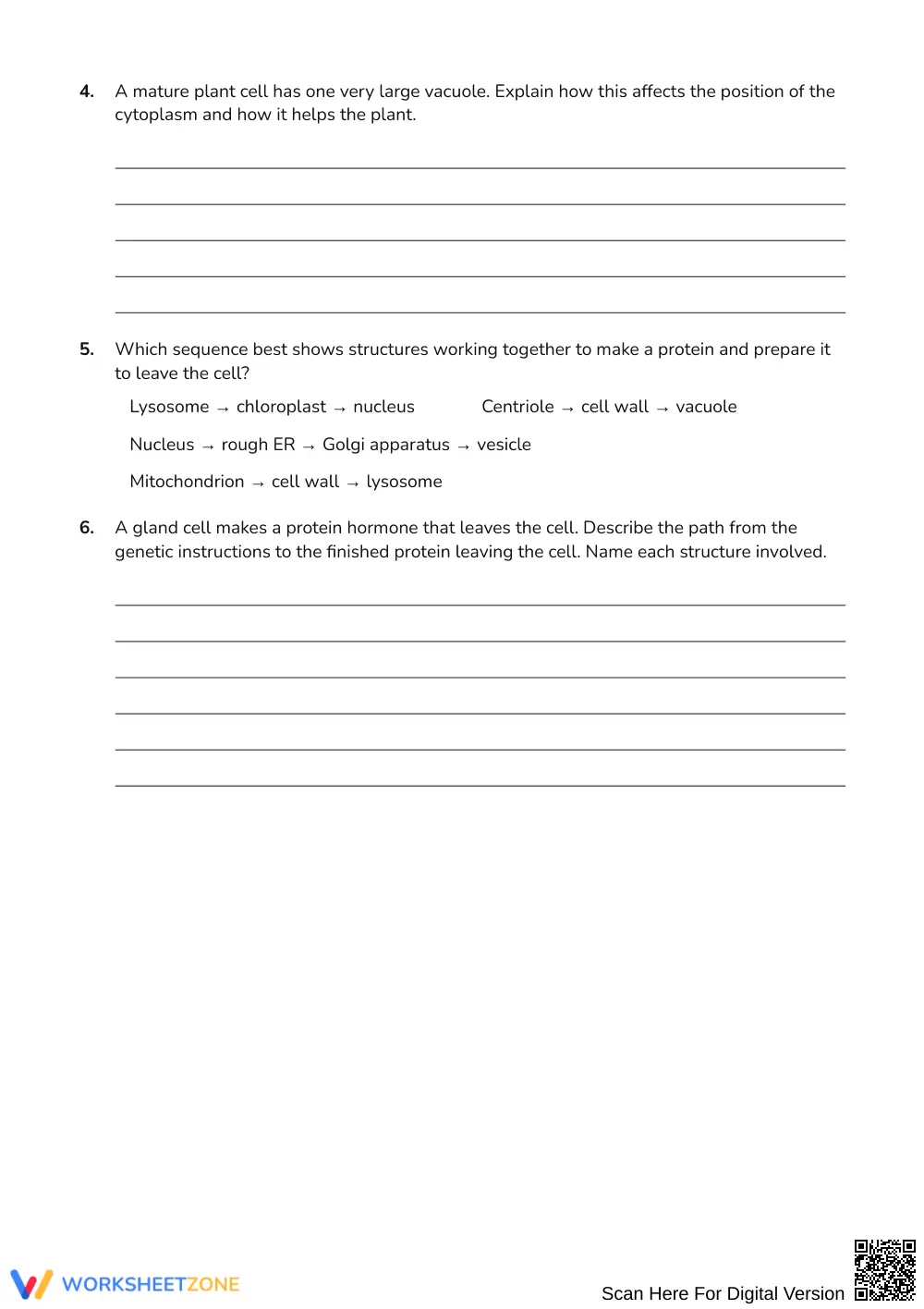
Spanning 4 student pages, this resource features distinct analytical sections: animal and plant diagram labeling with a word bank, comparative presence and category classification, matching organelle functions, and multi-step relationship analysis using quantitative mitochondrial data. A complete 4-page answer key provides worked model responses for open-ended explanations and protein synthesis pathways.
The activity follows an intentional scaffolded progression to develop mastery:
- Guided Practice: Students label 17 organelle structures on animal and plant diagrams using an accessible word bank to activate recall.
- Supported Practice: Learners complete 14 classification checks and 5 functional matching prompts categorizing organelles by physiological roles such as energy conversion and protein production.
- Independent Practice: Students evaluate a 12-item quantitative data set and synthesis prompts, connecting mitochondrial density and protein trafficking to organelle interactions.
This gradual-release structure moves students systematically from basic organelle identification to sophisticated, evidence-based reasoning.
This worksheet aligns with secondary life science standards requiring students to develop and use models explaining the structure and function of cells as interconnected systems. It emphasizes how organelles interact during protein export and energy production. Both standard principles can be copied directly into lesson plans, IEP goals, or district curriculum mapping tools.
Deploy this worksheet after direct instruction on cell theory and organelle roles as a collaborative paired practice or independent summative review. During completion, monitor how students interpret the mitochondrial data table in Part D to gauge whether they distinguish correlation from causal cellular activity. The 48 tasks typically require 45 to 60 minutes of focused class time.
This resource serves general middle school life science students, introductory high school biology classes, and students requiring structured visual reinforcement. Pair it with an introductory microscope wet-mount lab or an interactive cell organelle anchor chart to connect physical specimens to abstract diagrammatic models.
According to Fisher & Frey (2014), purposeful instructional design relies on guided release frameworks where visual labeling and categorization precede complex scientific explanations. This cell labeling and organelle analysis resource targets secondary science standards requiring students to model cell structures and explain how internal subsystems interact to sustain life. By engaging with 48 tiered tasks across 4 instructional pages, students progress from identifying organelles to analyzing real-world mitochondrial density data across heart, liver, and skin tissues. Furthermore, synthesizing multi-step processes—such as tracing a hormone from genetic instructions in the nucleus through the rough endoplasmic reticulum and Golgi apparatus to the cell membrane—cultivates deep mechanistic reasoning. Educational research affirms that combining explicit vocabulary banks with structured comparative tables significantly improves scientific literacy and conceptual retention for diverse adolescent learners in secondary science classrooms.


