


























Views
Downloads


Complete Carrier vs Diffusion Worksheet | Grade 10 Biology
Paste this activity's link or code into your existing LMS (Google Classroom, Canvas, Teams, Schoology, Moodle, etc.).
Students can open and work on the activity right away, with no student login required.
You'll still be able to track student progress and results from your teacher account.
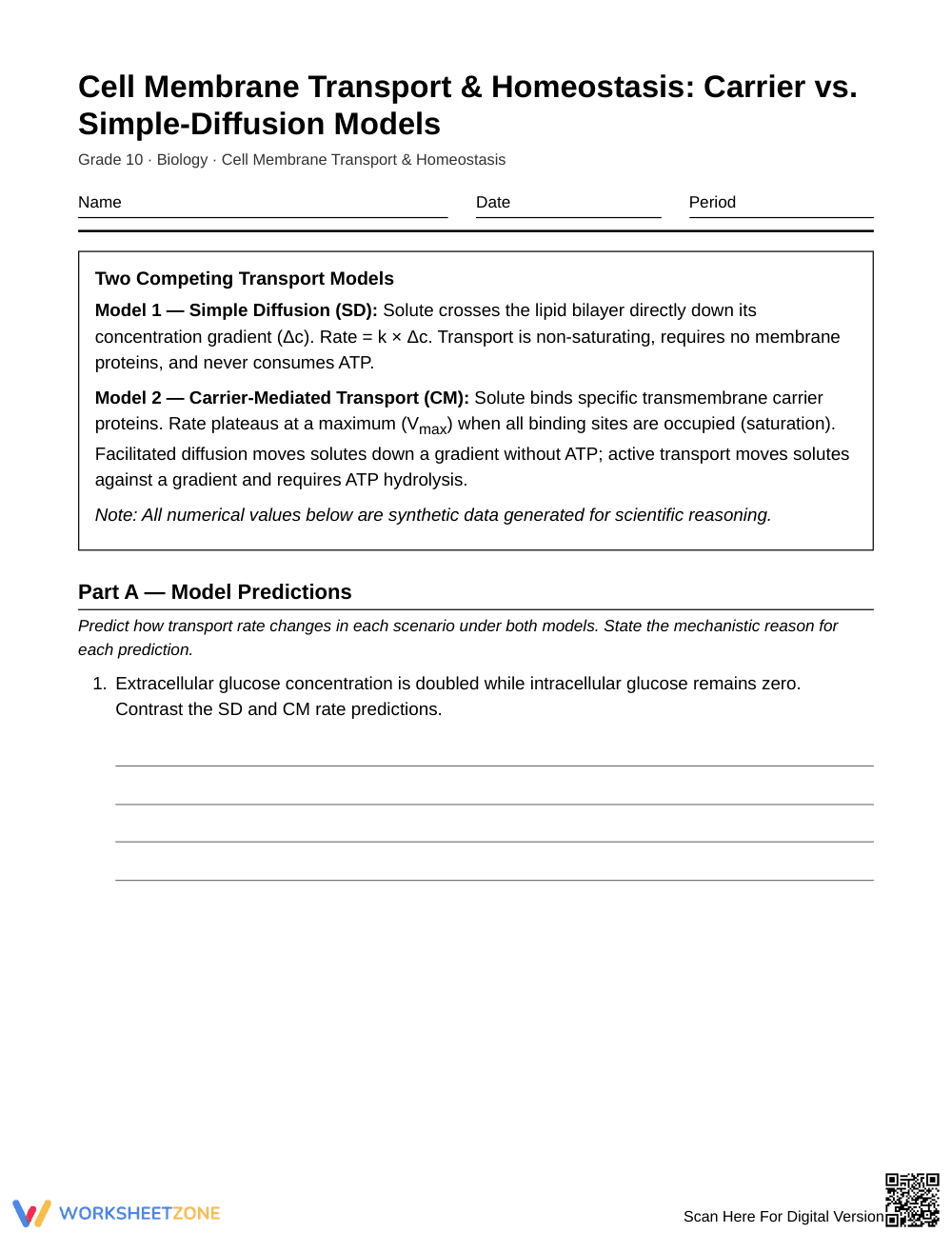
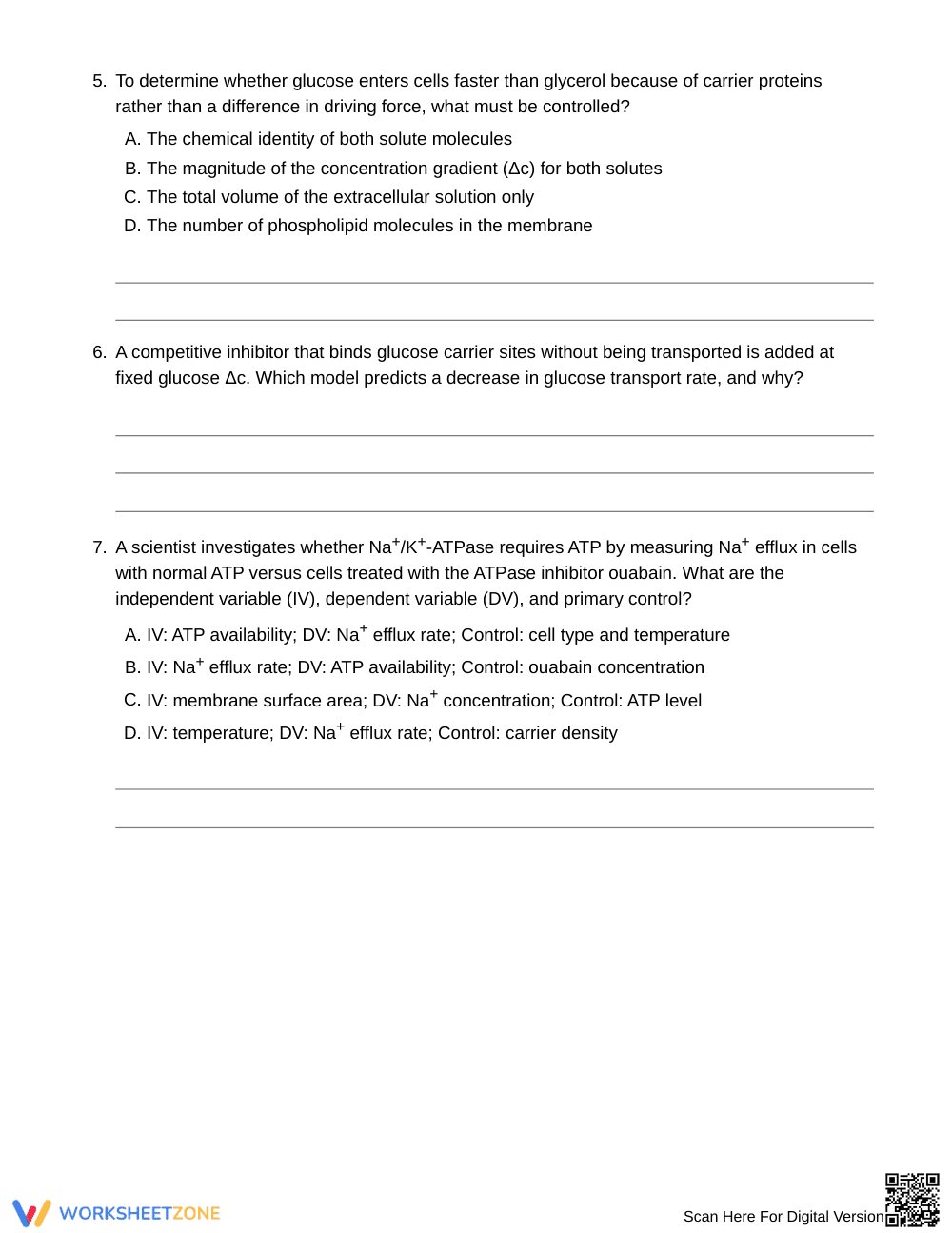
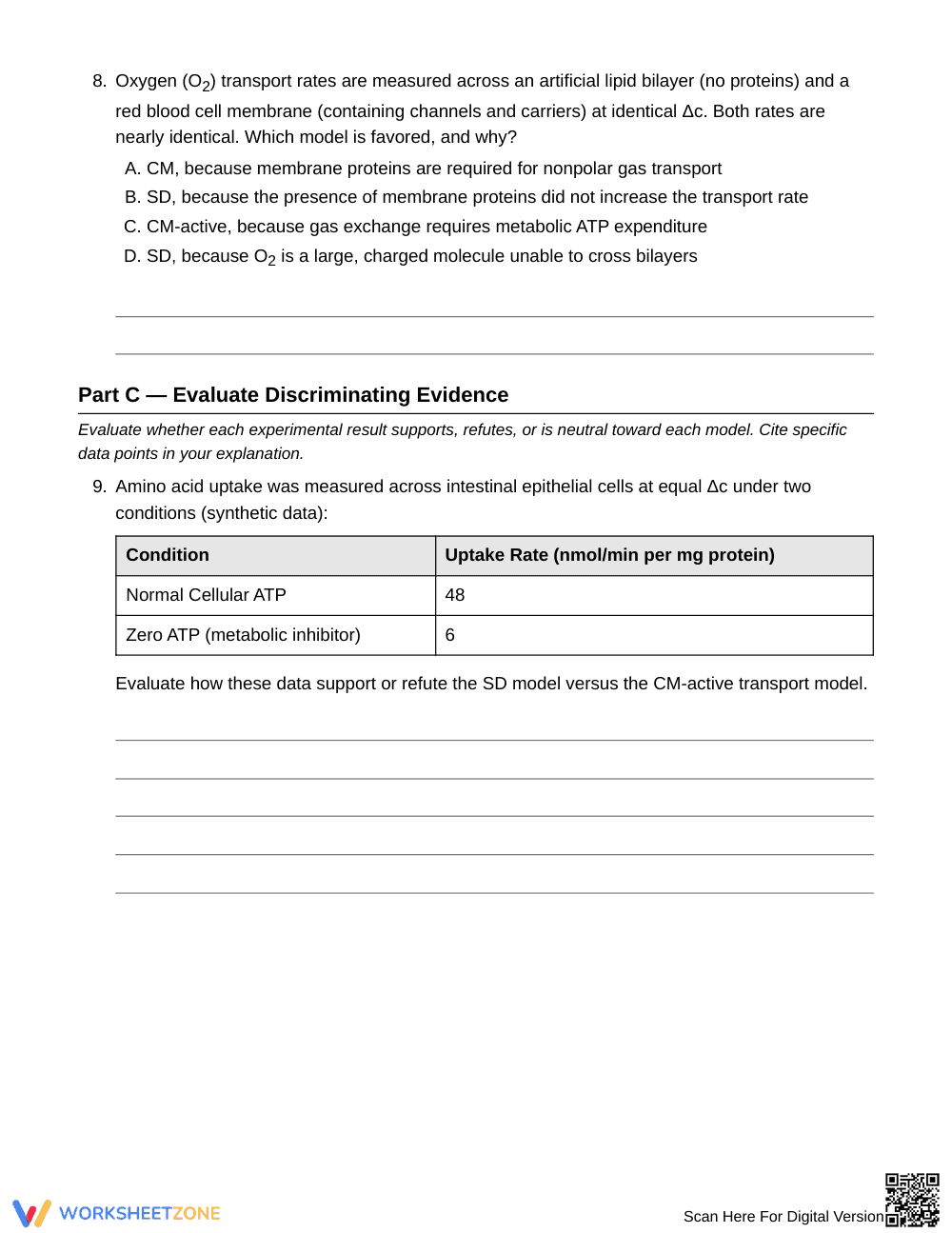
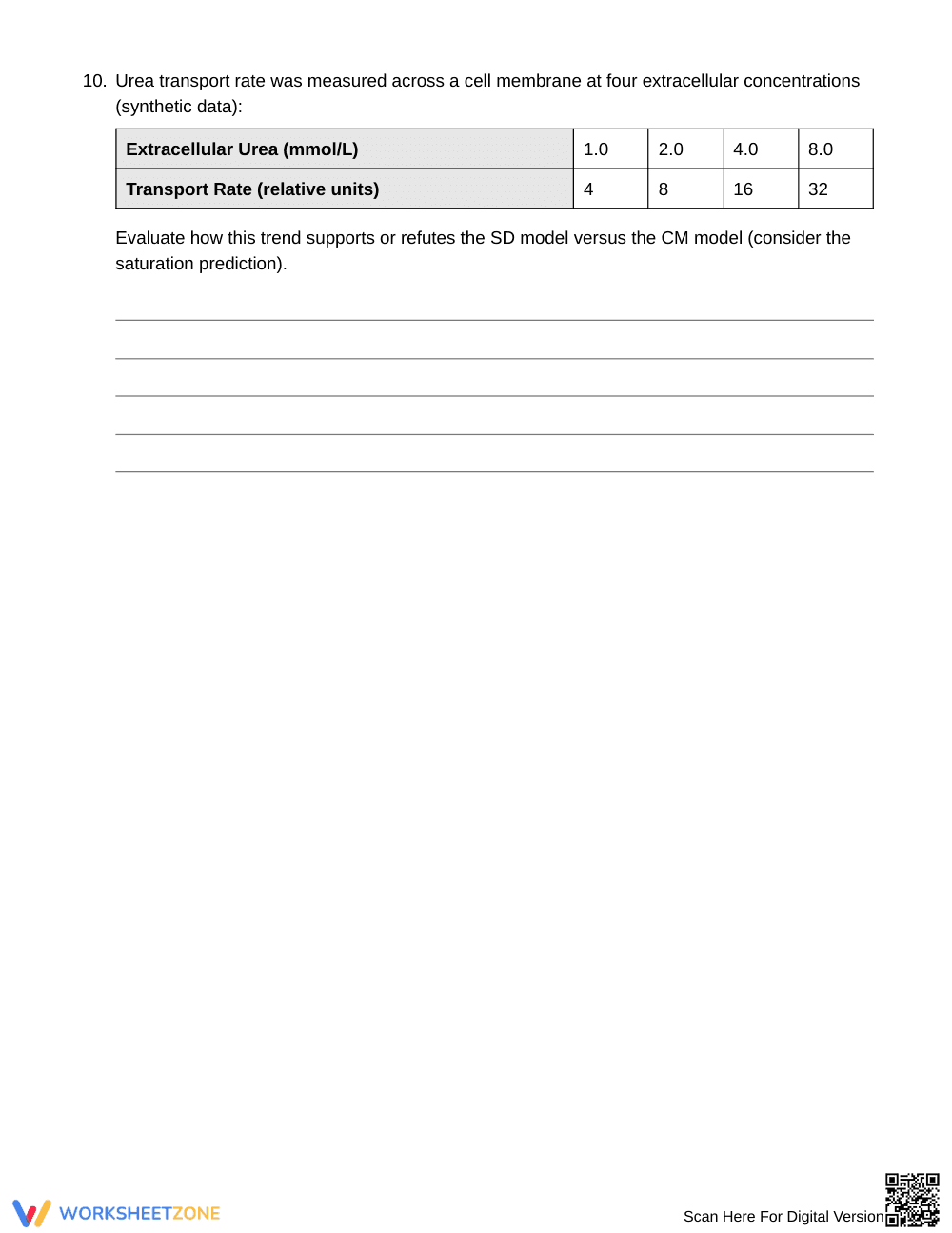
This Grade 10 biology worksheet trains students to analyze and compare carrier-mediated transport and simple diffusion models using synthetic experimental data. High school learners evaluate saturation kinetics, energy dependence, and molecular selectivity to distinguish between passive and active cellular mechanisms. By interpreting empirical trends and experimental variables, students master core transport principles across ten rigorous analytical tasks.
At a Glance
- Grade: 10 · Subject: Biology
- Standard: Cell Membrane Transport — Predict and contrast molecular movement across biological membranes using kinetic and energetic transport models
- Skill Focus: Compare Carrier and Diffusion Model Predictions
- Format: 5 pages · 10 problems · Answer key included · PDF
- Best For: Membrane transport formative assessment or review
- Time: 40–50 minutes
What's Inside
This 5-page printable resource includes reference model summaries detailing Simple Diffusion and Carrier-Mediated Transport alongside 10 structured reasoning tasks. The problems feature synthetic data tables, multiple-choice experimental design questions with written justifications, and comparative open-response prompts. A detailed 3-page answer key provides complete mechanistic explanations and criteria for evaluating student claims.
Skill Progression
- Guided practice: Part A presents 2 paired scenario prompts where students contrast transport rates and provide mechanistic rationales using clear model definitions.
- Supported practice: Part B challenges learners with 6 experimental design questions requiring variable identification, control analysis, and synthetic data interpretation.
- Independent practice: Part C tasks students with 2 rigorous data evaluations, analyzing whether multi-condition trials support or refute saturation and energetic models.
This structured progression follows the gradual-release framework, moving students from guided conceptual comparisons to autonomous data evaluation.
Standards Alignment
This resource aligns with high school life science standards focusing on cellular structure, membrane function, and homeostatic regulation. Students demonstrate how cell membranes maintain internal stability through selective permeability and active versus passive transport mechanisms. Both standard codes can be copied directly into lesson plans, IEP goals, or district curriculum mapping tools.
How to Use It
Deploy this worksheet after direct instruction on membrane transport mechanisms as a collaborative data-analysis activity or as an individual post-lab assessment. During group work, circulate to observe whether students recognize saturation plateaus as the hallmark of carrier mediation rather than simple diffusion. Expect students to finish the 10 tasks in 40 to 50 minutes.
Who It's For
This activity is designed for Grade 10 general and honors biology students studying cellular physiology. Scaffolds such as side-by-side model descriptions support developing readers, while complex quantitative data sets provide extension for advanced learners. Pair this worksheet with an interactive cell membrane transport simulation or a lecture on active versus passive transport.
According to Fisher & Frey (2014), structured scientific tasks that transition from conceptual model comparison to independent data interpretation significantly enhance secondary students' analytical reasoning. This Grade 10 biology resource directly targets membrane transport analysis by requiring learners to compare carrier and diffusion model predictions against synthetic experimental results. Students evaluate rate plateaus, saturation kinetics, and metabolic energy dependence across 10 multi-part analytical problems. Rather than relying on simple recall, learners must justify experimental controls, identify discriminating variables, and determine whether empirical trends refute or support competing biophysical models. The 5-page worksheet incorporates guided model summaries and an exhaustive 3-page answer key that outlines precise mechanistic explanations. By embedding deliberate scaffolding within rigorous quantitative scenarios, this instructional material provides the systematic practice necessary for high school students to achieve deep conceptual mastery of cellular homeostasis and selective membrane permeability.


