




























Views
Downloads

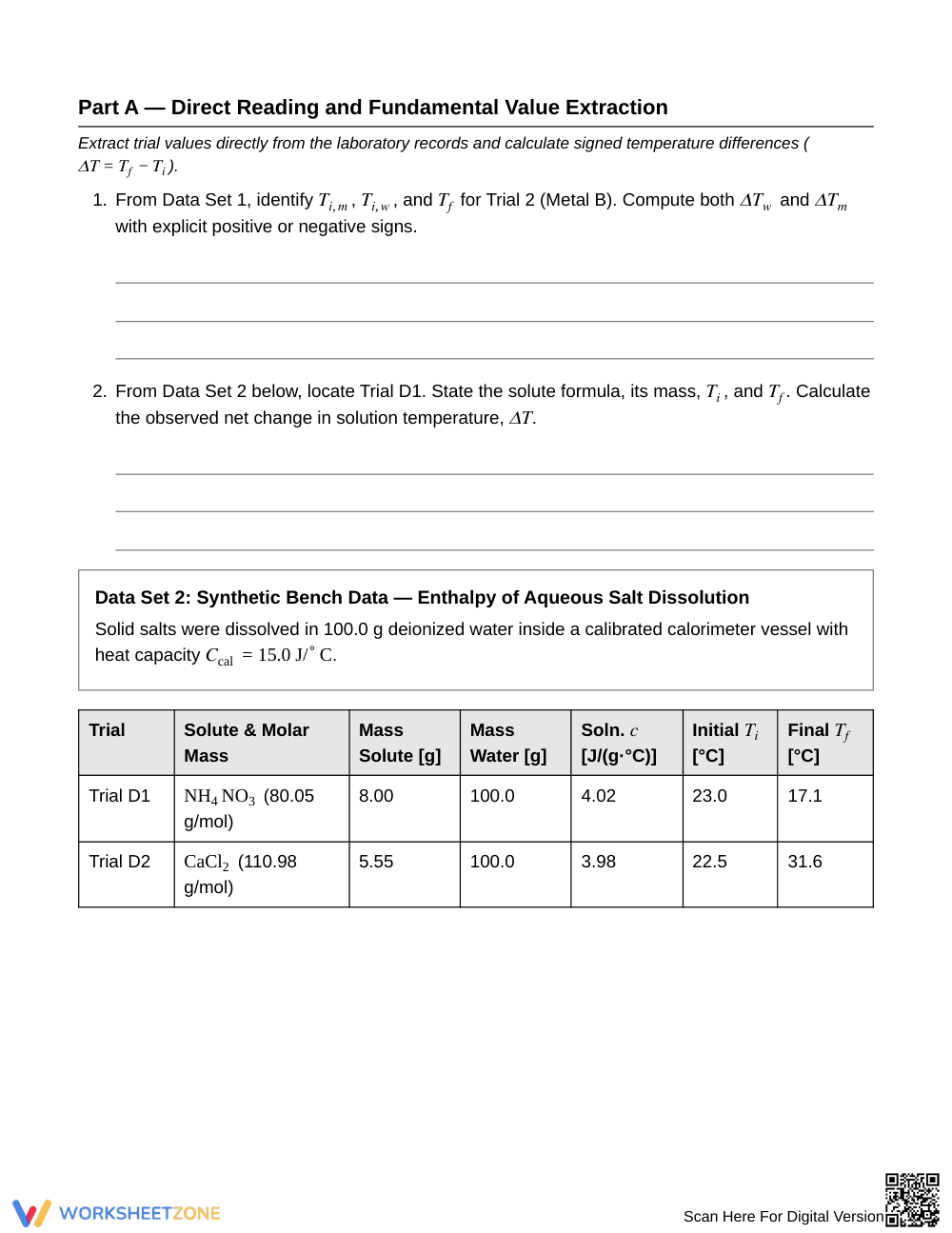


Complete Calorimetry Records Worksheet | Grade 11 Chemistry

Paste this activity's link or code into your existing LMS (Google Classroom, Canvas, Teams, Schoology, Moodle, etc.).
Students can open and work on the activity right away, with no student login required.
You'll still be able to track student progress and results from your teacher account.
This thermochemistry worksheet equips Grade 11 chemistry students to interpret calorimetry records, calculate specific heat capacities, and solve enthalpy problems. Learners analyze laboratory data from metal thermal equilibration and aqueous salt dissolution to connect observed temperature changes with First Law energy conservation principles.
At a Glance
- Grade: 11 · Subject: Chemistry
- Standard: Thermochemistry — Calculate energy transfers and analyze thermal data in chemical systems
- Skill Focus: Interpret Calorimetry Records
- Format: 5 pages · 10 problems · Answer key included · PDF
- Best For: Thermochemistry data analysis and calculation practice
- Time: 45–60 minutes
What's Inside
This 5-page worksheet delivers 10 structured analytical tasks across three progressive sections. Students work with a comprehensive reference box of constants, specific heat values, and algebraic sign conventions before evaluating two synthetic bench data tables. The resource includes complete mathematical solutions, step-by-step thermodynamic equations, and conceptual explanations across a detailed 3-page answer key.
Skill Progression
- Guided Practice (Part A, 2 tasks): Direct value extraction and sign-aware temperature difference calculations from raw laboratory data tables.
- Supported Practice (Part B, 6 tasks): Multi-step mathematical calculations applying energy conservation formulas, specific heat equations, molar dissolution enthalpies, and heat capacity logic.
- Independent Practice (Part C, 2 tasks): Advanced qualitative reasoning evaluating systematic transfer errors, unmonitored thermal losses, and realistic laboratory model limitations.
This structured progression reflects an explicit gradual-release model, transitioning students from fundamental data interpretation to complex thermodynamic analysis.
Standards Alignment
This resource aligns with high school physical science standards governing the conservation of energy and energy transfer. Students create and interpret computational models to calculate thermal equilibrium and enthalpy changes during chemical and physical processes. Standard codes can be copied directly into lesson plans, IEP goals, or district curriculum mapping tools.
How to Use It
Use this worksheet following direct instruction on specific heat and calorimetry calculations. In a 45 to 60 minute class period, have students work through Part A individually before collaborating on Part B calculations. For formative assessment, check whether students correctly maintain negative signs during exothermic dissolution calculations. Alternatively, assign Part C as a rigorous post-lab evaluation after hands-on cup calorimetry experiments.
Who It's For
This practice set is designed for on-level and honors Grade 11 chemistry students mastering quantitative thermochemistry. Built-in reference equations provide essential scaffolding for developing problem solvers, while advanced error analysis challenges higher-level thinkers. Pair this worksheet directly with a coffee-cup calorimetry laboratory experiment or an interactive thermodynamics simulation.
Calorimetry data analysis provides a critical bridge between observable macroscopic temperature shifts and submicroscopic energy transfers in secondary chemistry education. High school thermochemistry objectives require students to quantify heat flow, calculate specific heat capacities, and determine molar enthalpy changes using empirical data sets. Research documented in Fisher & Frey (2014) demonstrates that structured gradual-release frameworks significantly improve student mastery of complex multi-step science tasks. By scaffolding student tasks from initial data extraction to rigorous mathematical computation and qualitative error evaluation, this 10-task worksheet supports robust conceptual understanding alongside mathematical fluency. Students develop essential scientific literacy as they reconcile theoretical conservation laws with real-world calorimeter heat loss and systematic experimental uncertainties. This targeted instructional resource ensures Grade 11 chemistry learners develop durable analytical problem-solving competencies in thermodynamic modeling, laboratory data interpretation, and quantitative First Law accounting.


