




























Views
Downloads


Complete Calorimetry Errors Worksheet | Grade 11 Chemistry

Paste this activity's link or code into your existing LMS (Google Classroom, Canvas, Teams, Schoology, Moodle, etc.).
Students can open and work on the activity right away, with no student login required.
You'll still be able to track student progress and results from your teacher account.
This thermochemistry worksheet trains Grade 11 chemistry students to diagnose and correct algebraic sign and specific-heat calculation errors in calorimetry. Across 8 laboratory scenarios, learners master the First Law of Thermodynamics, enthalpy conventions, and sensible heat calculations without repeating common temperature inversion mistakes.
At a Glance
- Grade: 11 · Subject: Chemistry
- Standard: Thermochemistry — Calculate energy transfers and assign thermodynamic signs for enthalpy changes
- Skill Focus: Correct Sign and Specific-Heat Errors
- Format: 5 pages · 8 problems · Answer key included · PDF
- Best For: Calorimetry review and misconception remediation
- Time: 45–60 minutes
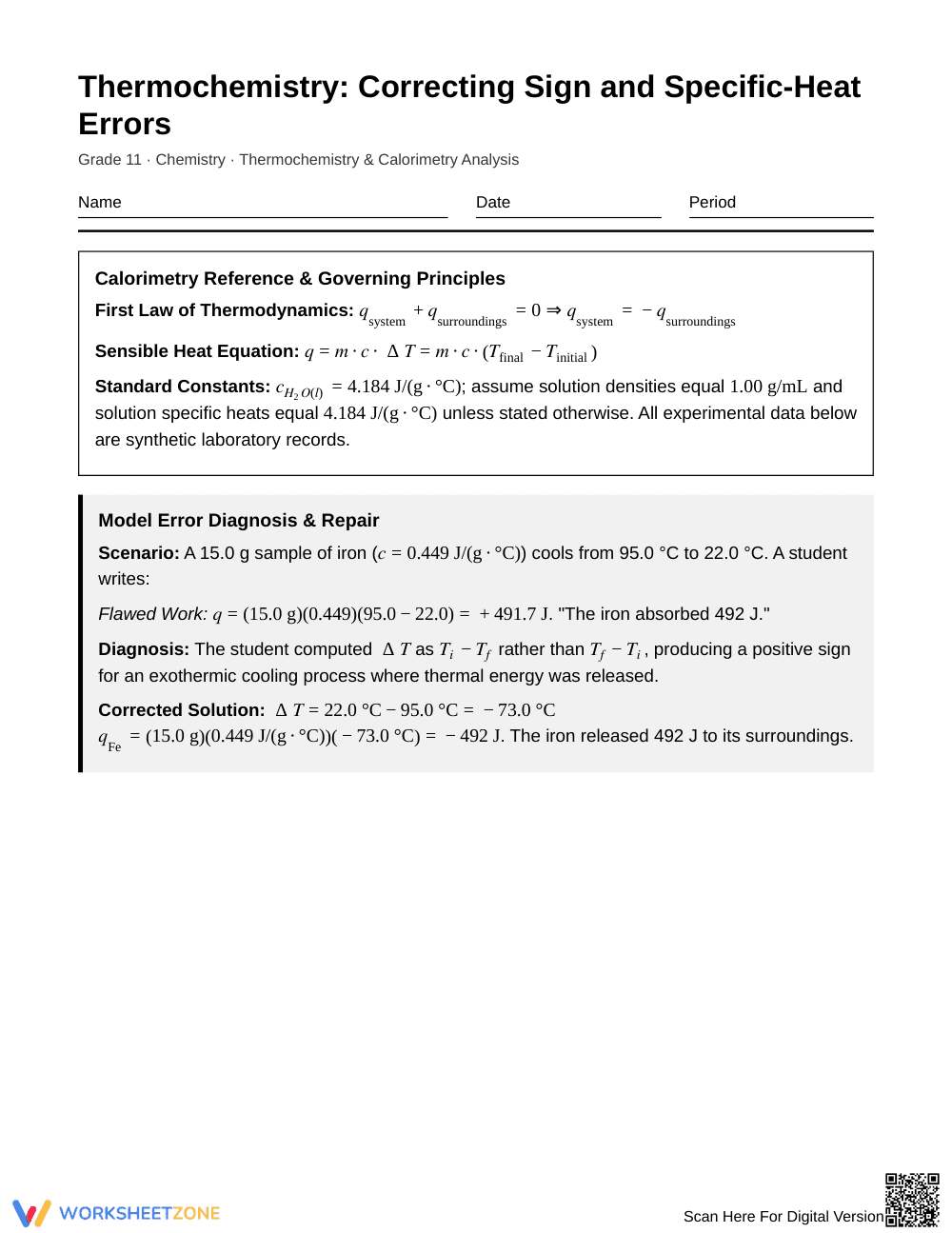
The 5-page printable worksheet includes a reference box of thermodynamic governing equations and standard constants, followed by a worked model error diagnosis. Students solve 8 synthetic laboratory scenarios spanning solution calorimetry, thermal equilibrium, neutralization, bomb calorimetry, and phase changes, supported by a 3-page comprehensive answer key.
Skill Progression
- Guided practice: A model error diagnosis illustrates how to identify inverted temperature intervals and correct sensible heat formulas.
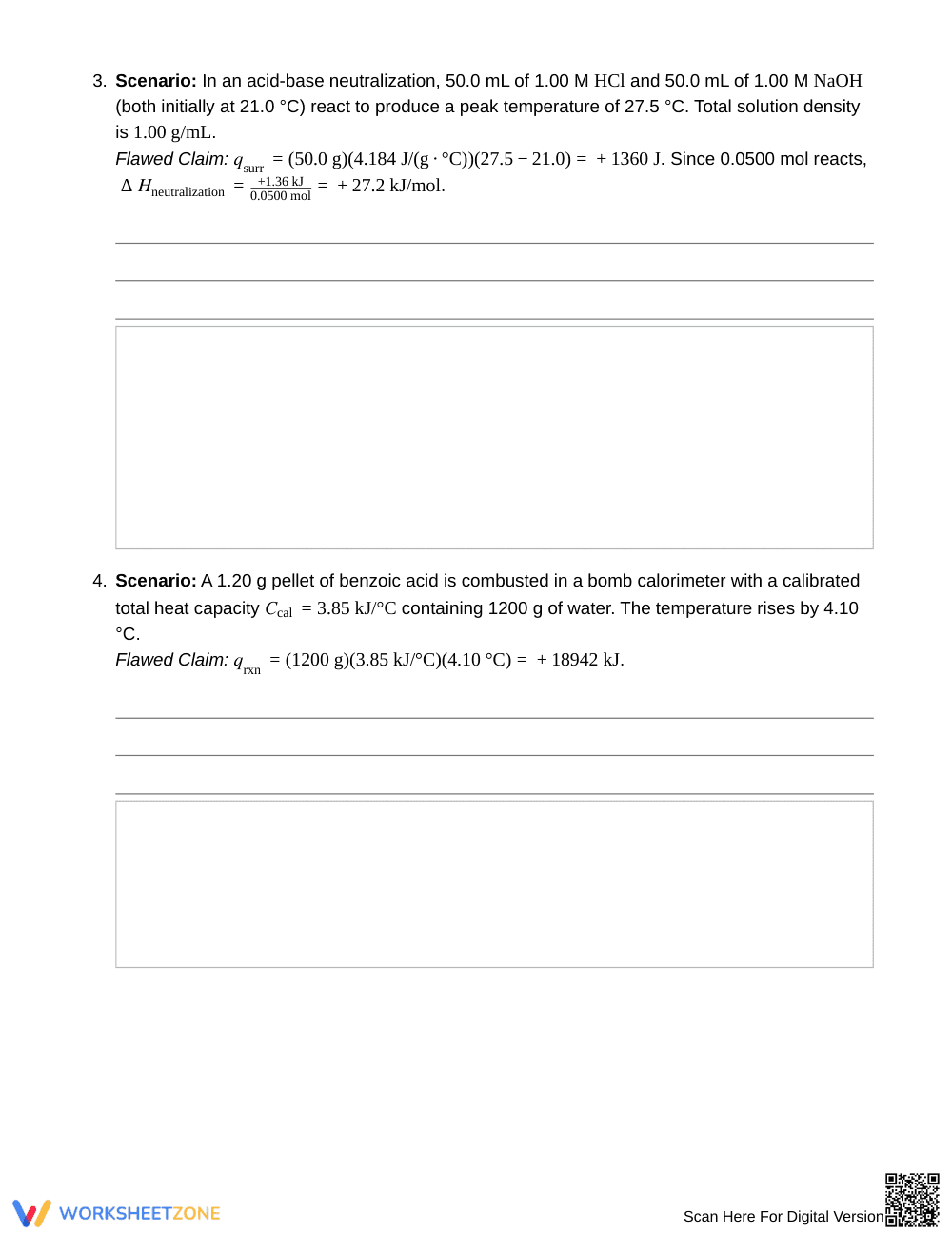
- Supported practice (Scenarios 1–4): Students correct single-variable errors in dissolution signs, metal specific heat values, neutralization solution masses, and bomb calorimetry capacities.
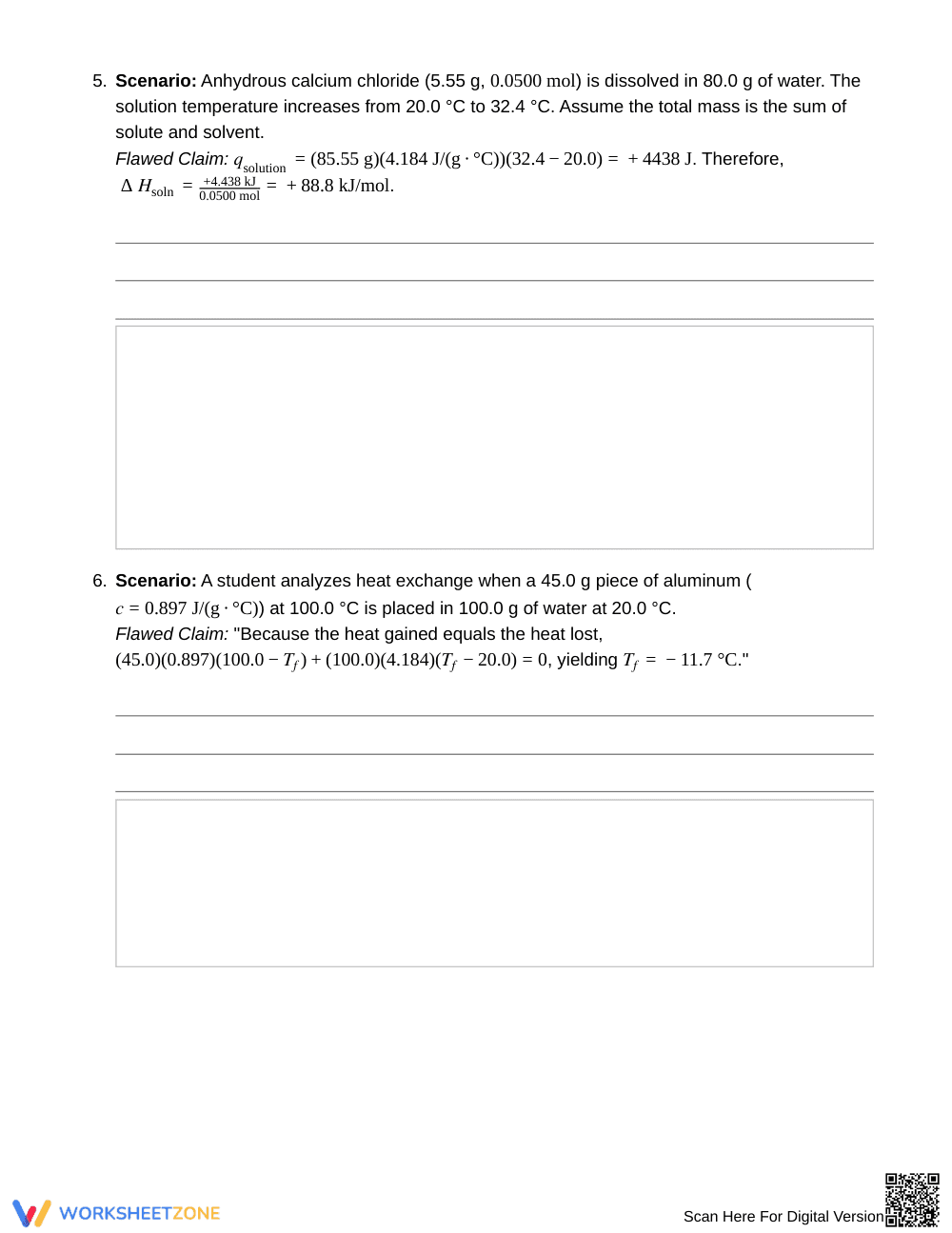
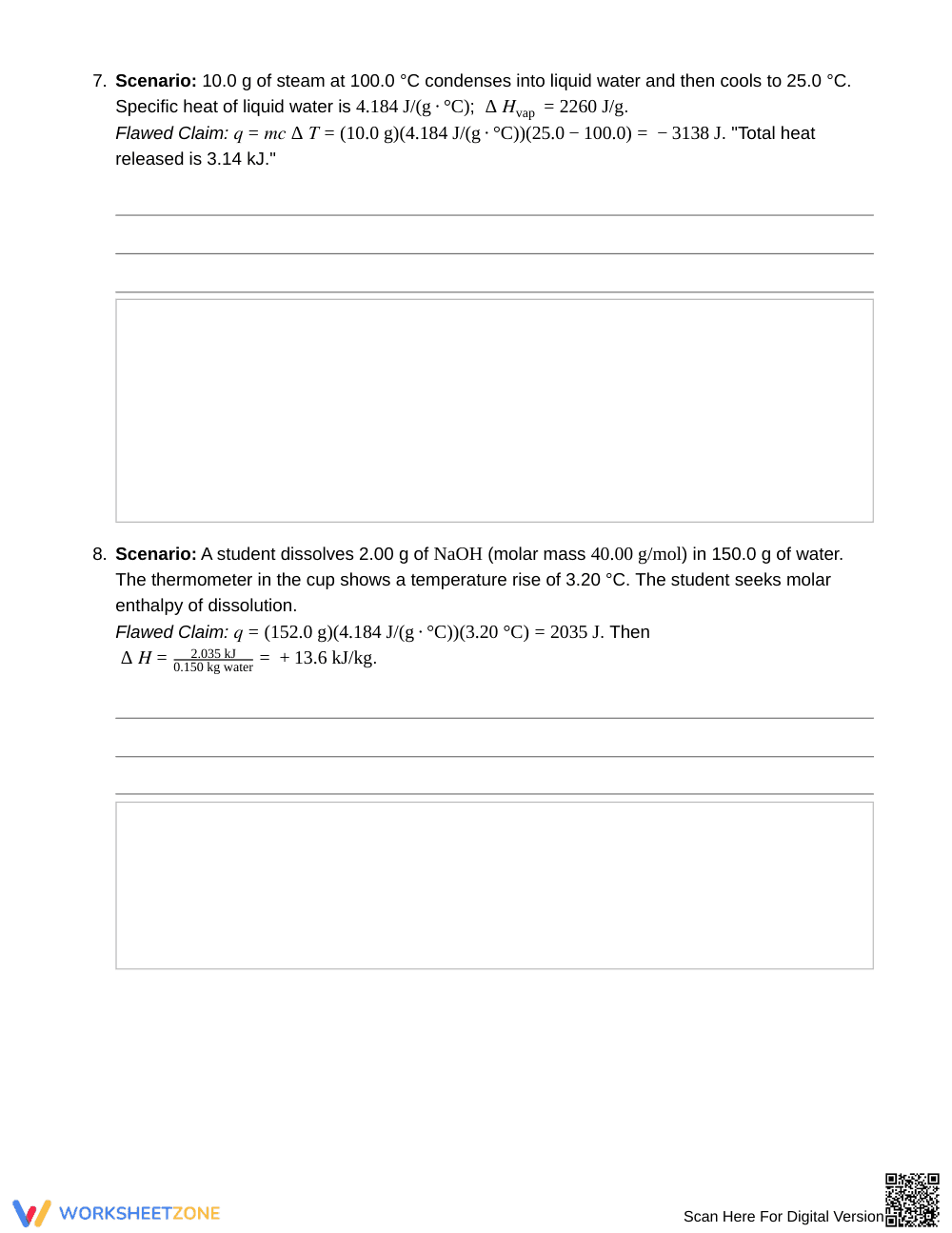
- Independent practice (Scenarios 5–8): Students independently resolve multi-step errors involving combined solution mass, thermal equilibrium algebra, condensation latent heat, and molar enthalpy conversions.
This gradual-release progression moves students from scaffolded error detection to independent mathematical precision.
Standards Alignment
This resource aligns with high school chemistry thermochemistry standards requiring students to calculate energy exchange using the sensible heat equation ($q = mc\Delta T$) and the First Law of Thermodynamics ($q_{\text{sys}} = -q_{\text{surr}}$). Both standard codes can be copied directly into lesson plans, IEP goals, or district curriculum mapping tools.
How to Use It
Assign this worksheet following direct instruction on calorimetry and enthalpy signs. Formatively assess student understanding by checking whether learners add solute and solvent masses before calculating heat exchange. The 8 scenarios take 45 to 60 minutes to complete in class or as homework.
Who It's For
Designed for Grade 11 chemistry, honors chemistry, and introductory AP Chemistry students preparing for quantitative thermochemistry assessments. Support emerging learners by referencing the provided formula box, and pair this worksheet directly with a coffee-cup calorimetry laboratory investigation.
According to Fisher & Frey (2014), explicit error diagnosis and repair activities significantly deepen student metacognition and conceptual problem-solving understanding across rigorous secondary STEM disciplines. This Grade 11 thermochemistry resource directly supports high school physical science standards by requiring students to analyze and correct sign conventions, system boundaries, and specific heat substitutions in calorimetry calculations. Rather than simply executing rote formulas, students evaluate synthetic laboratory records to identify common mathematical missteps, including inverted temperature differences, misattributed reaction enthalpies, and omitted latent heat terms during phase changes. By distinguishing between system heat exchange and surrounding temperature changes, learners master the governing principles of the First Law of Thermodynamics. The structured 8-task progression bridges initial guided modeling with independent technical computation, reinforcing core quantitative reasoning skills required for advanced chemistry coursework and standardized assessment success.


