





























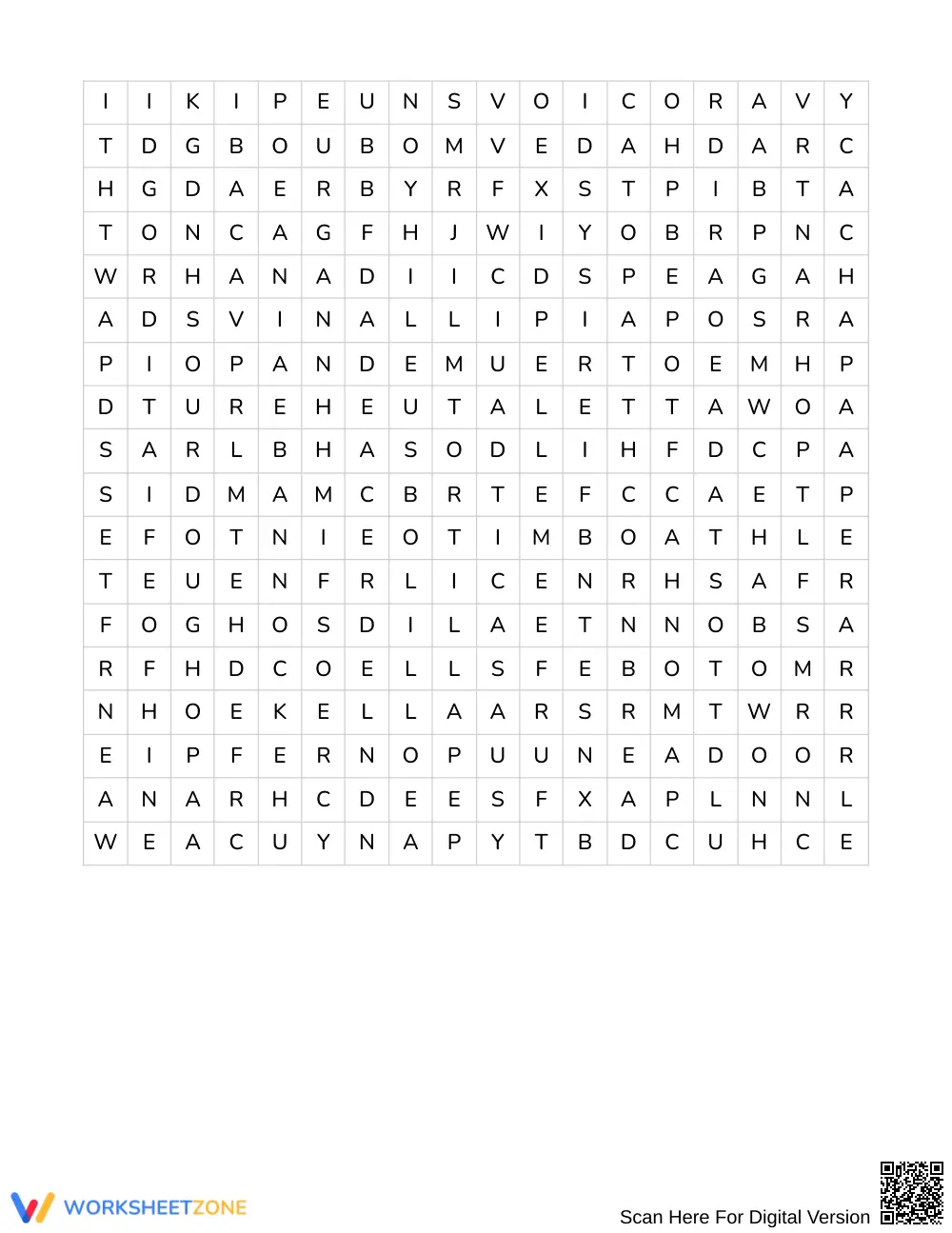


Complete Breads of Americas Word Search | Grades 6–7 ELA

Paste this activity's link or code into your existing LMS (Google Classroom, Canvas, Teams, Schoology, Moodle, etc.).
Students can open and work on the activity right away, with no student login required.
You'll still be able to track student progress and results from your teacher account.
This cultural vocabulary word search challenges middle school learners to discover 16 traditional breads from North, Central, and South America. Students analyze culinary definitions to deduce target vocabulary before locating each term across an authentic letter grid. The activity reinforces reading comprehension, cultural awareness, and word-recognition skills through engaging, context-rich puzzle solving.
At a Glance
- Grade: Grades 6–7 · Subject: English Language Arts
- Standard: Not standards-assessed — vocabulary enrichment
- Skill Focus: Breads from the Americas
- Format: 3 pages · 16 words · Answer key included · PDF
- Best For: Vocabulary enrichment and cultural literacy units
- Time: 25–35 minutes
This resource features a full 3-page printable set designed for rigorous vocabulary engagement. It includes a comprehensive clue sheet with 16 descriptive culinary definitions, an oversized letter grid, and a full 3-page answer key showing exact word placements. Rather than relying on a passive word bank, students read cultural descriptions to identify terms such as arepa, bannock, and bolillo before searching.
Students navigate an 18 × 18 letter grid where all 16 target terms are concealed across eight possible directions: North, Northeast, East, Southeast, South, Southwest, West, and Northwest. Because this challenge provides descriptive clues without an explicit word bank, learners must first deduce each bread from its cultural description. The omnidirectional layout requires focused visual scanning and reinforces orthographic memory.
This activity serves strictly as vocabulary enrichment and cultural literacy practice; it is not aligned to a specific state or national content standard. Instead, it provides interdisciplinary value by connecting English Language Arts vocabulary acquisition with geographical and historical food traditions across Indigenous and Latin American cultures.
Deploy this puzzle during a cultural food unit or as an independent literacy station following a direct lesson on informational text structures. Alternatively, use it as an engaging fast-finisher activity or sub plan. While students work, conduct brief formative checks by asking learners to justify how a specific clue corresponds to a given bread name. The full task typically takes between 25 and 35 minutes to complete.
This activity is designed for Grades 6–7 students expanding their academic and multicultural vocabulary. For developing readers or multilingual learners, consider pairing the puzzle with visual food reference cards or bilingual dictionaries. The resource pairs naturally with non-fiction informational reading passages exploring the agricultural history of maize and cassava across the Americas.
Vocabulary acquisition relies on active semantic processing rather than rote memorization, especially when introducing domain-specific or culturally authentic terminology. According to research on vocabulary development and guided reading instruction by Fisher & Frey (2014), students demonstrate significantly stronger word retention when vocabulary tasks require them to connect contextual definitions with orthographic word forms. By removing the standard word bank and requiring learners to interpret culinary descriptions across North, Central, and South America, this activity transforms a traditional puzzle into an analytical task. Students must actively decode clues, retrieve target terms, and locate them within an 18 by 18 letter matrix across eight spatial orientations. This cognitive integration of definition analysis and directional visual scanning strengthens lexical mapping, supports reading comprehension, and enriches cultural literacy across middle school English Language Arts curricula.


