





























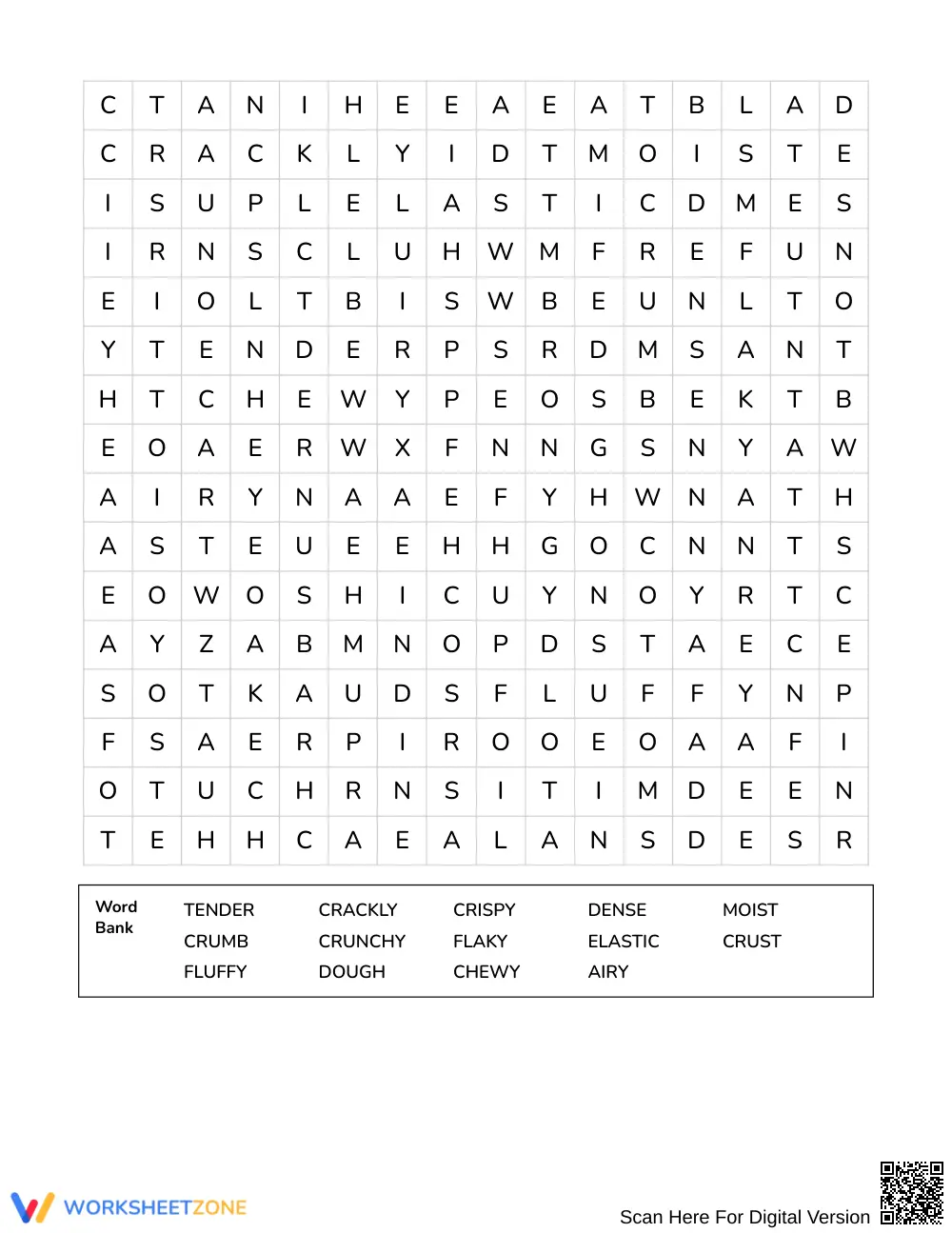


Complete Bread Textures Word Search | Grades 4–5 ELA

Paste this activity's link or code into your existing LMS (Google Classroom, Canvas, Teams, Schoology, Moodle, etc.).
Students can open and work on the activity right away, with no student login required.
You'll still be able to track student progress and results from your teacher account.
This sensory vocabulary word search engages upper elementary students in exploring bread crust and crumb textures. Learners read descriptive culinary definitions to identify 14 target terms before tracking them down inside the puzzle grid, strengthening precise adjective recognition and domain-specific vocabulary retention through an interactive clue-matching format.
At a Glance
- Grade: Grades 4–5 · Subject: English Language Arts
- Standard: Not standards-assessed — vocabulary enrichment
- Skill Focus: Bread crust and crumb textures
- Format: 3 pages · 14 words · Answer key included · PDF
- Best For: Vocabulary enrichment and sensory word study
- Time: 20–30 minutes
This 3-page printable resource includes a student puzzle page, clue sheet, and complete 3-page solution reference. Students encounter 14 context-rich clues defining specific textural properties such as density, elasticity, and crispiness. Each definition prompts students to determine the target word from a bank of terms before locating it within the letter grid.
The puzzle features a dense 16 by 16 letter grid designed to challenge intermediate readers. Words are arranged in four distinct directional orientations: northeast, east, southeast, and south. Rather than relying on a straightforward list, learners act as word detectives, analyzing culinary descriptions to deduce the correct vocabulary term before seeking the hidden word path across diagonal and vertical lines.
This learning activity serves as general vocabulary enrichment and does not align to an assessed state academic standard. Instead, the task strengthens descriptive language use and tier-two adjective acquisition, reinforcing how authors employ precise sensory details to describe food textures, baking processes, and tactile physical properties across narrative and informational texts.
Deploy this word search during an introductory descriptive writing workshop or as an independent literacy center after direct instruction on sensory details. As students work, circulate to observe whether they deduce terms directly from the contextual clues or require support distinguishing subtle texture concepts like crumb versus dough. The activity takes approximately 20 to 30 minutes, functioning smoothly as an engaging warm-up, fast-finisher challenge, or quiet Friday enrichment task.
This activity is designed for Grades 4–5 students developing sophisticated sensory vocabularies. It offers accessible semantic practice for emerging bilingual learners and aspiring descriptive writers. Pair this printable with a mentor text read-aloud describing bakeries, or combine it with an anchor chart detailing culinary sensory adjectives.
Explicit domain-specific vocabulary instruction accelerates reading comprehension and enhances descriptive writing precision in intermediate elementary learners. According to Fisher & Frey (2014), intentional word exposure coupled with contextual problem-solving supports long-term lexical retrieval and semantic schema development across content areas. Rather than engaging in passive rote memorization, students who analyze descriptive definitions to solve word-based puzzles actively connect culinary concepts such as elasticity, density, and crumb structure to their underlying tactile meanings. This multi-step cognitive process requires students to retrieve target adjectives from memory, verify complex spelling configurations, and visually track letter sequences across multiple spatial orientations. Incorporating contextualized sensory word studies into upper elementary literacy blocks broadens students' expressive lexicons, enabling them to replace generic modifiers with vivid, accurate descriptions in their own compositions while deepening their overall reading fluency and word awareness.


