































Complete Bread Baking Word Search | Grades 4–5 ELA

Paste this activity's link or code into your existing LMS (Google Classroom, Canvas, Teams, Schoology, Moodle, etc.).
Students can open and work on the activity right away, with no student login required.
You'll still be able to track student progress and results from your teacher account.
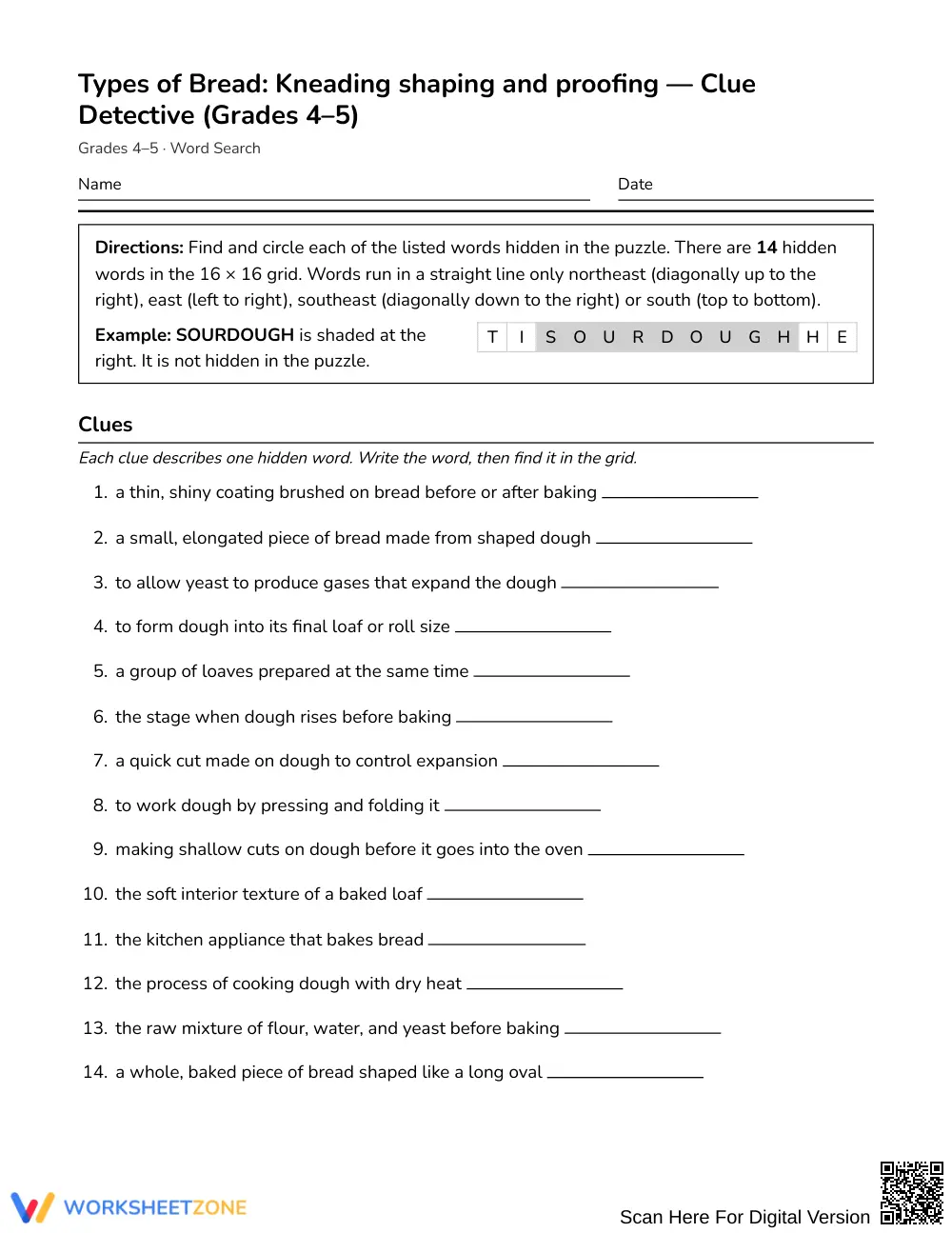
This bread baking vocabulary word search strengthens upper-elementary reading and language skills by challenging students to locate 14 key terms related to kneading, shaping, and proofing dough. Students read contextual definitions to discover essential baking concepts, reinforcing content-area vocabulary, spelling accuracy, and visual scanning skills across a structured puzzle format.
At a Glance
- Grade: Grades 4–5 · Subject: English Language Arts (ELA)
- Standard: Not standards-assessed — vocabulary enrichment
- Skill Focus: Technical bread baking vocabulary including kneading, shaping, and proofing
- Format: 2 pages · 14 words · Full answer key included · Printable PDF
- Best For: Independent vocabulary enrichment, literacy centers, and early finishers
- Time: 15–25 minutes
What's Inside
This 2-page instructional activity features a clue-based word search designed to deepen word consciousness. The student sheet contains 14 culinary vocabulary words with descriptive definitions that act as clues. Students review terms like ferment, proof, crumb, and scoring before finding each target word in the puzzle. A complete 16-by-16 solution grid is provided for rapid verification.
Puzzle Structure and Mechanics
The activity challenges students through an engaging search format that reinforces word recognition and orthographic patterns:
- Grid Dimensions: Words are arranged within a dense 16 x 16 letter grid that requires focused visual scanning.
- Search Orientations: Target terms are hidden across four distinct directions: northeast (NE), east (E), southeast (SE), and south (S).
- Clue Detective Format: Students match definitions from the word bank to identify and locate all 14 baking terms.
Standards Alignment
This word search serves as an engaging vocabulary enrichment resource rather than an assessment aligned to a specific state or national academic standard. It supports domain-specific language acquisition in English Language Arts by exposing learners to precise culinary terminology in a low-stakes, interactive format.
How to Use It
Introduce this word search after direct instruction on procedural texts or culinary science to consolidate key vocabulary. Alternatively, assign it as a collaborative warm-up before a cross-curricular reading unit on food production. During work time, circulate to observe whether students read the clue definitions to locate words or simply match letter strings, which reveals vocabulary comprehension versus rote scanning. Most students complete the activity within 15 to 25 minutes.
Who It's For
This resource is tailored for Grades 4–5 students developing informational reading skills and technical vocabulary. For English language learners and striving readers, pair the activity with an illustrated baking anchor chart displaying visual definitions of crumb, scoring, and proofing. Advanced learners can write original procedural sentences using each discovered word. It pairs naturally with an informational reading passage about yeast fermentation or commercial bread baking.
Explicit vocabulary instruction that links definitions directly to contextual word discovery builds strong lexical representations for upper-elementary students. According to Fisher & Frey (2014), intentional word exposure through structured literacy tasks accelerates domain-specific language acquisition and strengthens reading comprehension across informational texts. This 2-page English Language Arts word search engages Grades 4–5 learners in identifying 14 specialized bread-making terms, including kneading, proofing, fermenting, and scoring. By pairing descriptive clues with spatial search tasks across a 16 x 16 letter matrix, the activity prompts active retrieval and reinforces orthographic pattern recognition. Rather than functioning as a high-stakes assessment, this enrichment activity supports vocabulary retention, visual discrimination, and semantic connections during independent literacy block rotations or science-integrated baking units. Teachers can utilize the included full answer key to verify student accuracy quickly while promoting confident self-directed study.


