
































Complete Boyle's Law Worksheet | Grades 8-12 Science

Paste this activity's link or code into your existing LMS (Google Classroom, Canvas, Teams, Schoology, Moodle, etc.).
Students can open and work on the activity right away, with no student login required.
You'll still be able to track student progress and results from your teacher account.
This Boyle's Law worksheet guides students in grades 8–12 through investigating the inverse relationship between gas pressure and volume. Learners examine particle collisions, analyze laboratory data, and solve realistic scenarios involving scuba diving and altitude changes to achieve conceptual and quantitative mastery.
At a Glance
- Grade: 8–12 · Subject: Science
- Standard: Physical Science — Model gas behavior and calculate inverse pressure-volume relationships
- Skill Focus: Real-world applications and particle modeling of Boyle's Law
- Format: 4 pages · 16 problems · Answer key included · PDF
- Best For: Conceptual physics and chemistry application practice
- Time: 45–60 minutes
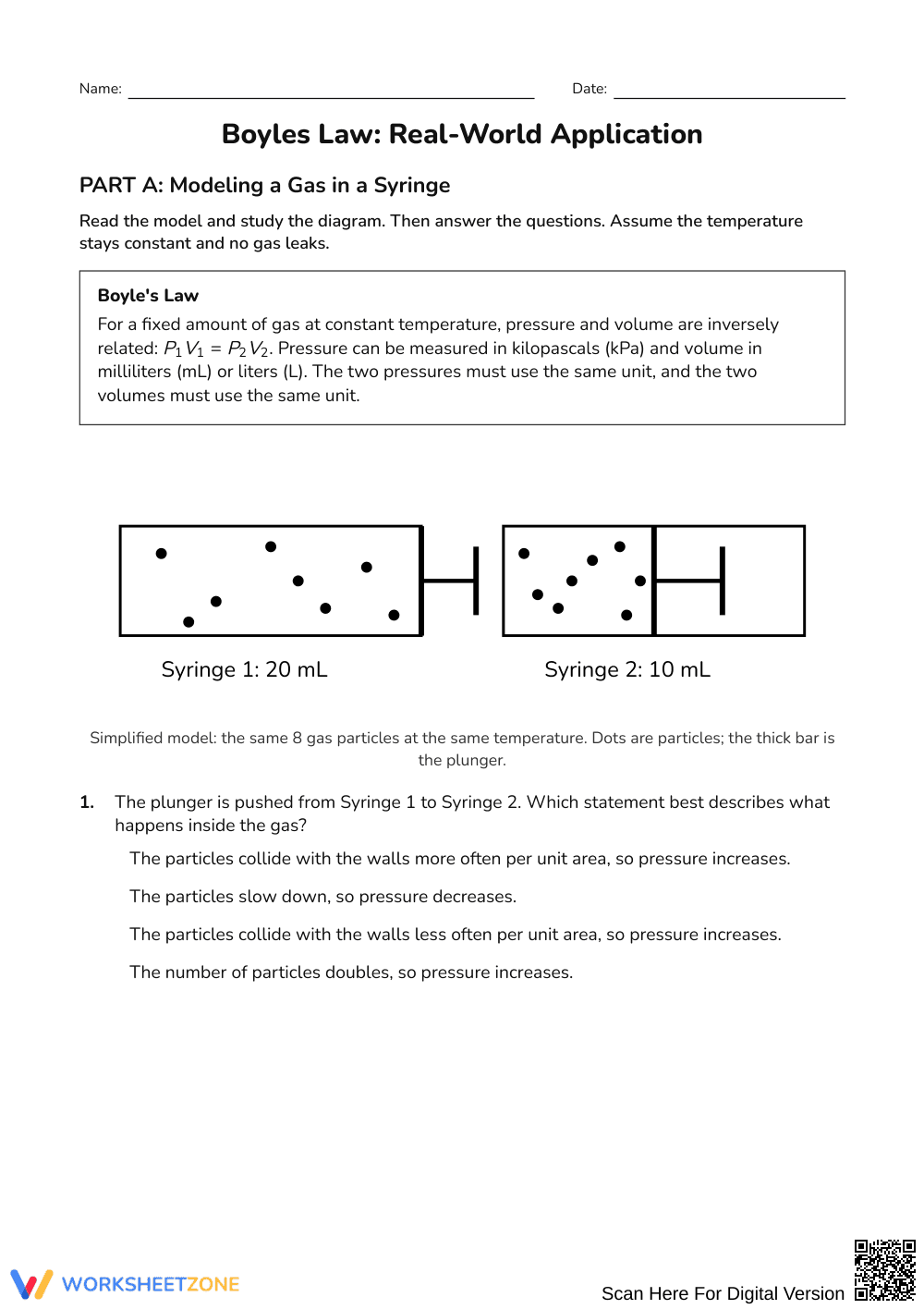
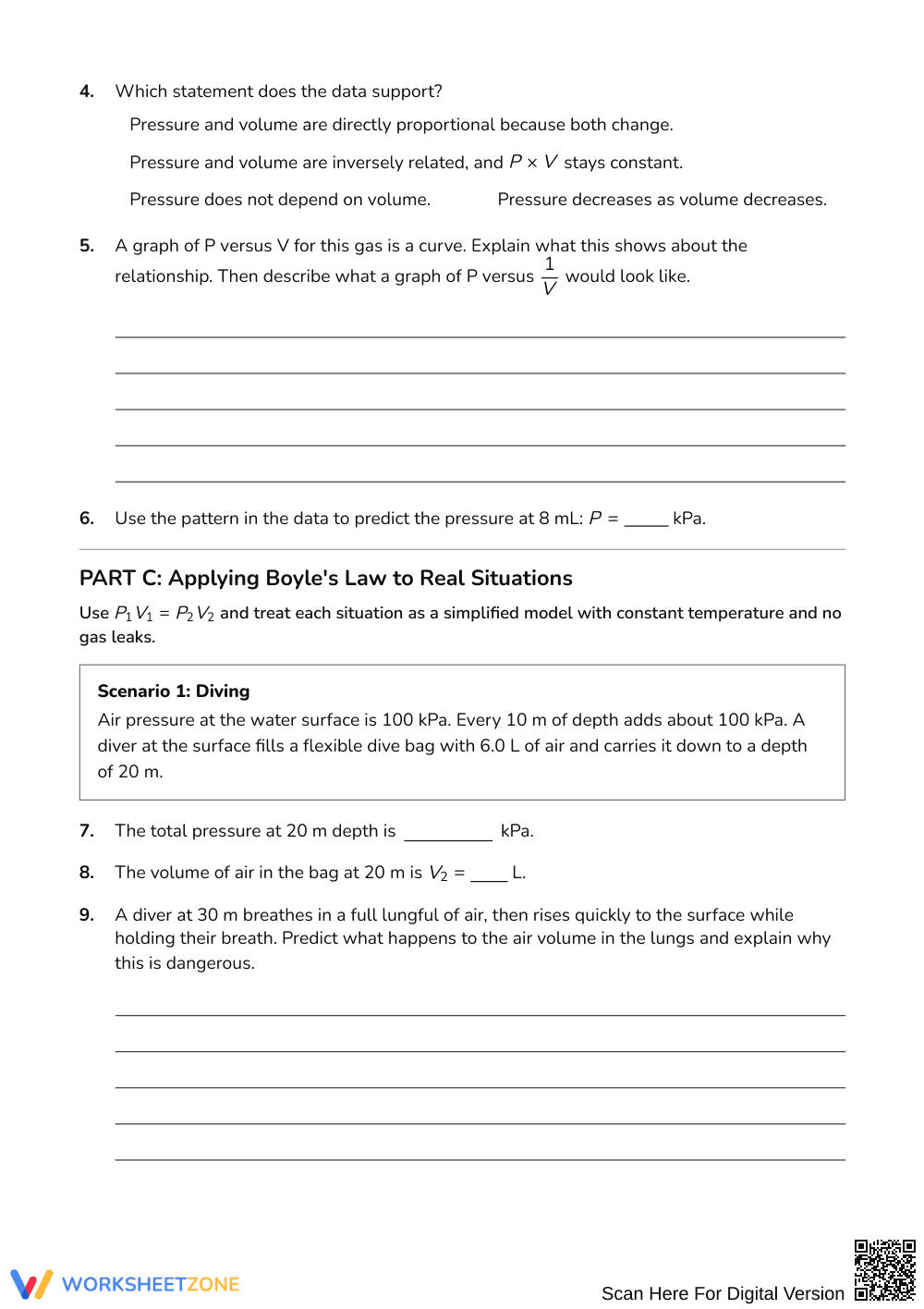
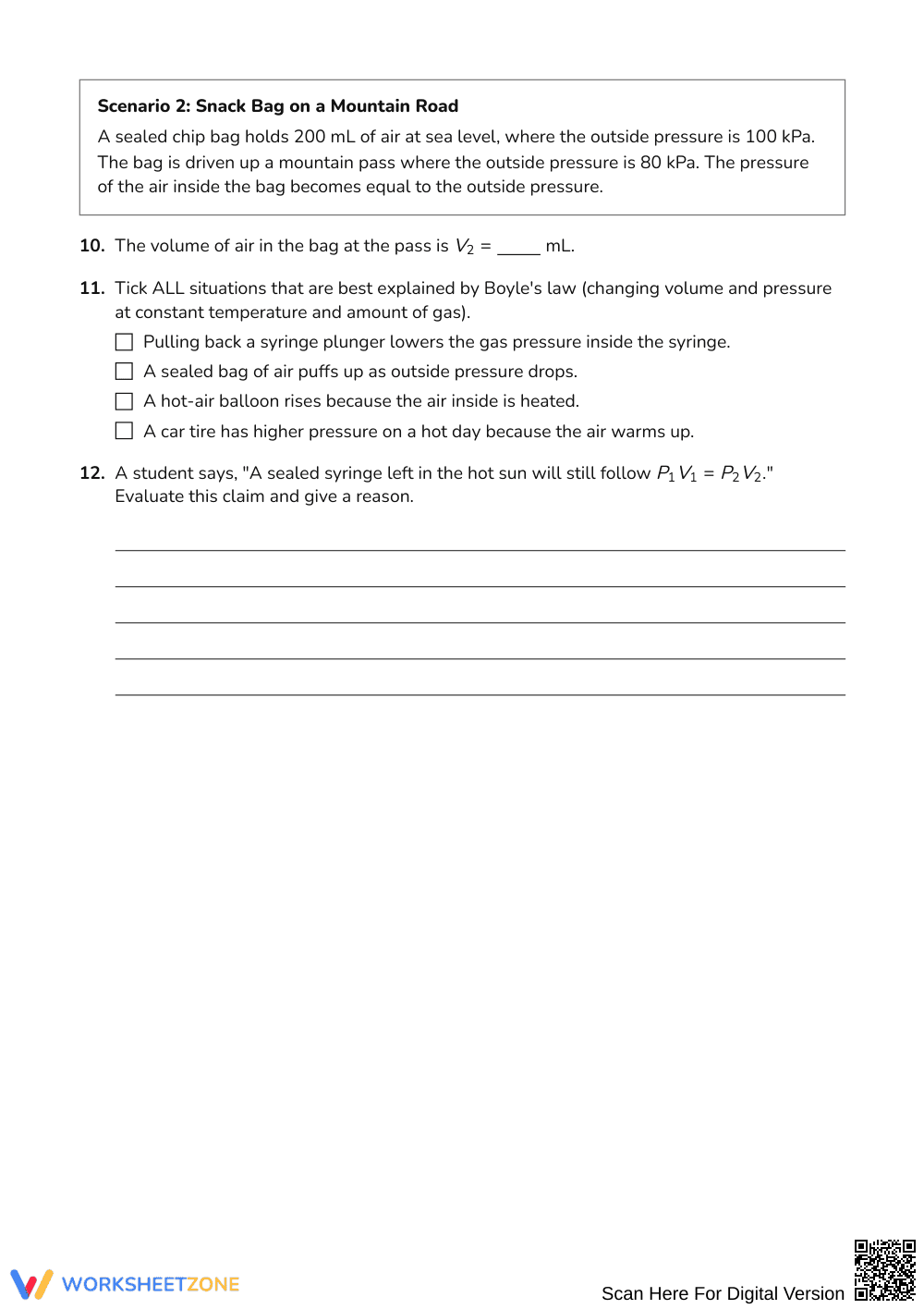
The 4-page resource includes 16 multi-step problems across three sections. Students evaluate particulate syringe diagrams, analyze a pressure-volume data table with graphical relationships, and apply the formula P₁V₁ = P₂V₂ to scuba diving and elevation scenarios. A full 4-page answer key provides complete numerical solutions and conceptual explanations.
Skill Progression
- Guided practice (Part A, 4 tasks): Students examine particle diagrams to explain how volume changes impact wall collision frequency at constant temperature.
- Supported practice (Part B, 4 tasks): Learners evaluate pressure-volume data sets, verify constant P × V products, and interpret inverse relationship graphs.
- Independent practice (Part C, 8 tasks): High schoolers apply Boyle's Law to calculate volume changes in deep-sea diving bags, explain pulmonary risks, and assess temperature limitations.
This sequence implements the gradual-release framework (I Do, We Do, You Do), taking students smoothly from particulate models to real-world calculations.
Standards Alignment
This activity aligns with middle and high school Physical Science standards addressing gas behaviors and the particulate nature of matter. Students use particle models to explain macroscopic pressure changes and employ mathematical representations to predict volume shifts. These standards-based descriptions can be copied directly into lesson plans, IEP goals, or district curriculum mapping tools.
How to Use It
Use this worksheet after introducing Boyle's Law concepts. For formative assessment, assign Part A during direct instruction to check whether students recognize that particle speed stays constant at fixed temperatures. Parts B and C serve effectively as independent practice or paired lab follow-up. Students typically complete all 16 tasks within 45 to 60 minutes.
Who It's For
Designed for grades 8–12 physical science and chemistry students, this resource accommodates diverse learning needs. Particulate diagrams assist emerging bilingual learners, while transfer calculations engage advanced problem solvers. Pair this worksheet with a hands-on syringe lab or interactive gas simulation.
According to Fisher & Frey (2014), purposeful instructional scaffolding that moves from concrete models to independent transfer is essential for developing durable scientific literacy. This 4-page, 16-task Boyle's Law resource embodies gradual-release instruction by anchoring mechanical reasoning in particle diagrams before introducing algebraic equations. In secondary science, students frequently struggle to bridge qualitative molecular ideas and quantitative formulas like P₁V₁ = P₂V₂. By prompting learners to inspect collision dynamics, examine laboratory data tables, and calculate pressure changes in scuba diving and elevation scenarios, this worksheet actively cultivates conceptual understanding and mathematical skill. Grounding gas properties in realistic contexts reinforces core physical science concepts and ensures meaningful knowledge retention. Educators can use this structured resource and its comprehensive answer key to systematically evaluate student mastery across qualitative modeling and quantitative problem solving in diverse classroom environments.


