































Complete Boyle's Law Worksheet | Grades 8-12 Science

Paste this activity's link or code into your existing LMS (Google Classroom, Canvas, Teams, Schoology, Moodle, etc.).
Students can open and work on the activity right away, with no student login required.
You'll still be able to track student progress and results from your teacher account.
This Boyle's law worksheet guides science students through the relationship between gas pressure and volume. Learners master foundational vocabulary, examine particle collision models, analyze inverse variation data, and address common misconceptions. Through structured scientific tasks, students build strong conceptual foundations before tackling complex mathematical calculations.
At a Glance
- Grade: Grades 8–12 · Subject: Science
- Standard: Gas Laws — Explain inverse pressure-volume relationships using particle collisions
- Skill Focus: Boyle's Law Foundations & Vocabulary
- Format: 4 pages · 30 problems · Answer key included · PDF
- Best For: Gas laws introduction and conceptual review
- Time: 45–60 minutes
What's Inside
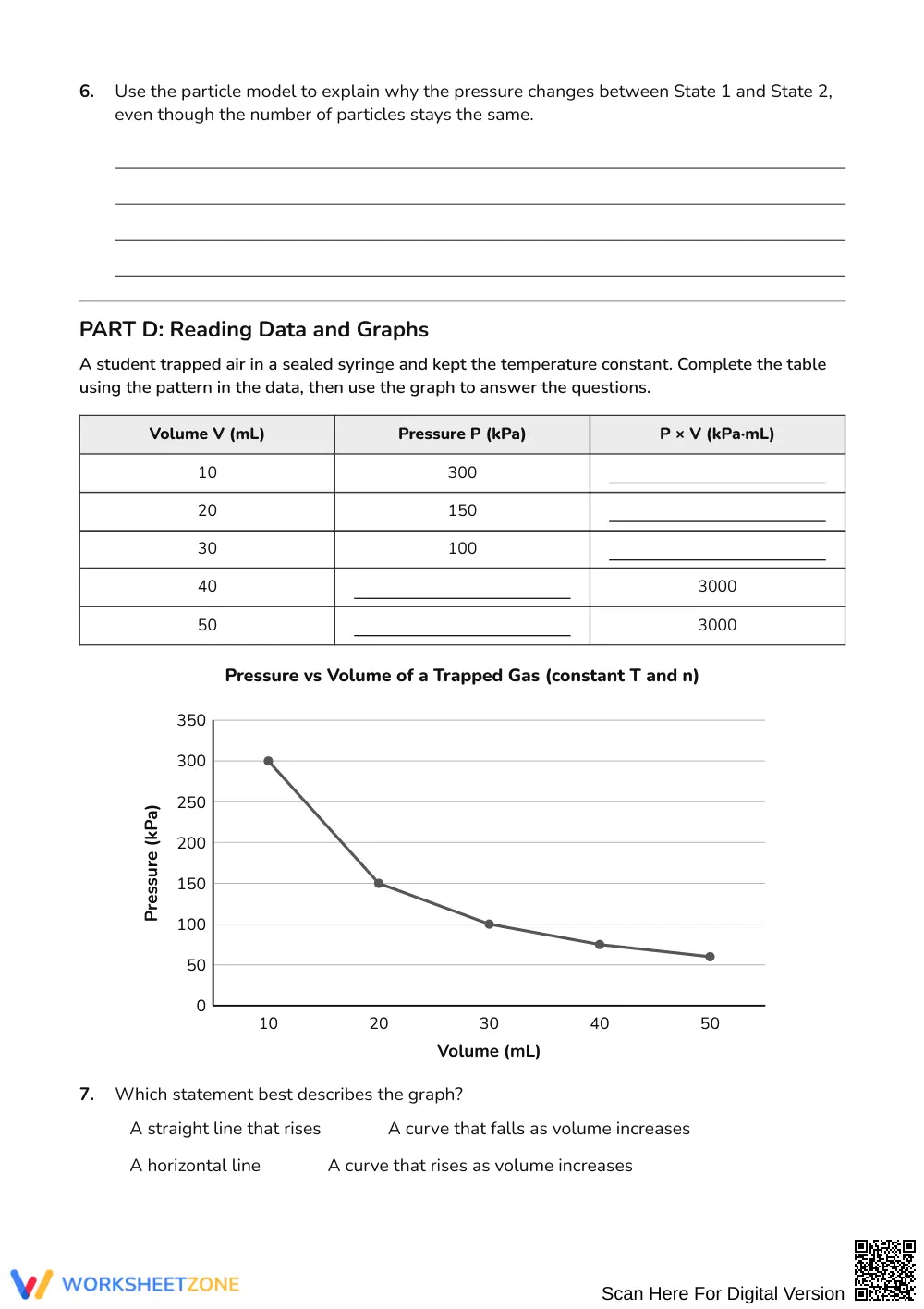
This four-page resource provides 30 targeted tasks organized across five progressive parts. Students complete vocabulary matching, analyze real-world scenarios, interpret particle diagrams in syringes, read pressure-volume tables and graphs, and resolve misconceptions. A complete four-page answer key provides step-by-step explanations.
Skill Progression
- Guided Practice (Parts A–B): Define core terminology and identify controlled conditions across 10 matching and classification items.
- Supported Practice (Parts C–D): Interpret particle collision diagrams and evaluate inverse pressure-volume relationships across 12 data-driven items.
- Independent Practice (Part E): Disprove common particulate misconceptions and calculate pressure predictions across 8 multi-step problems.
This gradual-release sequence moves systematically from conceptual vocabulary to independent proportional problem-solving.
Standards Alignment
This resource aligns with physical science standards covering kinetic molecular theory, gas properties, and inverse proportions. Students investigate how particle collisions generate pressure when volume shifts at constant temperature. Supporting standards address graphical interpretation of inverse functions. These curriculum alignment benchmarks can be copied directly into lesson plans, IEP goals, or district curriculum mapping tools.
How to Use It
Use this worksheet immediately after introducing kinetic molecular theory to reinforce microscopic behavior. It also functions effectively as a small-group intervention station before quantitative problem sets. During class, monitor Part C to confirm students connect pressure changes to collision frequency rather than particle size. Expect completion within 45 to 60 minutes.
Who It's For
This activity supports middle and high school physical science or introductory chemistry students studying gas laws. Visual particle diagrams and scaffolded matching aid English learners and developing readers. Pair this resource with an interactive syringe demonstration or an introductory slide presentation on gas behavior.
This physical science instructional resource develops mastery of Boyle's law foundations and vocabulary through structured particle modeling and graphical analysis for students in grades 8 through 12. Learners examine how particle collisions generate pressure in sealed systems, distinguish valid gas law conditions from non-examples, and calculate pressure shifts using inverse relationships. Grounded in the gradual-release model documented by Fisher & Frey (2014), the resource structures tasks from vocabulary recognition to complex proportional prediction. Empirical findings confirm that explicit progression from conceptual particle models to quantitative representations significantly reduces persistent student misconceptions about gas compressibility and particle scale. Science educators can implement this four-page print-and-go document to build empirical reasoning skills, evaluate student understanding formatively, and prepare learners for advanced thermodynamic equations. With 30 tiered tasks and an exhaustive answer key, it provides rigorous evidence-based support for foundational physical chemistry curricula.


