































Complete Boyle's Law Process Worksheet | Grades 8-12 Science

Paste this activity's link or code into your existing LMS (Google Classroom, Canvas, Teams, Schoology, Moodle, etc.).
Students can open and work on the activity right away, with no student login required.
You'll still be able to track student progress and results from your teacher account.
This comprehensive Boyle's law worksheet guides students through 23 structured problems to master the microscopic cause-and-effect sequence of gas compression and expansion. Learners analyze particle models, order mechanical steps, graph inverse pressure-volume relationships, and apply kinetic principles to real atmospheric scenarios with complete scientific accuracy.
At a Glance
- Grade: Grades 8–12 · Subject: Science
- Standard: Physical Science — Explain how changing gas volume alters pressure at constant temperature
- Skill Focus: Sequence or Process in Boyle's Law
- Format: 4 pages · 23 problems · Answer key included · PDF
- Best For: Chemistry and physics practice
- Time: 45–60 minutes
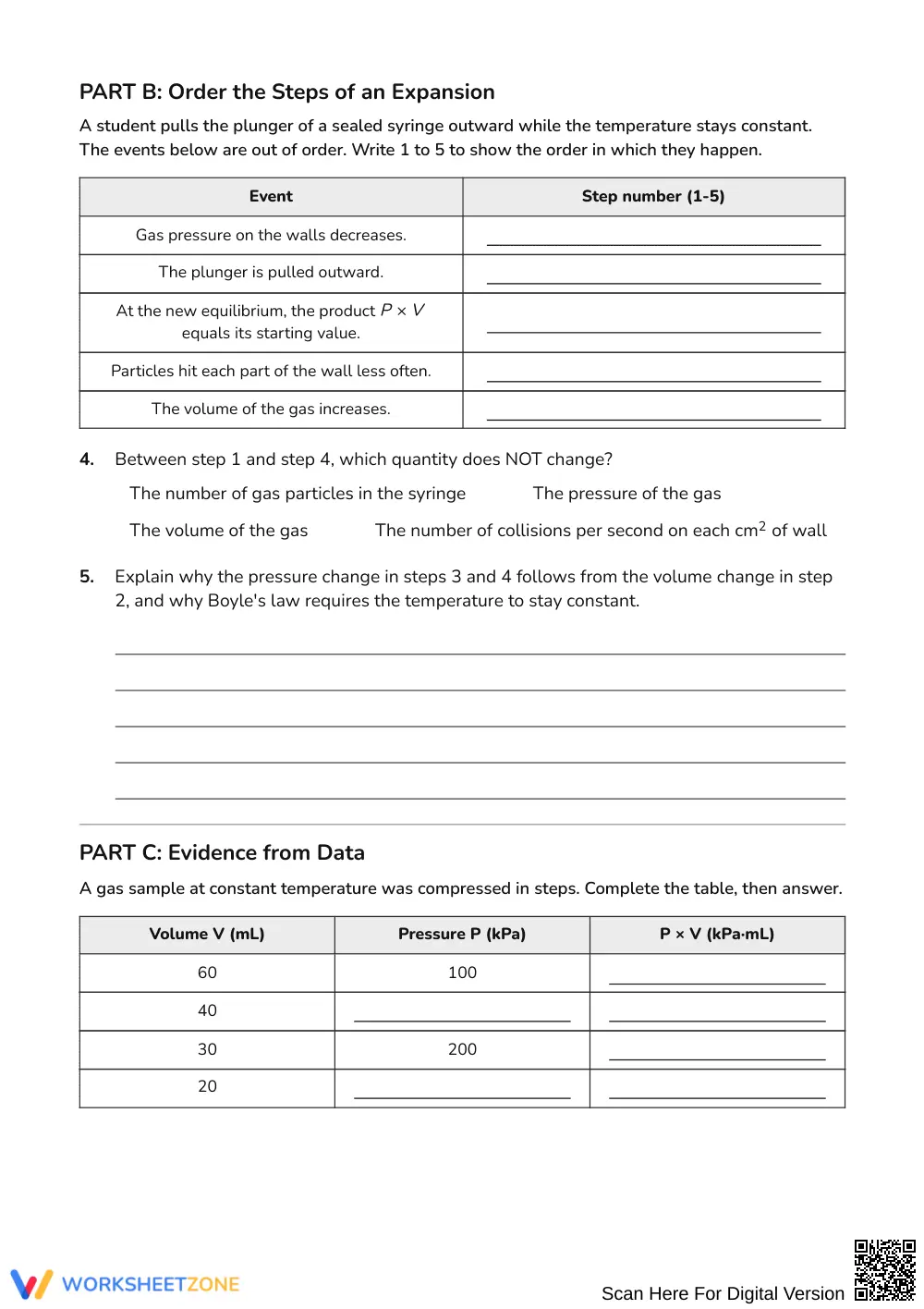
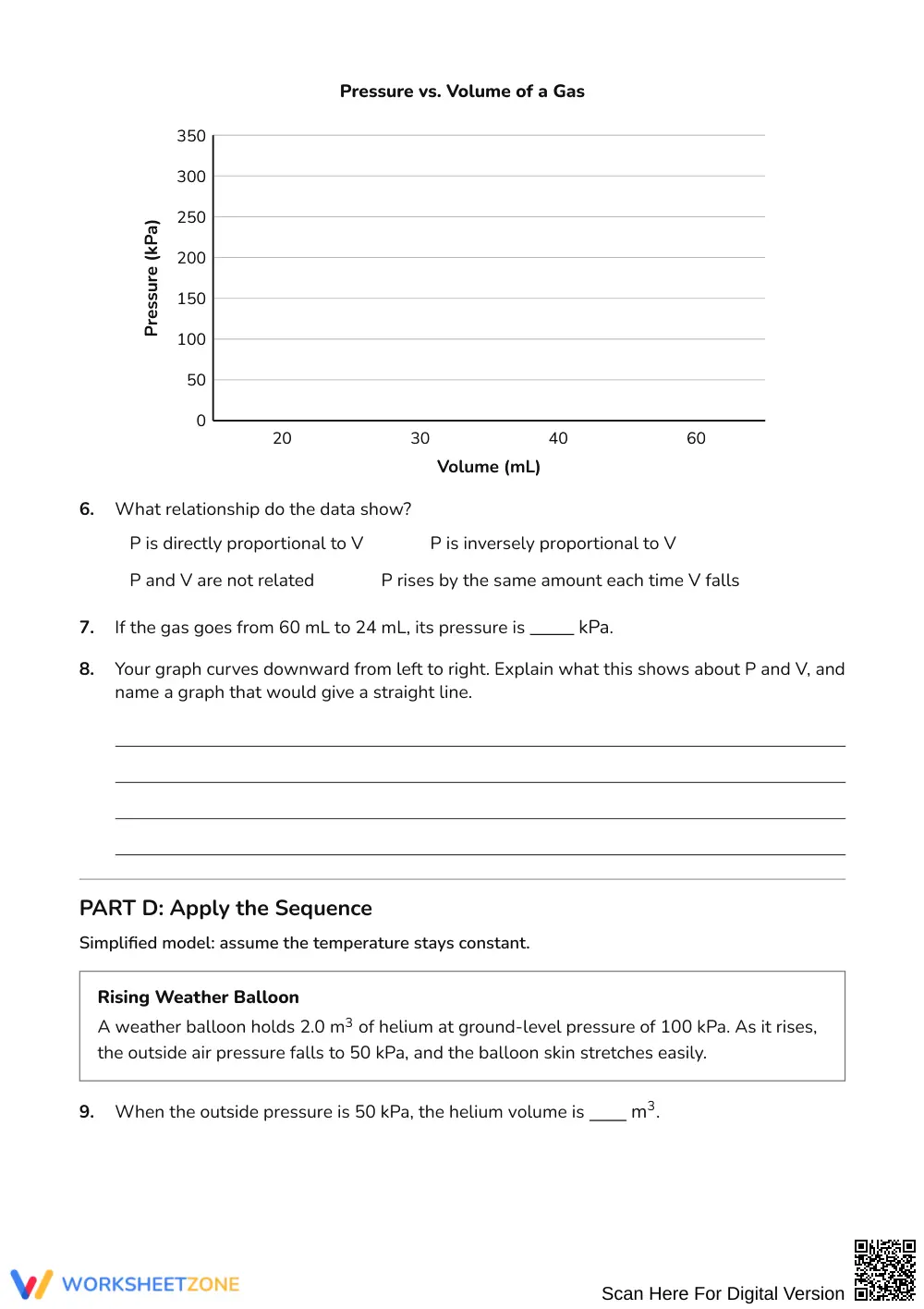
What's Inside: Across 4 well-structured pages, students examine gas behavior through particle diagrams, process-ordering matrices, quantitative data tables, and word problems. The activity includes qualitative syringe models, a multi-step equilibrium reconstruction task, an inverse-variation table with graphing prompts, and a 4-page detailed answer key with complete particle collision rationales.
Skill Progression
- Guided practice: Part A presents particle drawings of a syringe compression where students identify constant quantities and predict pressure changes across 4 structured visual tasks.
- Supported practice: Parts B and C guide students through ordering a 5-step expansion sequence and computing constant P × V products across 12 analytical tasks.
- Independent practice: Part D challenges learners with 7 rigorous questions applying the sequence to a rising weather balloon without scaffolding.
This scaffolded progression aligns with the gradual-release model, transitioning students smoothly from conceptual particle models to independent mathematical application.
Standards Alignment
This worksheet aligns with high school physical science standards addressing the relationships among gas properties, particle motion, and pressure-volume equilibrium. It also supports core mathematical standards for evaluating inversely proportional quantities and non-linear data curves. Both standard codes can be copied directly into lesson plans, IEP goals, or district curriculum mapping tools.
How to Use It
Implement this worksheet after direct instruction on kinetic molecular theory to reinforce qualitative and quantitative reasoning. Alternatively, use Part B as a collaborative mid-unit check where pairs sequence equilibrium steps on whiteboards. During independent work, check whether students attribute pressure drops to collision frequency rather than particle speed. Most students complete all 4 pages in 45 to 60 minutes.
Who It's For
This resource targets physical science, chemistry, and physics students in grades 8 through 12. Teachers can support struggling learners by providing physical syringes for tactile demonstration, while advanced students can calculate non-linear linearization slopes. Pair this worksheet with an interactive gas simulation lab or particle motion anchor chart.
According to Fisher & Frey (2014), structuring science tasks around explicit cause-and-effect sequences significantly deepens student conceptual transfer and prevents common misconceptions in physical systems. This 4-page worksheet systematically reinforces the sequence of Boyle's law, guiding Grades 8 through 12 learners through 23 scaffolded tasks that connect microscopic particle collisions to macroscopic pressure-volume observations. Rather than treating gas laws as isolated algebra formulas, the resource requires students to reconstruct mechanical equilibrium chronologically: plunger displacement shifts available volume, altered wall collision frequency modifies internal force per area, and internal pressure equalizes with external forces. By explicitly tracing each transitional state alongside mathematical data tables, students build durable mental models of inverse proportionality. Educators can deploy this resource for targeted intervention or core instruction to ensure rigorous physical science mastery.


