





























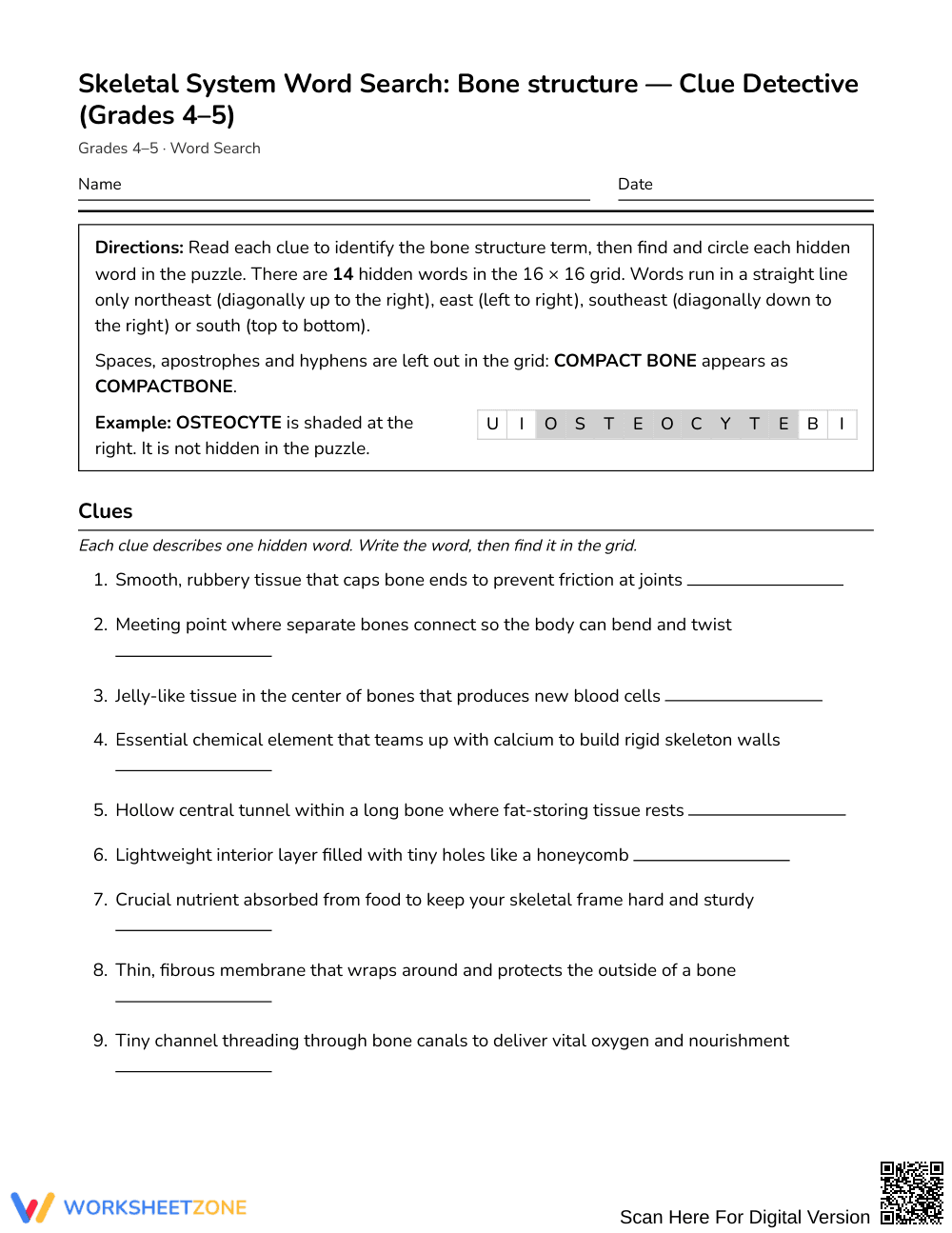
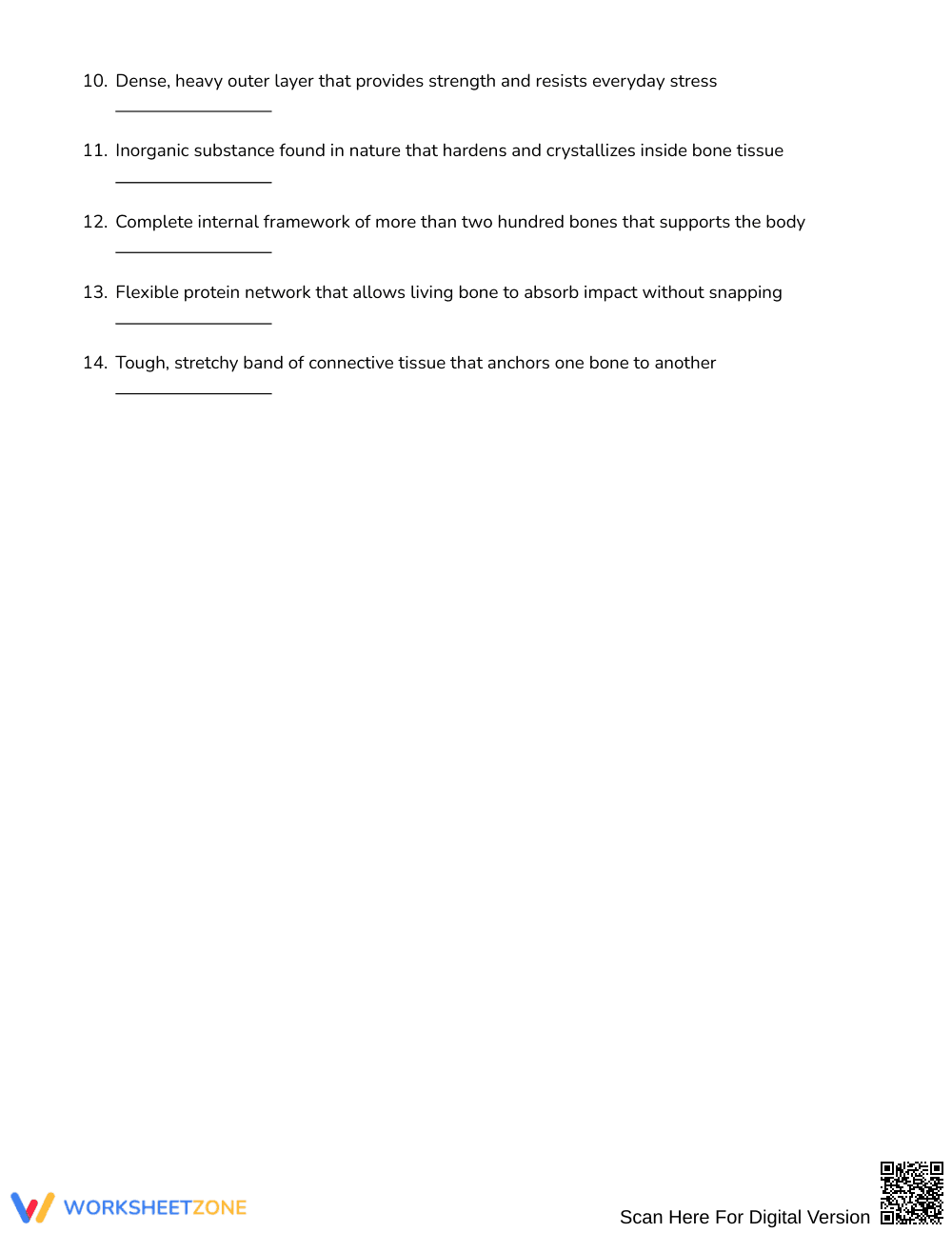


Complete Bone Structure Word Search | Grades 4–5 Science

Paste this activity's link or code into your existing LMS (Google Classroom, Canvas, Teams, Schoology, Moodle, etc.).
Students can open and work on the activity right away, with no student login required.
You'll still be able to track student progress and results from your teacher account.
This Grades 4–5 science word search strengthens foundational understanding of bone structure by connecting 14 key anatomical terms directly to descriptive definitions. Learners read clues describing compact bone, marrow, and periosteum, then locate the terms within the letter grid, reinforcing specialized life science vocabulary through active pattern recognition and text retrieval.
At a Glance
- Grade: Grades 4–5 upper elementary · Subject: Science (Life Science)
- Standard: Not standards-assessed — vocabulary enrichment and foundational science literacy
- Skill Focus: Skeletal system anatomy and bone structure terminology
- Format: 3 pages · 14 words · Full answer key included · Printable PDF
- Best For: Science vocabulary enrichment, independent review, and sub plans
- Time: 15–25 minutes of focused student work
Inside this 3-page printable science resource, teachers will find a student puzzle worksheet featuring 14 targeted vocabulary clues, a 16 by 16 letter grid, and a shuffled word bank that challenges students to deduce answers before hunting for letters. A matching 3-page answer key clearly highlights word placements, facilitating rapid grading or student self-checking.
Puzzle Mechanics and Structure
The activity is built on a 16 by 16 letter grid containing 14 hidden skeletal system terms. Words run in four specific orientations: northeast, east, southeast, and south. Rather than simply scanning a list, students read clue definitions—such as identifying the fibrous periosteum membrane or sponge-like interior tissue—and check the shuffled word bank to verify spelling before circling each term.
Standards Alignment
This activity provides targeted vocabulary enrichment and is not aligned to a specific state or national science standard. Instead of formal standards assessment, it builds foundational domain-specific literacy regarding human anatomy and skeletal tissues, supporting broader fourth and fifth grade life science units on human body systems and internal structures.
How to Use It
Introduce this word search immediately after direct instruction on the human skeleton, using it as an independent consolidation activity or station task. Alternatively, assign it as a quiet warm-up to activate prior knowledge before a lab on bone density. During work time, observe whether students read the clues first or search randomly; students relying on clues show stronger vocabulary retention. Plan for 15 to 25 minutes of completion time.
Who It's For
This puzzle is designed for fourth and fifth grade science students exploring biology and human body systems. The detailed clue format provides built-in scaffolding for English language learners and developing readers needing explicit contextual support. For best results, pair this word search with a labeled cross-section diagram of a long bone or an anatomical skeletal system anchor chart.
According to Fisher & Frey (2014), intentional exposure to domain-specific vocabulary through contextual clues and interactive word retrieval strengthens conceptual retention in upper elementary science instruction. This Grades 4–5 skeletal system word search targets foundational bone structure terminology—including periosteum, compact bone, cartilage, and marrow—without the pressure of formal testing. Because this activity is designed purely for vocabulary enrichment rather than standards-based assessment, elementary learners engage with rigorous scientific definitions in an accessible clue-and-search puzzle format. Educational research on vocabulary acquisition demonstrates that pairing descriptive, functional definitions with orthographic search patterns reinforces anatomical terminology significantly faster than rote memorization. Science educators can utilize this 14-word printable activity to support reading comprehension across informational texts, bolster scientific discourse during human body units, and establish durable cognitive schemas before formal anatomical evaluations take place in the science classroom.


