




























Views
Downloads


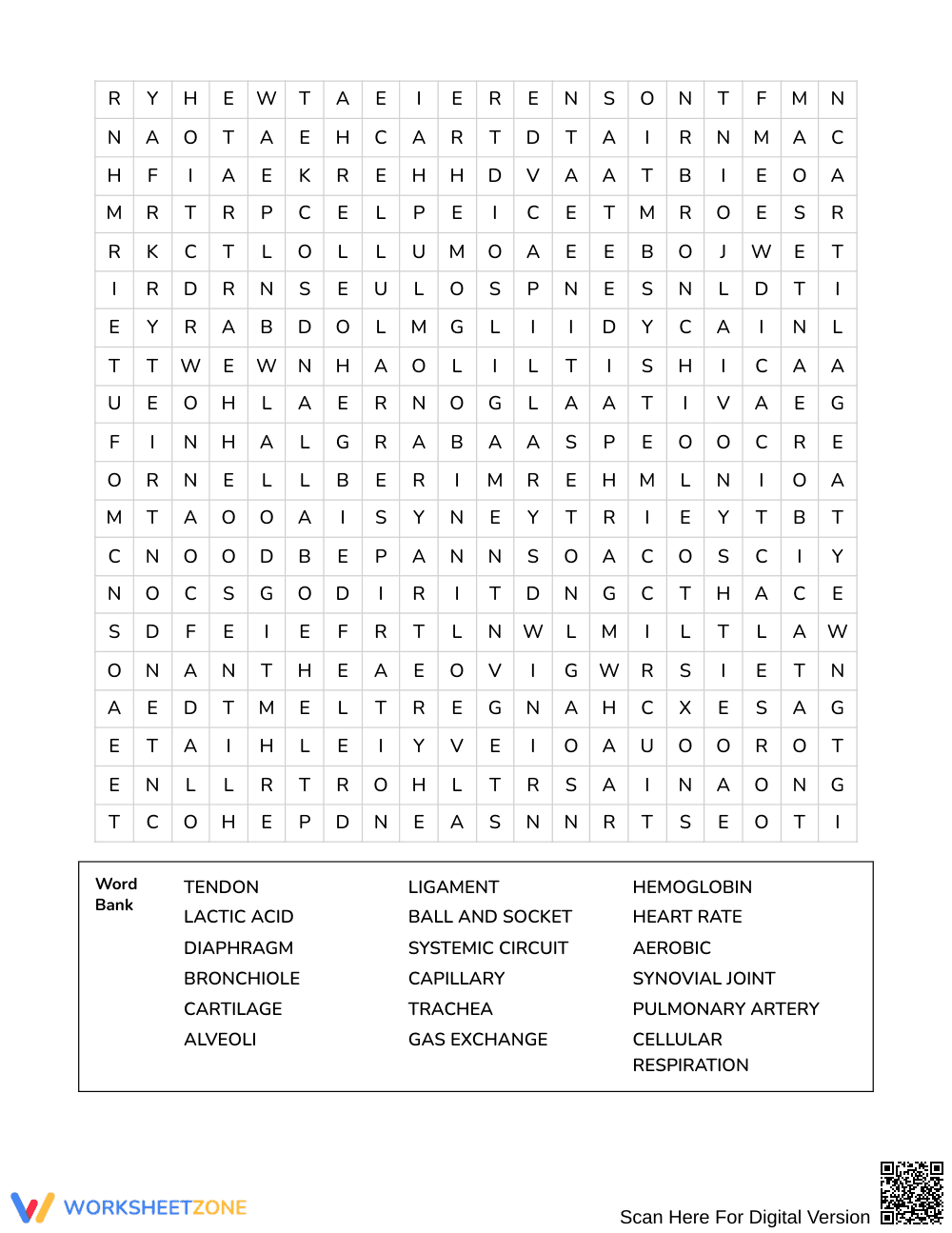

Complete Body Systems Word Search | Grades 7–8 Science

Paste this activity's link or code into your existing LMS (Google Classroom, Canvas, Teams, Schoology, Moodle, etc.).
Students can open and work on the activity right away, with no student login required.
You'll still be able to track student progress and results from your teacher account.
This body systems word search reinforces how movement, breathing, and circulation function together during physical activity. Designed for life science students in Grades 7–8, the cumulative review requires learners to decipher scientific clues and identify key physiological terms. Students strengthen scientific literacy and conceptual connections across human organ systems while completing the activity independently.
At a Glance
- Grade: Grades 7–8 · Subject: Middle School Science
- Standard: Not standards-assessed — targeted vocabulary enrichment and review
- Skill Focus: Human movement, breathing, and circulation interactions
- Format: 3 pages · 18 hidden words · Full answer key included · PDF
- Best For: Cumulative organ system review, fast finishers, or emergency sub plans
- Time: 25–35 minutes
What's Inside
The resource spans 3 student-facing pages centered on a challenging puzzle grid. Rather than scanning for an exposed alphabetical list, students read 18 precise biological clues defining key structures and processes, including cellular respiration, systemic circulation, and synovial joints. A complete 4-page answer key provides circled solutions for immediate self-checking or teacher grading.
Puzzle Mechanics
This word search operates on an authentic 20 × 20 letter grid containing 18 hidden vocabulary terms. Words run in all 8 compass directions: north, northeast, east, southeast, south, southwest, west, and northwest, including forward and backward orientations. Students read the content-rich clue bank to determine the correct physiological term before locating it in the letter array, transforming basic letter-finding into genuine conceptual recall.
Standards Alignment
This resource serves as targeted vocabulary enrichment and is not aligned to a formal performance standard. The content reviews essential life science terminology covering muscular, respiratory, and circulatory coordination during exercise, providing strong conceptual reinforcement across middle school biology units.
How to Use It
Deploy this word search at the conclusion of your organ systems unit to synthesize how respiratory and circulatory pathways support muscular movement. Alternatively, assign it as an independent station task during lab rotations or as a zero-prep sub plan. While students work, conduct a formative check by asking them to explain orally how hemoglobin and capillary networks cooperate during vigorous exercise. Most learners finish within 25 to 35 minutes.
Who It's For
This activity is designed for Grades 7–8 science classrooms studying integrated human body systems. It offers accessible terminology practice for general education students while supporting visual learners through structured spatial search. Pair this word search with a physiological diagram of gas exchange or an introductory lab on pulse recovery rates to bridge structural definitions with real-world biological functions.
Integrating clue-based retrieval into science vocabulary instruction strengthens domain-specific literacy and conceptual retention. According to Fisher & Frey (2014), purposeful vocabulary acquisition requires students to actively associate technical definitions with structural terms rather than relying on isolated memorization. This word search engages middle school learners in dual-stage cognitive processing: students first interpret 18 complex physiological clues—spanning gas exchange, cardiac output, and musculoskeletal articulation—and then search for target terms across an expansive 20 × 20 grid. By embedding all 8 compass directions, the puzzle challenges spatial analysis while securing neural pathways between anatomical labels and their biological roles during exertion. The resource consolidates foundational knowledge across the muscular, respiratory, and cardiovascular systems without requiring extensive teacher setup. Educators can cite this resource as a structured vocabulary reinforcement activity that bridges textbook definitions and comprehensive organ system comprehension in middle school science curricula.


