































Complete Body Systems Data Worksheet | Grades 6-10 Science

Paste this activity's link or code into your existing LMS (Google Classroom, Canvas, Teams, Schoology, Moodle, etc.).
Students can open and work on the activity right away, with no student login required.
You'll still be able to track student progress and results from your teacher account.
This body systems worksheet guides secondary science students through quantitative data analysis across human organ systems. Learners evaluate exercise physiology and fluid balance tables, compute ventilation rates, create bar graphs, and construct scientific explanations. Students discover how respiratory, circulatory, muscular, and urinary systems coordinate to maintain stable internal homeostasis.
At a Glance
- Grade: Grades 6–10 · Subject: Science
- Standard: Analyze data to show how body systems interact to maintain homeostasis
- Skill Focus: Data table interpretation and physiological homeostasis
- Format: 4 pages · 31 problems · Answer key included · PDF
- Best For: Physiology data analysis lab
- Time: 45–60 minutes
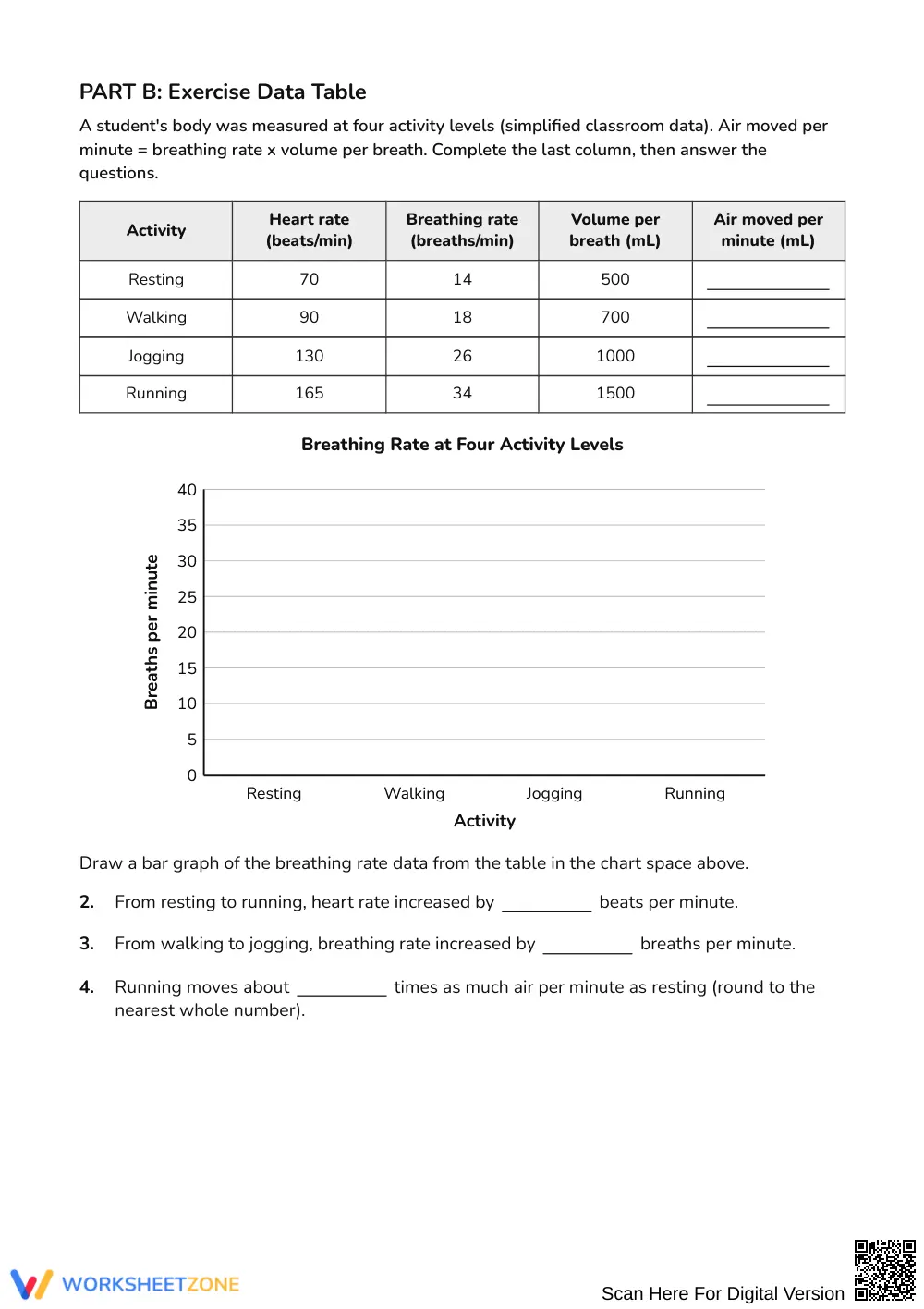
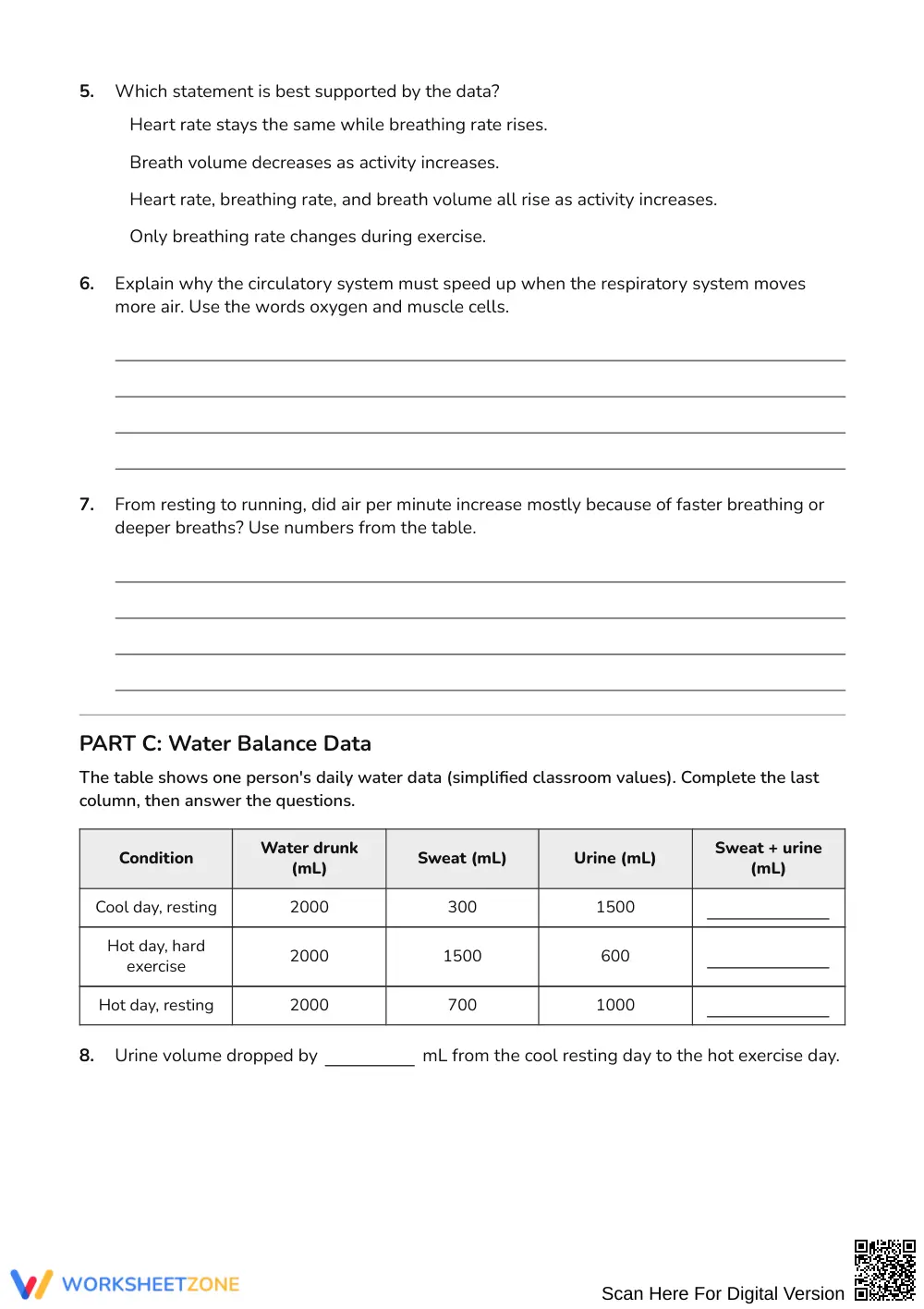
This 4-page packet contains 31 structured tasks across three modules. Students identify internal organs and match them to systems. Two classroom data tables present exercise ventilation rates and daily water conservation. Tasks integrate multiplication calculations, graphing, multiple-choice questions, and short-answer reasoning.
Skill Progression
- Guided Practice (Part A, Tasks 1–8): Students identify internal organs on an anatomical diagram and match organ pairs with physiological roles.
- Supported Practice (Part B, Tasks 9–19): Learners calculate minute ventilation, graph exercise trends, and interpret circulatory responses.
- Independent Practice (Part C, Tasks 20–31): Students analyze water balance tables and write a Claim-Evidence-Reasoning response on multi-system regulation.
This sequence follows gradual release, advancing from direct recall to rigorous scientific argumentation.
Standards Alignment
This resource addresses life science expectations requiring students to use evidence to show how interacting organ systems support multicellular organisms. Learners investigate how feedback mechanisms sustain homeostasis during exercise and heat stress. The tasks also develop quantitative reasoning. These skills can be copied directly into lesson plans, IEP goals, or district curriculum mapping tools.
How to Use It
Use this worksheet after direct instruction on human anatomy as an interactive data lab or review rotation. For formative assessment, observe students calculating ventilation rates in Part B to verify numerical accuracy before they graph. Expect completion in 45 to 60 minutes.
Who It's For
This activity supports middle school life science and introductory biology students. Structured tables support developing readers, while open-ended analysis challenges advanced learners. Pair this printable with an introductory video on circulatory gas exchange or a resting pulse lab.
According to Fisher & Frey (2014), structured data analysis tasks that integrate visual models, quantitative problem sets, and guided scientific argumentation significantly improve conceptual retention in secondary science classrooms. This worksheet operationalizes multi-system interactions and internal homeostasis by leading students through 31 sequential tasks across three data-rich physiological contexts. Learners examine organ function diagrams, calculate product metrics for respiratory minute volumes, construct visual data displays, and synthesize fluid regulation balances across varying activity and temperature environments. By bridging quantitative table interpretation with a culminating Claim-Evidence-Reasoning written response, the resource ensures students move past rote anatomical memorization toward authentic scientific inquiry. Teachers can use the included four-page answer key to evaluate student comprehension rapidly during formative checks or summative unit assessments, ensuring learners master the complex relationships that govern human physiological regulation.


