




























Views
Downloads



Complete Big Bang Evidence Word Search | Grades 6–7 Science

Paste this activity's link or code into your existing LMS (Google Classroom, Canvas, Teams, Schoology, Moodle, etc.).
Students can open and work on the activity right away, with no student login required.
You'll still be able to track student progress and results from your teacher account.
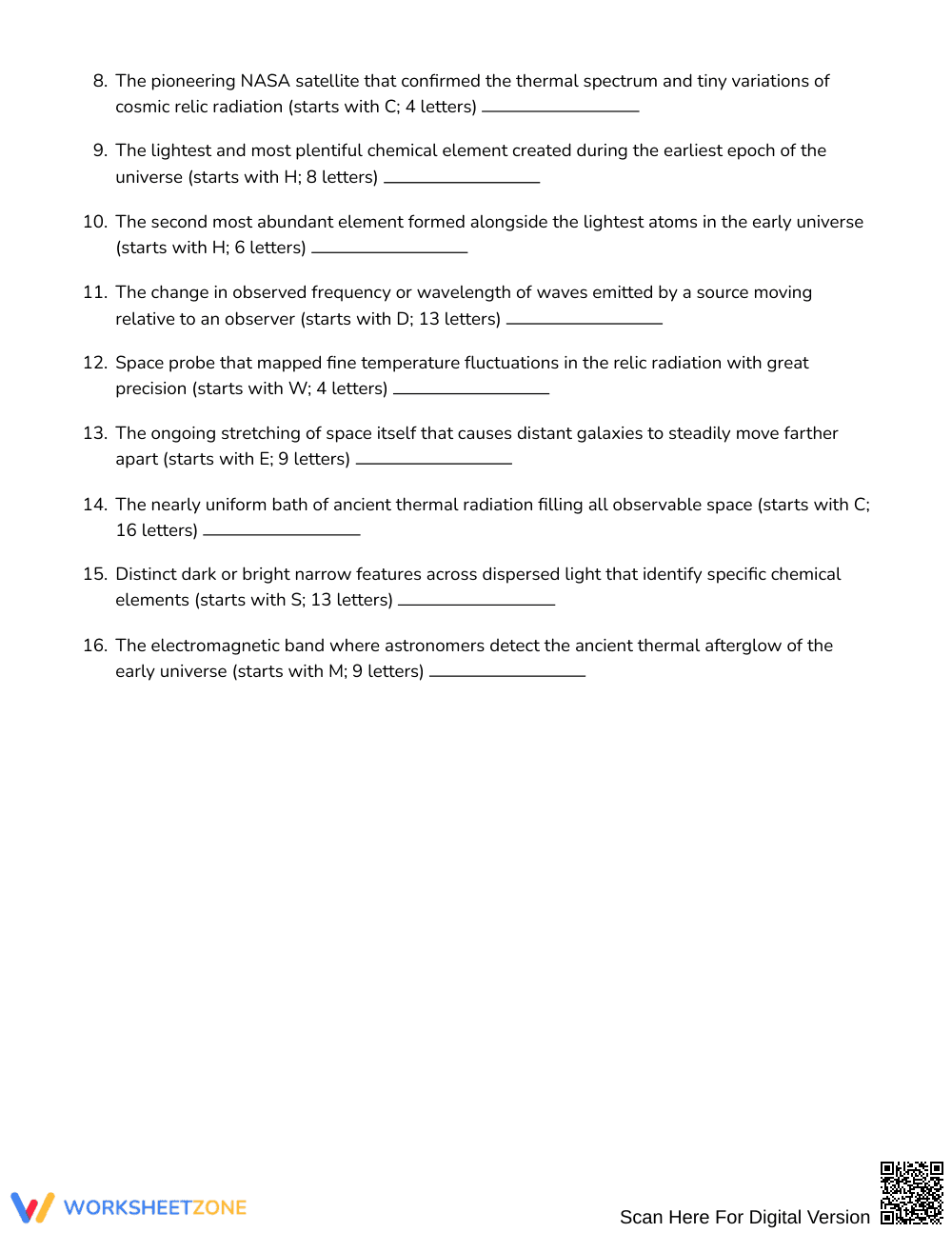
This astronomy word search reinforces essential vocabulary surrounding the Big Bang theory, cosmological evidence, and astronomical instrumentation for Grades 6–7 science students. By deciphering 16 descriptive clues without a word bank, learners actively retrieve key terms like redshift, cosmic background radiation, and spectroscope before locating them in the grid.
At a Glance
- Grade: Grades 6–7 · Subject: Science
- Standard: Not standards-assessed — vocabulary enrichment
- Skill Focus: Astronomical instruments and evidence
- Format: 3 pages · 16 words · Answer key included · PDF
- Best For: Vocabulary review and unit wrap-up
- Time: 25–35 minutes
What's Inside
This 3-page printable activity challenges students to synthesize astronomy concepts through clue-based retrieval. Rather than relying on a word bank, the activity features 16 content clues covering major discoveries, satellites, and physical principles. A complete letter grid contains all hidden terms, supported by a multi-page answer key showing exact placements for rapid checking.
Puzzle Structure and Mechanics
Designed as a no-bank challenge, this word search requires students to determine each target term from conceptual definitions before scanning the grid. The puzzle includes:
- 18 x 18 Letter Grid: A dense matrix containing all 16 target astronomy terms.
- Full-Direction Search: Words run in 8 directions (N, NE, E, SE, S, SW, W, NW).
- Clue-Driven Retrieval: The absence of a word bank prompts active recall of instruments and cosmological principles.
Standards Alignment
This activity serves as a vocabulary enrichment resource rather than a standards-assessed worksheet. While it reinforces terminology essential for understanding cosmological expansion, spectral analysis, and electromagnetic radiation, it does not evaluate an individual performance standard directly.
How to Use It
Introduce this word search after direct instruction on the Big Bang theory to consolidate scientific vocabulary. Alternatively, assign it as a collaborative partner review during study stations. During independent work, check whether students identify instruments like COBE, WMAP, or spectroscope from descriptions before scanning the puzzle. Expected completion time is 25 to 35 minutes.
Who It's For
This activity is designed for Grades 6–7 science classrooms exploring space systems and cosmic history. It provides an engaging vocabulary task for general education classes, early finishers, and review days. Pair this puzzle with an introductory reading passage on cosmic background radiation or a lesson on galactic redshift.
According to research by Fisher & Frey (2014) on disciplinary literacy and vocabulary acquisition, domain-specific terminology serves as the foundation for conceptual comprehension in secondary science. When students engage with science concepts through definition-to-term retrieval rather than passive recognition, they develop stronger semantic pathways that support scientific discourse. This enrichment word search operationalizes retrieval practice across 16 core astronomical vocabulary terms, including redshift, nucleosynthesis, and cosmic background radiation. By removing the traditional word bank and requiring students to resolve functional definitions, the puzzle transforms searching into a meaningful cognitive exercise. Research demonstrates that pairing contextual definitions with visual scanning strengthens orthographic mapping and content retention in middle school learners. Science educators can integrate this puzzle during astronomy units to reinforce scientific communication and ensure learners accurately identify historical instruments, satellites, and observational evidence connected to modern cosmological models without adding grading overhead.


