






























Paste this activity's link or code into your existing LMS (Google Classroom, Canvas, Teams, Schoology, Moodle, etc.).
Students can open and work on the activity right away, with no student login required.
You'll still be able to track student progress and results from your teacher account.


Complete Autumn Woodland Food Web: Turkeys and Oaks

Paste this activity's link or code into your existing LMS (Google Classroom, Canvas, Teams, Schoology, Moodle, etc.).
Students can open and work on the activity right away, with no student login required.
You'll still be able to track student progress and results from your teacher account.
This forest food web worksheet guides Grade 5 students to trace energy flow and matter cycling across woodland trophic levels. Students identify producers, consumers, and decomposers, track food chains from oak trees to predators, and evaluate how environmental disruptions impact ecosystem balance across 18 targeted tasks.
At a Glance
- Grade: Grade 5 · Subject: Science
- Standard: Trace energy flow and matter cycles across forest producers, consumers, and decomposers
- Skill Focus: Trace energy and matter through a forest food web
- Format: 3 pages · 18 problems · Answer key included · PDF
- Best For: Independent practice, science centers, or assessment
- Time: 30–45 minutes
What's Inside
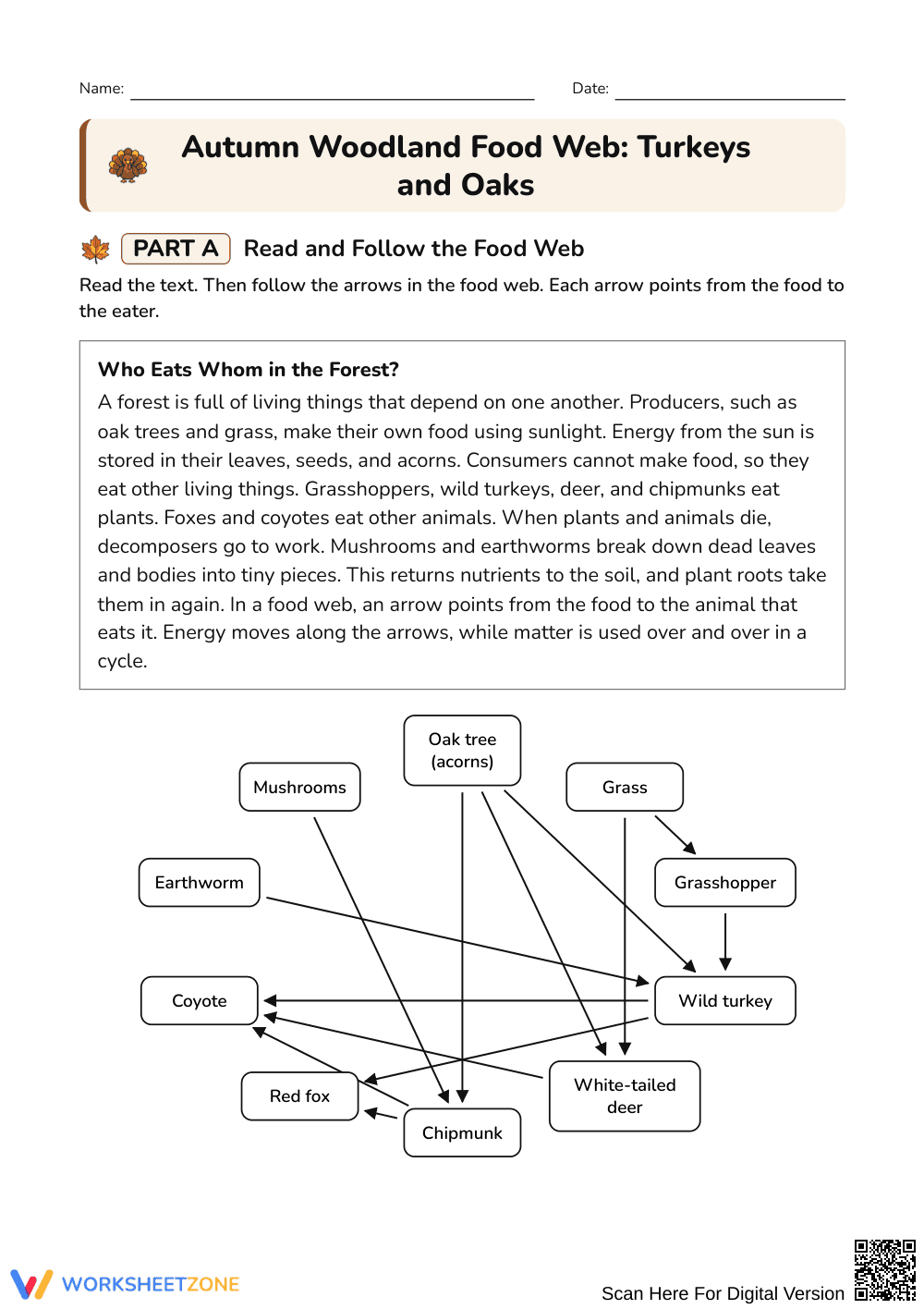
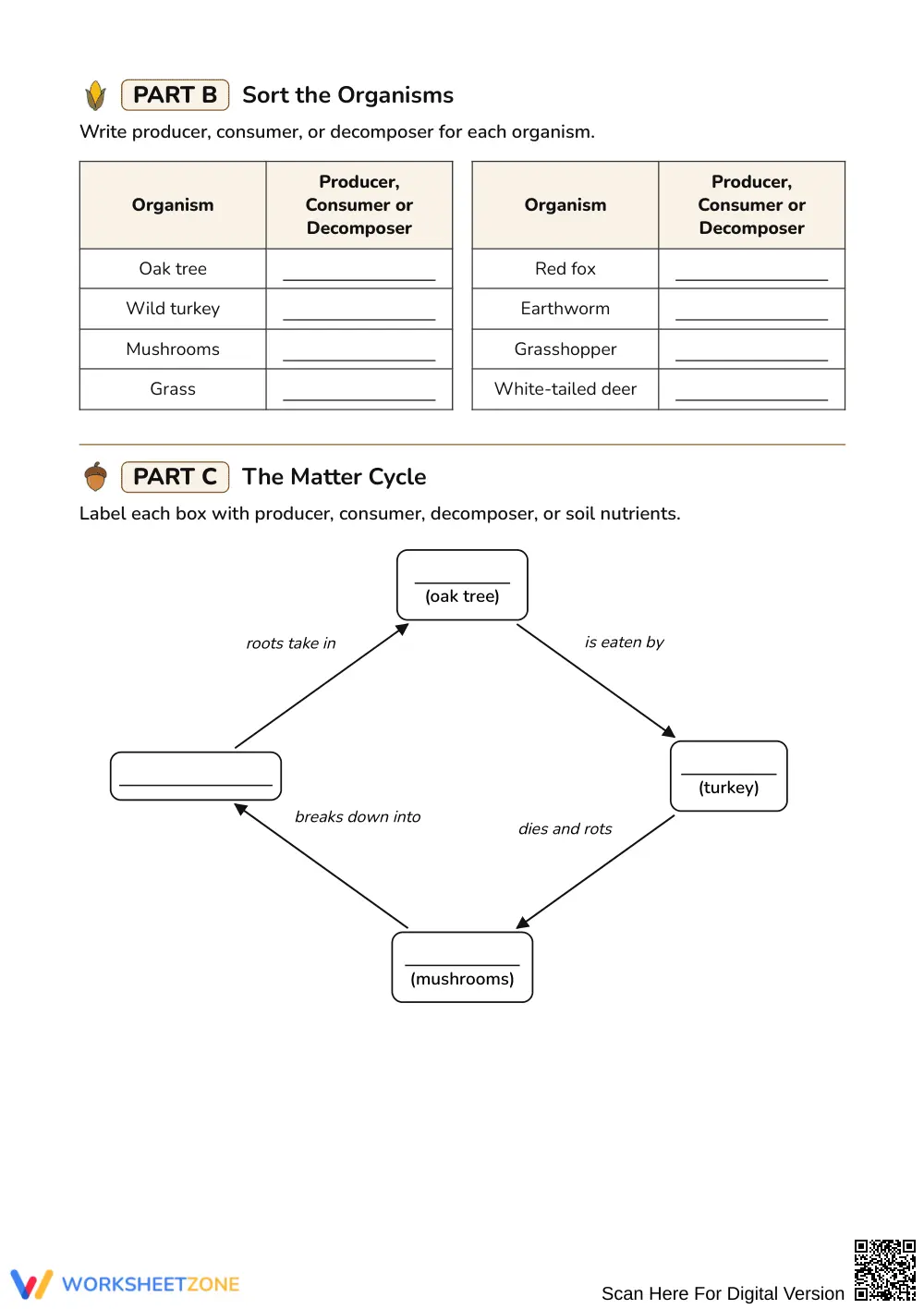
This 3-page packet contains 18 tasks across four parts. Part A features an informational passage and food web diagram. Part B provides an eight-organism classification chart. Part C presents a matter cycling diagram with label boxes, and Part D delivers four multiple-choice questions plus two short-answer prompts. A 3-page answer key provides complete solutions.
Skill Progression
- Guided practice (Part A): Students read an explanatory passage defining organism roles alongside an arrow-tracking guide.
- Supported practice (Parts B and C): Learners classify 8 organisms and label a four-stage matter cycle diagram.
- Independent practice (Part D): Students answer 4 multiple-choice items and write 2 responses analyzing population changes.
This sequence follows gradual release principles, shifting students from guided diagram analysis to independent reasoning.
Standards Alignment
This resource aligns with Grade 5 life science standards focused on developing models of matter cycling and energy transfer. Supporting expectations address woodland food chains and habitat interdependence. Both standard codes can be copied directly into lesson plans, IEP goals, or district curriculum mapping tools.
How to Use It
Use this resource after direct instruction on ecosystem dynamics. Teachers can assign Parts A through C as partner practice during class, reserving Part D as an individual exit ticket. When circulating, check that students recognize food web arrows show energy moving into the consumer. Students finish within 30 to 45 minutes.
Who It's For
Designed for Grade 5 general education, science intervention, and multilingual learners mastering academic vocabulary. Scaffolding in Parts A and B supports struggling readers, while Part D extends critical thinking. Pair this resource with a woodland food web anchor chart before starting.
According to Fisher & Frey (2014), structuring student tasks around a gradual release of responsibility significantly enhances conceptual retention and domain-specific analytical reasoning in upper elementary science classrooms. This Grade 5 science worksheet operationalizes that pedagogical framework across 18 targeted tasks that trace energy flow and matter cycling through a woodland ecosystem. By guiding learners from foundational reading comprehension of producers, consumers, and decomposers into classification tables, matter cycle labeling, and scenario-based disruption analysis, the resource directly supports mastery of Grade 5 life science standards without instructional gaps. The intentional sequence moves students from supported diagram interpretation to independent synthesis, ensuring that learners develop an evidence-based understanding of how organisms depend on reciprocal relationships. As demonstrated by educational research, providing structured opportunities for students to explain ecological cause-and-effect relationships cultivates higher-order scientific literacy, preparing fifth graders for advanced middle school life science investigations.


