































Complete Artery Oxygen Claims Worksheet | Grade 8 Science

Paste this activity's link or code into your existing LMS (Google Classroom, Canvas, Teams, Schoology, Moodle, etc.).
Students can open and work on the activity right away, with no student login required.
You'll still be able to track student progress and results from your teacher account.
This Grade 8 science worksheet dismantles the common misconception that arteries exclusively transport oxygenated blood while veins only carry deoxygenated blood. Through structured hemodynamic analysis, students evaluate physiological data to define blood vessels strictly by direction of flow relative to the heart, mastering core circulatory mechanics across both circuits.
At a Glance
- Grade: 8 · Subject: Science
- Standard: Analyze structural cardiovascular interactions to explain how vessel flow direction determines dual-circuit blood transport
- Skill Focus: Correct Artery-Always-Means-Oxygenated Claims
- Format: 5 pages · 8 problems · Answer key included · PDF
- Best For: Mid-unit conceptual error correction and data analysis
- Time: 40–50 minutes
What's Inside
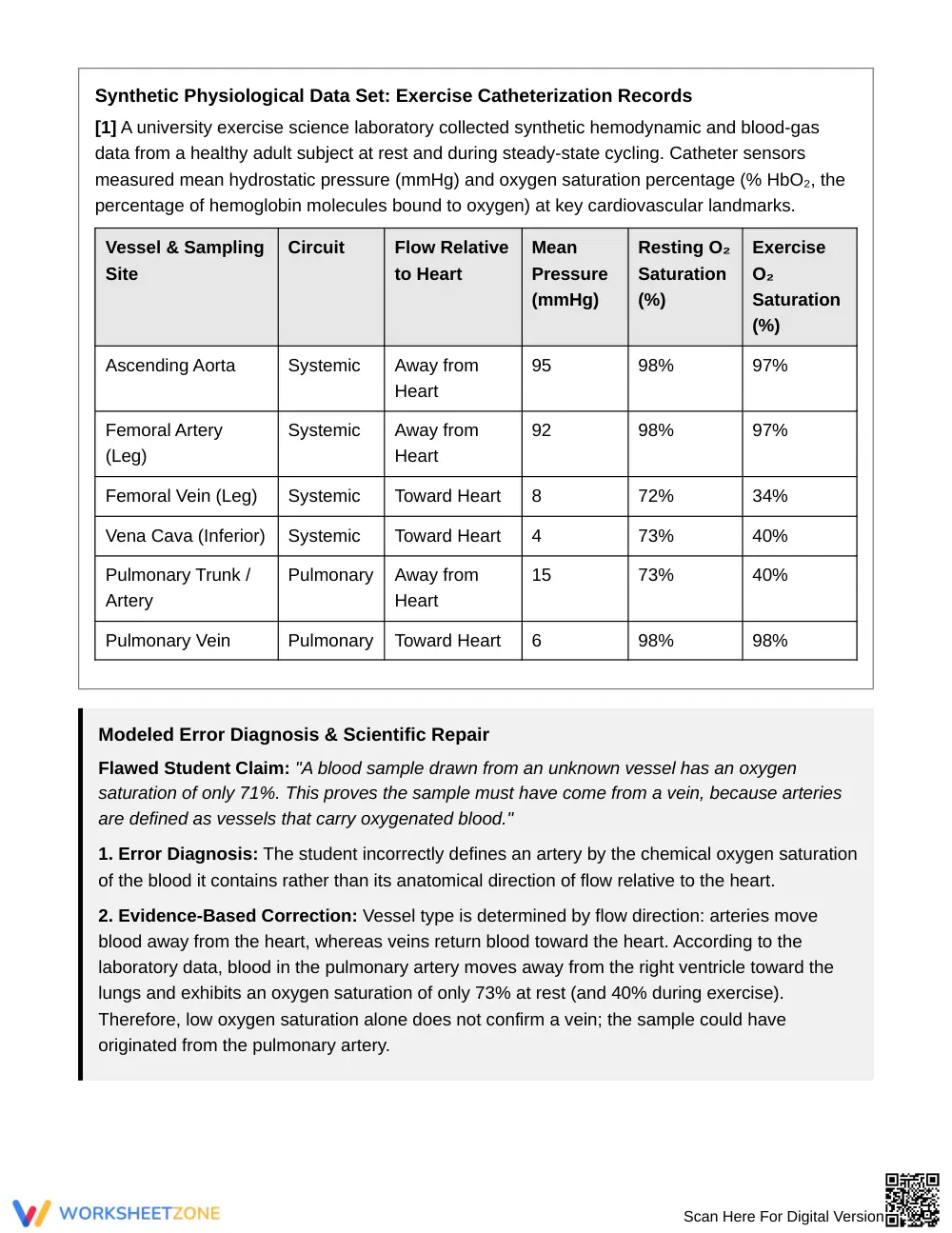
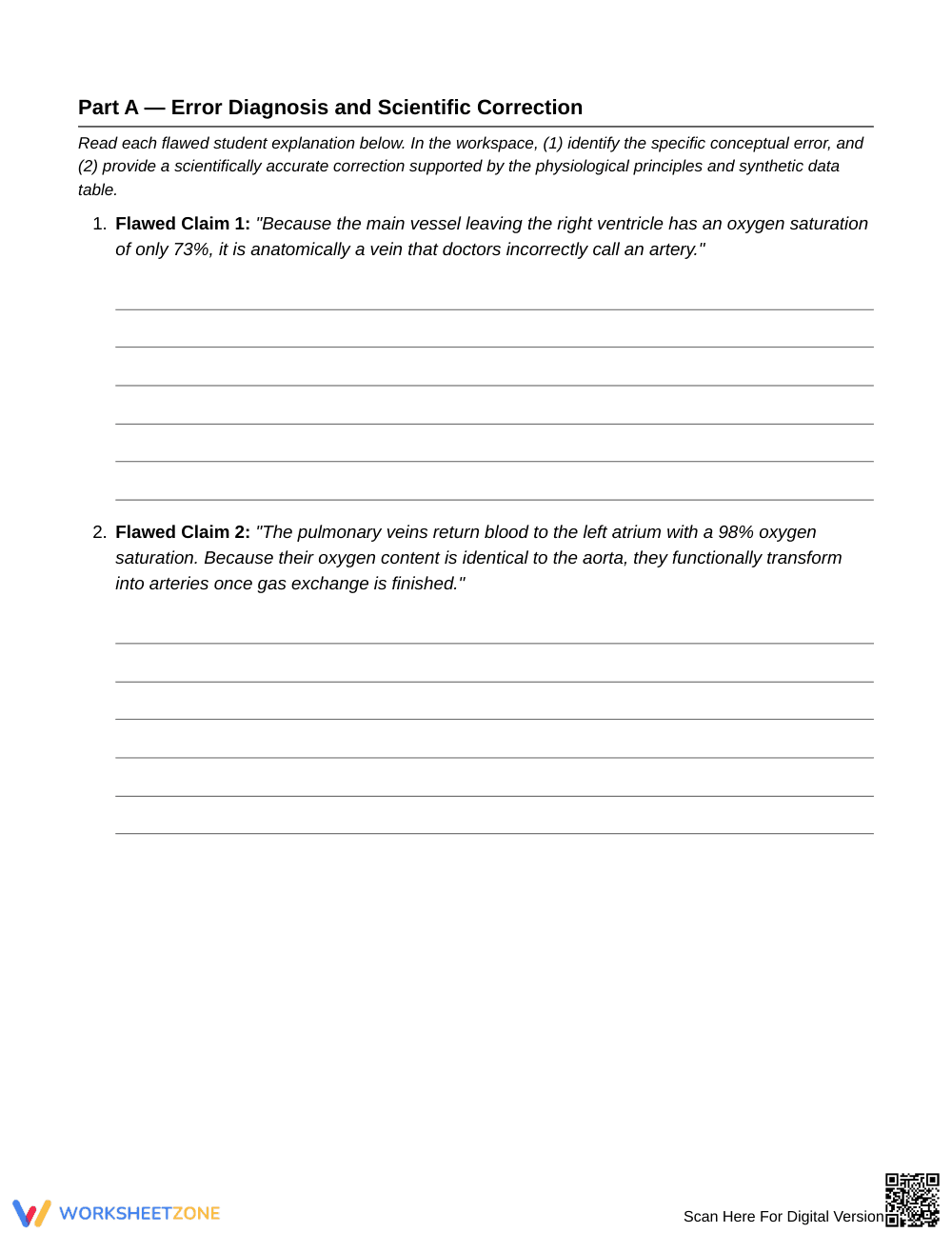
This 5-page instructional resource contains a physiological guide defining vessel mechanics, a catheterization data table comparing rest and exercise oxygen levels, a worked error-diagnosis exemplar, and 8 two-part correction tasks. A 3-page answer key provides anatomical explanations and data citations for every prompt.
Skill Progression
- Guided practice: A fully annotated worked example models how to deconstruct flawed claims, identifying conceptual errors before drafting evidence-based corrections using hemodynamic data.
- Supported practice: Tasks 1 through 4 prompt students to evaluate pulmonary circuit reversals and systemic vessel features using provided pressure and oxygen saturation tables.
- Independent practice: Tasks 5 through 8 demand autonomous reasoning, requiring students to critique assertions regarding wall thickness, valve mechanics, and gas exchange sites without scaffolds.
This sequence mirrors the gradual-release framework, moving learners from modeled diagnosis to independent, evidence-based scientific argumentation.
Standards Alignment
This resource aligns with middle school life science standards addressing how organ systems interact. Students synthesize anatomical structure and physiological function by investigating dual-circuit circulation. The supporting crosscutting concept highlights structure and function, reinforcing that vessel morphology and pathway orientation govern circulatory roles. Both standard descriptions can be copied directly into lesson plans, IEP goals, or district curriculum mapping tools.
How to Use It
Deploy this worksheet after direct instruction on cardiovascular anatomy as a formative intervention. Circulate while students complete Tasks 1 through 4 to observe whether they cite specific percentages from the catheterization table or rely on flawed intuition. Alternatively, assign the activity as a paired workshop where partners critique each other's written diagnoses. Expected student completion time is 40 to 50 minutes.
Who It's For
Designed for Grade 8 science students, this resource particularly supports visual and analytical learners addressing stubborn biological misconceptions. Structured workspaces and reference tables provide scaffolds for emerging writers, while advanced students gain rigorous practice in data interpretation. Pair this activity with a whole-class circulatory diagramming lesson or an interactive heart model to solidify structural understanding.
According to Fisher & Frey (2014), the gradual release of responsibility model systematically shifts cognitive load from teacher modeling to independent student practice. In secondary science education, addressing entrenched misconceptions—such as conflating arterial anatomy with blood oxygenation—requires deliberate exposure to counter-evidence and explicit error-repair protocols. This 8-task instructional resource applies those empirical findings by pairing a structured hemodynamic catheterization data set with modeled diagnostic criteria. Middle school students directly analyze pressure gradients and gas saturation metrics across pulmonary and systemic circuits, actively contrasting anatomical directionality with chemical state. By generating written scientific corrections supported by authentic data tables, learners move past intuitive fallacies to achieve conceptual mastery. Such targeted diagnostic tasks develop foundational disciplinary literacy, equipping eighth-grade students to justify physiological claims with quantitative evidence across subsequent advanced life science curricula.


