




























Complete Arteries & Veins Worksheet | Grades 6–10 Science
Paste this activity's link or code into your existing LMS (Google Classroom, Canvas, Teams, Schoology, Moodle, etc.).
Students can open and work on the activity right away, with no student login required.
You'll still be able to track student progress and results from your teacher account.
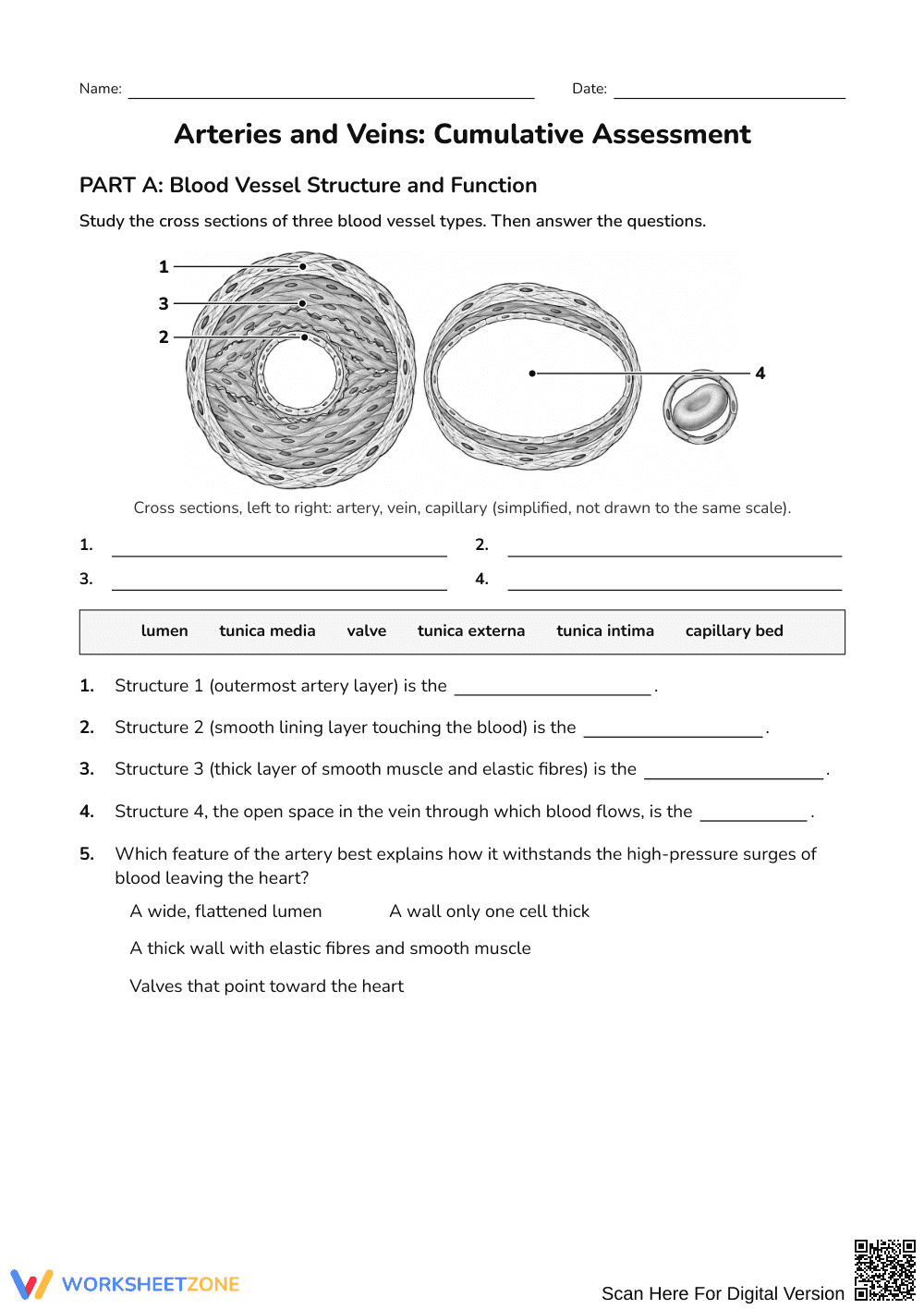
This science assessment evaluates student understanding of blood vessel anatomy, systemic and pulmonary circulation, and hemodynamic pressure gradients. Designed for middle and early high school life science courses, the 4-page worksheet requires students to analyze histological diagrams, evaluate circulation models, and interpret systemic blood pressure data.
At a Glance
- Grade: Grades 6–10 · Subject: Science
- Standard: Relate vessel structure to function and analyze circulatory blood pressure data
- Skill Focus: Arteries, veins, capillaries, double circulation, and pressure mechanics
- Format: 4 pages · 34 problems · Answer key included · PDF
- Best For: Cumulative end-of-unit assessment
- Time: 45–60 minutes
This 4-page assessment delivers 34 structured questions across three distinct sections. Part A explores vessel histology using cross-sectional diagrams of the tunica externa, media, intima, and lumen. Part B examines double circulation pathways and model conventions. Part C presents systemic blood pressure graph data alongside analytical free-response prompts and a complete 4-page answer key.
Skill Progression
- Guided practice (Part A, 12 items): Students identify vessel wall layers and connect anatomical structures, like elastic fibers and single-cell capillary walls, to functional roles.
- Supported practice (Part B, 10 items): Students trace pulmonary versus systemic loops and critique color-coding conventions using directional flow definitions.
- Independent practice (Part C, 12 items): Students analyze a 92 mmHg pressure decline across systemic vessels to explain venous valve function.
This gradual-release structure advances students from anatomical diagram identification to evidence-based physiological synthesis.
Standards Alignment
This assessment aligns with life science standards governing organ systems and structure-function relationships in multicellular organisms. Students interpret quantitative hemodynamic data to explain how specialized tissues maintain equilibrium. Standard benchmarks can be copied directly into lesson plans, IEP goals, or district curriculum mapping tools.
How to Use It
Administer this assessment as a summative exam following cardiovascular instruction, allowing 45 to 60 minutes for completion. Alternatively, divide it into three distinct class warm-ups. During testing, check whether students define pulmonary arteries by directional flow rather than oxygenation, identifying misconceptions before moving forward.
Who It's For
This resource serves general middle school life science and introductory high school biology students. Teachers can differentiate by providing an anatomical word bank for the tunic layers or pre-annotating the pressure graph. Pair this test directly with a sheep heart dissection or vascular microscopy lab.
Fisher & Frey (2014) emphasize that structured gradual-release instructional frameworks significantly improve secondary student retention of complex biological concepts by systematically bridging guided diagram analysis and independent empirical problem-solving. This comprehensive 34-task assessment applies that research-backed progression by guiding students from cross-sectional vessel anatomy through double circulation mechanics directly to systemic blood pressure data interpretation. By requiring students to explain physiological mechanisms using quantitative hemodynamic data—such as evaluating the steep pressure decline from large arteries through capillaries—the assessment fosters authentic analytical reasoning rather than superficial memorization. Empirical research findings confirm that combining structural anatomical models with quantitative data interpretation solidifies robust conceptual schemas across secondary science classrooms. Educators can utilize this rigorous 4-page assessment to obtain actionable diagnostic evidence of student mastery, ensuring all learners develop foundational scientific competency for advanced biological and physiological coursework.


