



























Complete Arteries & Veins Worksheet | Grades 6–10 Science
Paste this activity's link or code into your existing LMS (Google Classroom, Canvas, Teams, Schoology, Moodle, etc.).
Students can open and work on the activity right away, with no student login required.
You'll still be able to track student progress and results from your teacher account.
This comprehensive circulatory system worksheet guides secondary students through the foundational structures, functions, and comparative anatomy of arteries, veins, and capillaries. Through 28 focused tasks, learners identify key anatomical layers, analyze pressure graphs, and dismantle common misconceptions about blood oxygenation to achieve lasting conceptual understanding in human body systems.
At a Glance
- Grade: Grades 6–10 · Subject: Science
- Standard: Structure and function of human circulatory system vessels and blood transport
- Skill Focus: Arteries, veins, and capillaries structure-function relationships
- Format: 4 pages · 28 problems · Answer key included · PDF
- Best For: Initial instruction or targeted biology review
- Time: 40–50 minutes
What's Inside
This 4-page student activity contains six distinct practice sections covering vessel histology, directional flow, and hemodynamics. Resources include a contextual vocabulary bank, matching exercises, cross-sectional anatomical diagrams, a comparative feature matrix, an evidence-based misconception analysis, and a resting blood pressure line evaluation complete with a full four-page teacher answer key.
Skill Progression
- Guided practice (Tasks 1–11): Students define foundational terminology using an anchor word bank and match major anatomical structures, including the tunica intima, tunica media, and aorta, to descriptive functions.
- Supported practice (Tasks 12–16): Learners label detailed cross-sectional models of arteries, veins, and capillaries, distinguishing wall thickness and lumen diameter before classifying comparative physiological features.
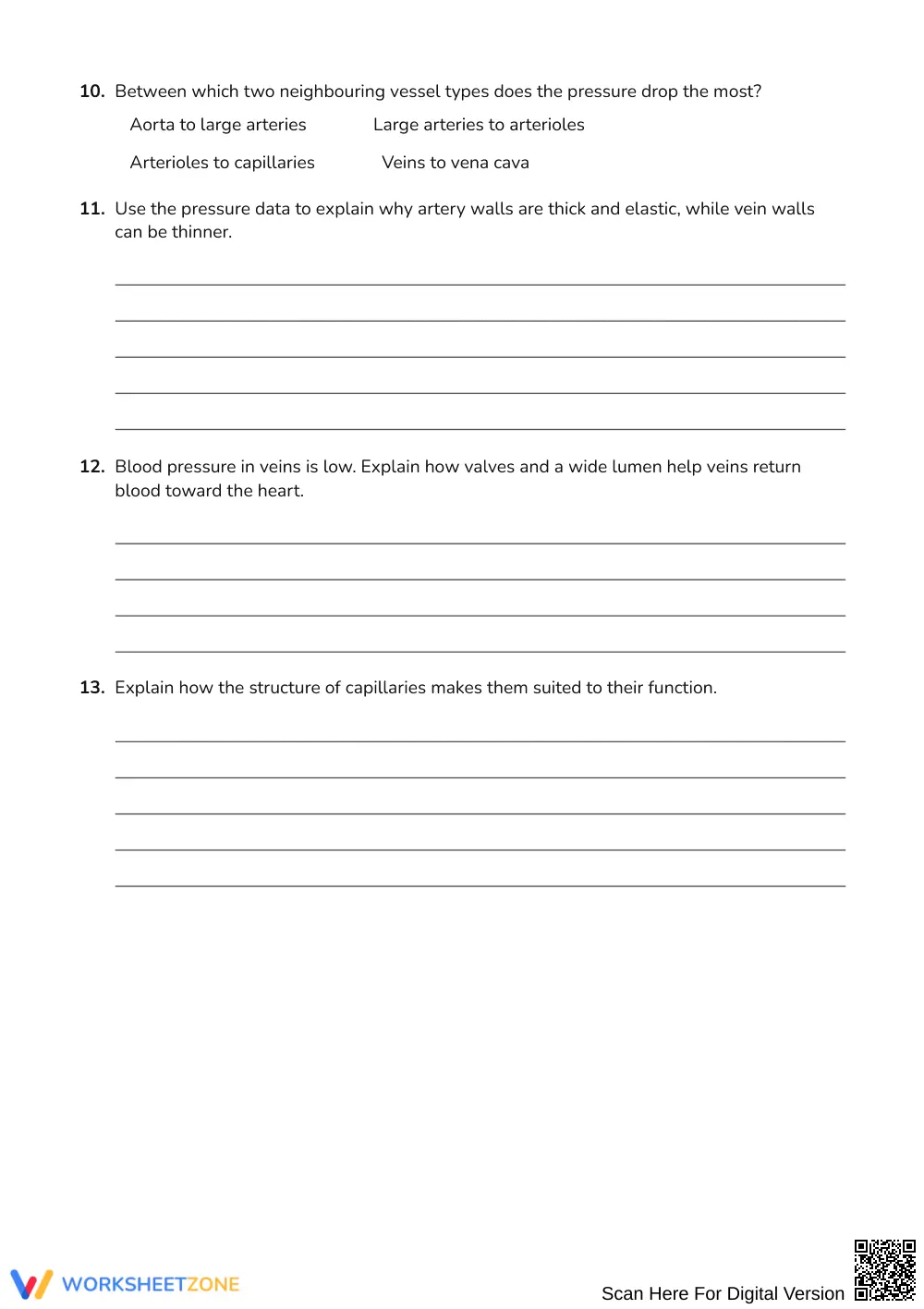
- Independent practice (Tasks 17–28): Students debunk the persistent myth that vessel type depends on oxygenation, evaluate real-world resting pressure gradients, and compose explanatory arguments connecting capillary wall thickness to cellular diffusion.
This structure follows an explicit gradual-release model, shifting students smoothly from scaffolded recall to independent data interpretation.
Standards Alignment
This resource supports middle and high school life science standards focusing on how specialized cells and tissues within organ systems interact to perform vital life functions. Students relate microscopic tissue adaptations directly to whole-body circulation and transport. These structural concepts can be copied directly into lesson plans, IEP goals, or district curriculum mapping tools.
How to Use It
Introduce this activity during direct instruction on the circulatory system or as a formative mid-unit checkpoint. During student independent work, circulate to observe responses on Part E; identify students confusing vessel direction with oxygen saturation and prompt them to trace blood flow through the pulmonary circuit. The full set takes approximately 40 to 50 minutes to complete.
Who It's For
Designed for middle school life science and introductory high school biology courses, this print-ready resource offers built-in vocabulary scaffolds for English learners and striving readers. Pair this activity directly with a whole-class circulatory diagram or microviewer lab exploring real vascular tissue slides.
According to Fisher & Frey (2014), structured practice that moves systematically from foundational vocabulary acquisition to evidence-based graphical evaluation accelerates conceptual mastery in secondary science classrooms. By requiring students to analyze anatomical diagrams, interpret physiological blood pressure metrics, and correct persistent circulatory misconceptions using pulmonary vessels, this 28-task practice packet strengthens higher-order analytical reasoning. Learners directly connect microscopic structural properties, such as single-cell capillary walls and tunica media elasticity, to macroscopic circulatory performance. The multi-tiered sequence of scaffolded matching, anatomical diagram labeling, and data-driven short responses ensures that students synthesize complex biological terminology into durable conceptual frameworks, providing measurable diagnostic evidence of student readiness for advanced physiological coursework.


