


























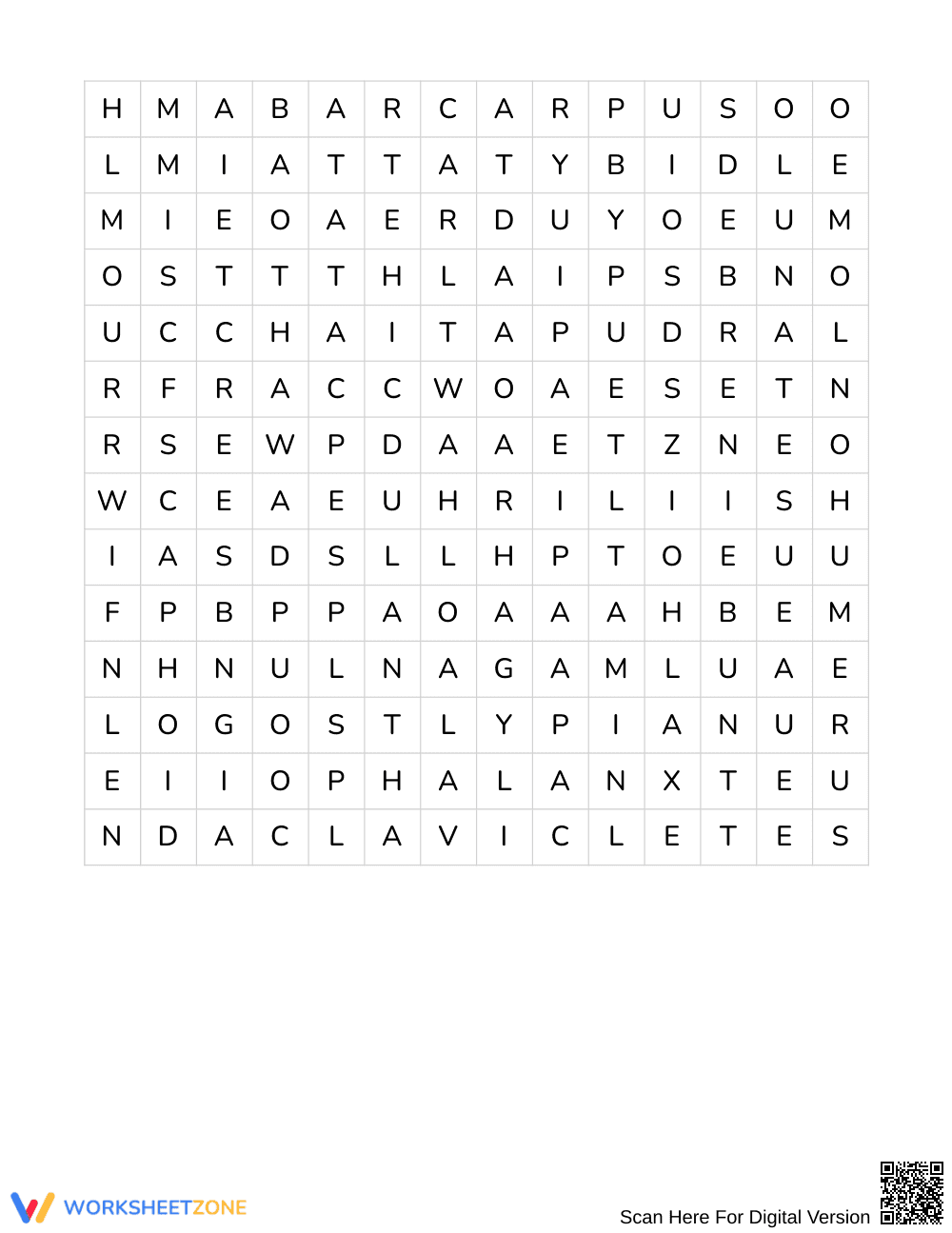

Complete Arm & Hand Bones Word Search | Grades 3–4 Science
Paste this activity's link or code into your existing LMS (Google Classroom, Canvas, Teams, Schoology, Moodle, etc.).
Students can open and work on the activity right away, with no student login required.
You'll still be able to track student progress and results from your teacher account.
This Grades 3–4 skeletal system word search reinforces anatomical vocabulary by challenging students to locate 12 foundational arm and hand bone terms. Organized around anatomical regions, this printable activity builds structural awareness and strengthens spelling retention while introducing young learners to upper-extremity anatomy through self-directed puzzle solving.
At a Glance
- Grade: Grades 3–4 · Subject: Science
- Standard: Not standards-assessed — vocabulary enrichment
- Skill Focus: Arm and hand bones
- Format: 2 pages · 12 words · Answer key included · PDF
- Best For: Anatomy vocabulary practice or sub plans
- Time: 15–25 minutes
What's Inside
This 2-page science resource features a cleanly laid out puzzle grid paired with a categorized word bank and an anatomical reference list. Students track down 12 specific bone terms grouped by anatomical region: Shoulder Girdle, Upper Arm, Forearm, and Wrist & Hand. A complete 3-page answer key clearly highlights every hidden term for fast verification.
Puzzle Mechanics
The puzzle utilizes a spacious 14 × 14 letter grid configured specifically for intermediate elementary learners. All 12 hidden terms run in three accessible orientations: east (left-to-right), southeast (diagonal down-right), and south (top-to-bottom). Words never run backwards, keeping search frustration low while reinforcing standard left-to-right reading patterns. The categorized word bank groups bones by bodily region, helping students connect individual terms such as the humerus, radius, and phalanges to their physical locations.
Standards Alignment
This activity serves as dedicated vocabulary enrichment and is not aligned to an assessed state science standard. It enriches elementary human body units by introducing domain-specific anatomical terminology in an engaging, low-stakes puzzle format.
How to Use It
Deploy this word search during an introductory human body unit or after direct instruction on the human skeleton. It works exceptionally well as a quiet warm-up, an independent science station, or an effortless emergency sub plan. For a formative check, pause after 10 minutes and have students point to their own clavicle or radius before continuing. Most students complete the activity within 15 to 25 minutes.
Who It's For
Designed for Grades 3–4 science classrooms, this activity supports general education students, curious young scientists, and visual learners who benefit from word immersion. Pair this printable with a labeled skeleton diagram or an interactive arm-model lesson to deepen anatomical understanding.
Structured vocabulary enrichment accelerates domain-specific language acquisition in elementary science classrooms. According to Fisher & Frey (2014), intentional exposure to technical terminology within organized categorical frameworks enhances conceptual retention and improves reading comprehension across informational texts. This printable word search introduces 12 distinct arm and hand bones across a 14 × 14 grid, utilizing forward and diagonal pathways to reinforce letter sequencing and spatial awareness. By organizing target vocabulary into anatomical regions such as the shoulder girdle, forearm, and wrist, the resource bridges early anatomical recognition and spelling accuracy. The inclusion of full-page answer keys ensures self-checking efficiency and low teacher overhead, establishing an engaging supplementary resource that solidifies foundational life science knowledge for third and fourth grade students without requiring instructional prep.


