


























Views
Downloads


Complete Argument Transitions Worksheet | Grade 6 ELA
Paste this activity's link or code into your existing LMS (Google Classroom, Canvas, Teams, Schoology, Moodle, etc.).
Students can open and work on the activity right away, with no student login required.
You'll still be able to track student progress and results from your teacher account.
This Grade 6 argumentative writing worksheet guides middle school writers to logically connect claims, reasons, and conclusions using purposeful transitional words and clauses. Working from a campus news report, students evaluate conflicting viewpoints, select cohesive connectors, and draft a well-supported 180-to-240-word persuasive letter to a school council.
At a Glance
- Grade: 6 · Subject: ELA
- Standard:
W.6.1.c— Use words, phrases, and clauses to clarify relationships among claims and reasons.- Skill Focus: Connect Claims, Reasons, and Conclusions
- Format: 5 pages · 8 problems · Full 4-page answer key included · PDF
- Best For: Argumentative transition practice and revision
- Time: 40–50 instructional minutes
What's Inside
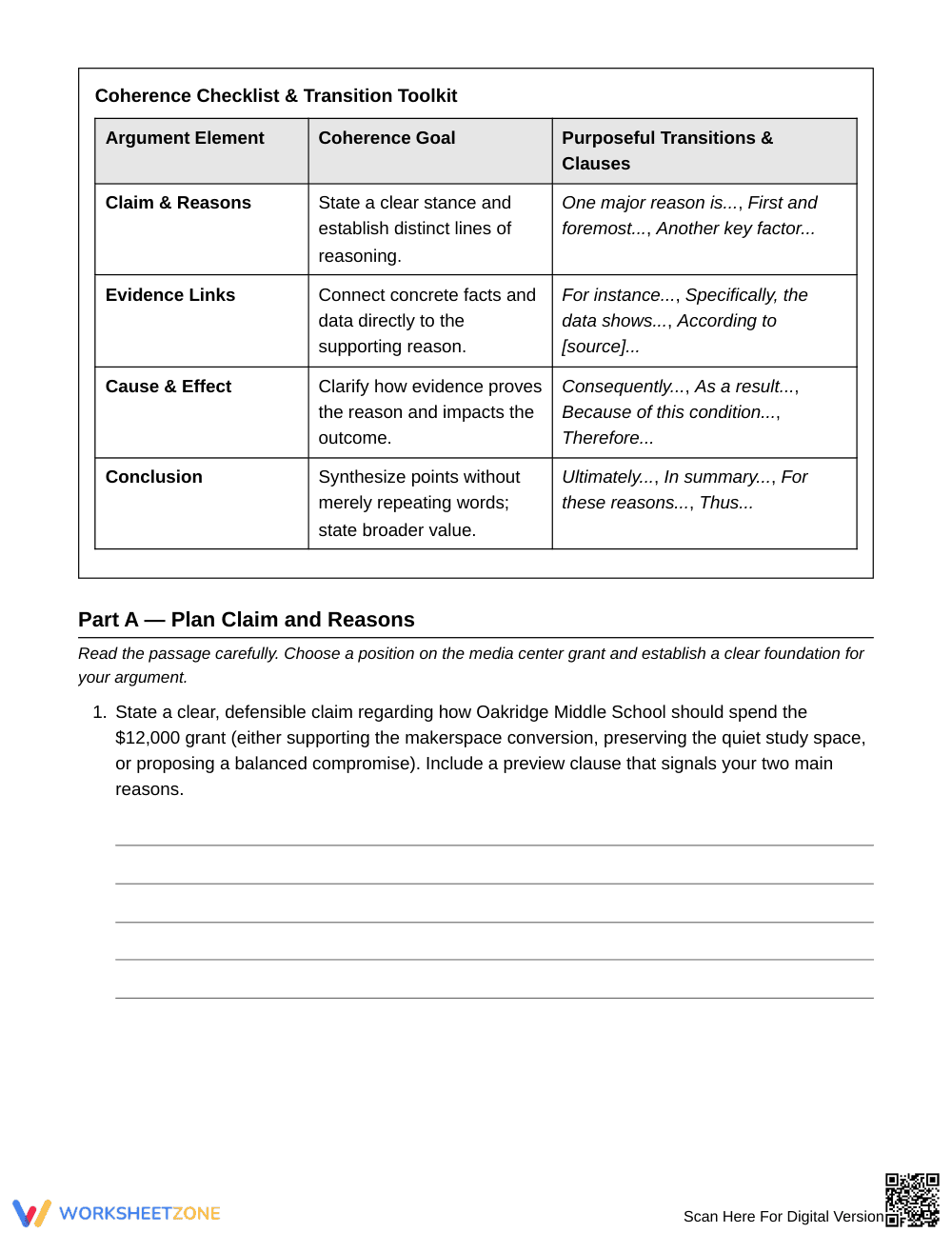
This 5-page resource features a news report on a media center grant alongside a Coherence Checklist and Transition Toolkit. Across 8 sequential tasks, students analyze evidence, select transitions, repair choppy sentences, and compose an argument. A comprehensive 4-page answer key provides complete writing models and explanations.
Skill Progression
- Guided practice (Tasks 1–2): Students analyze the text, establish a claim with preview clauses, and plan two supporting reasons.
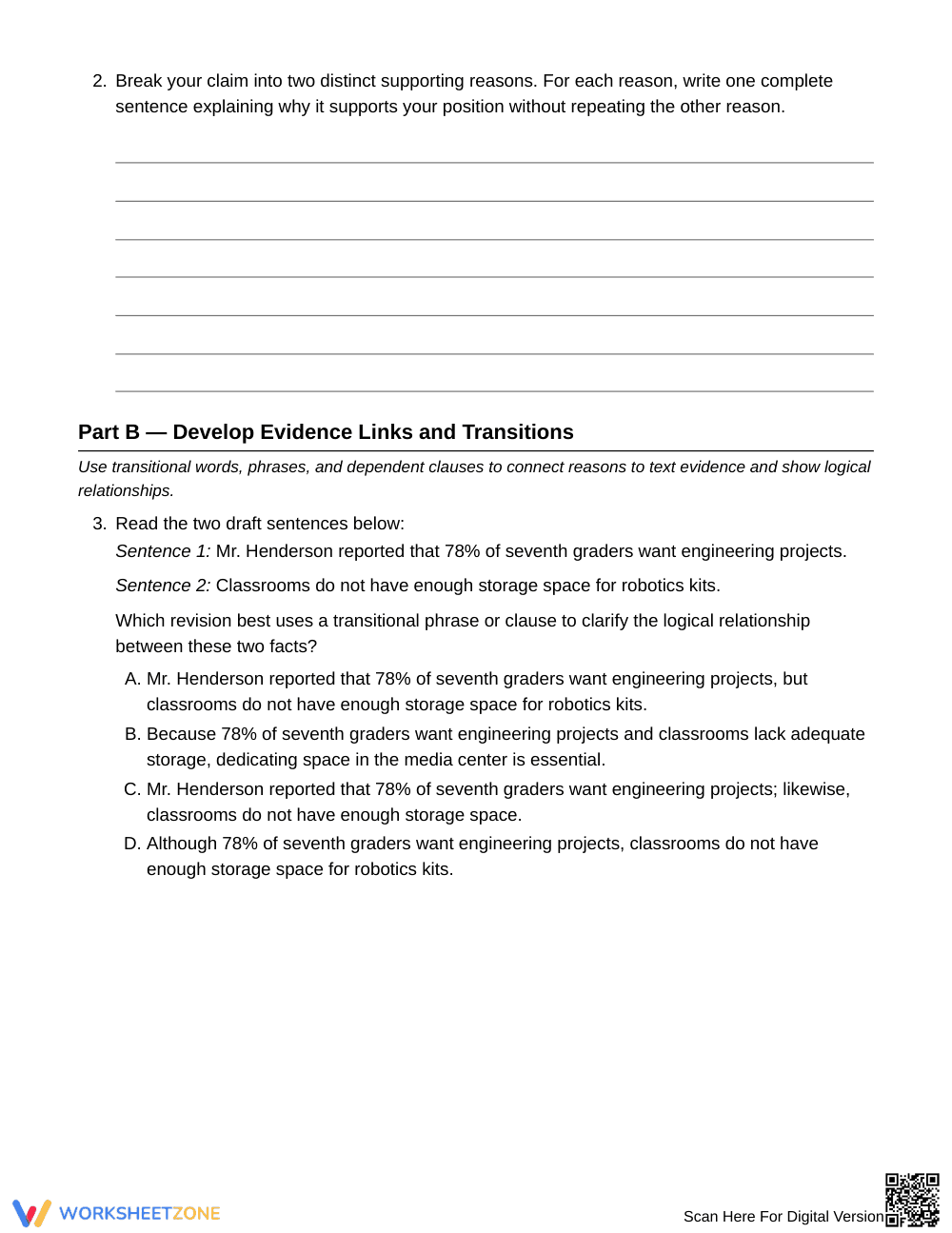
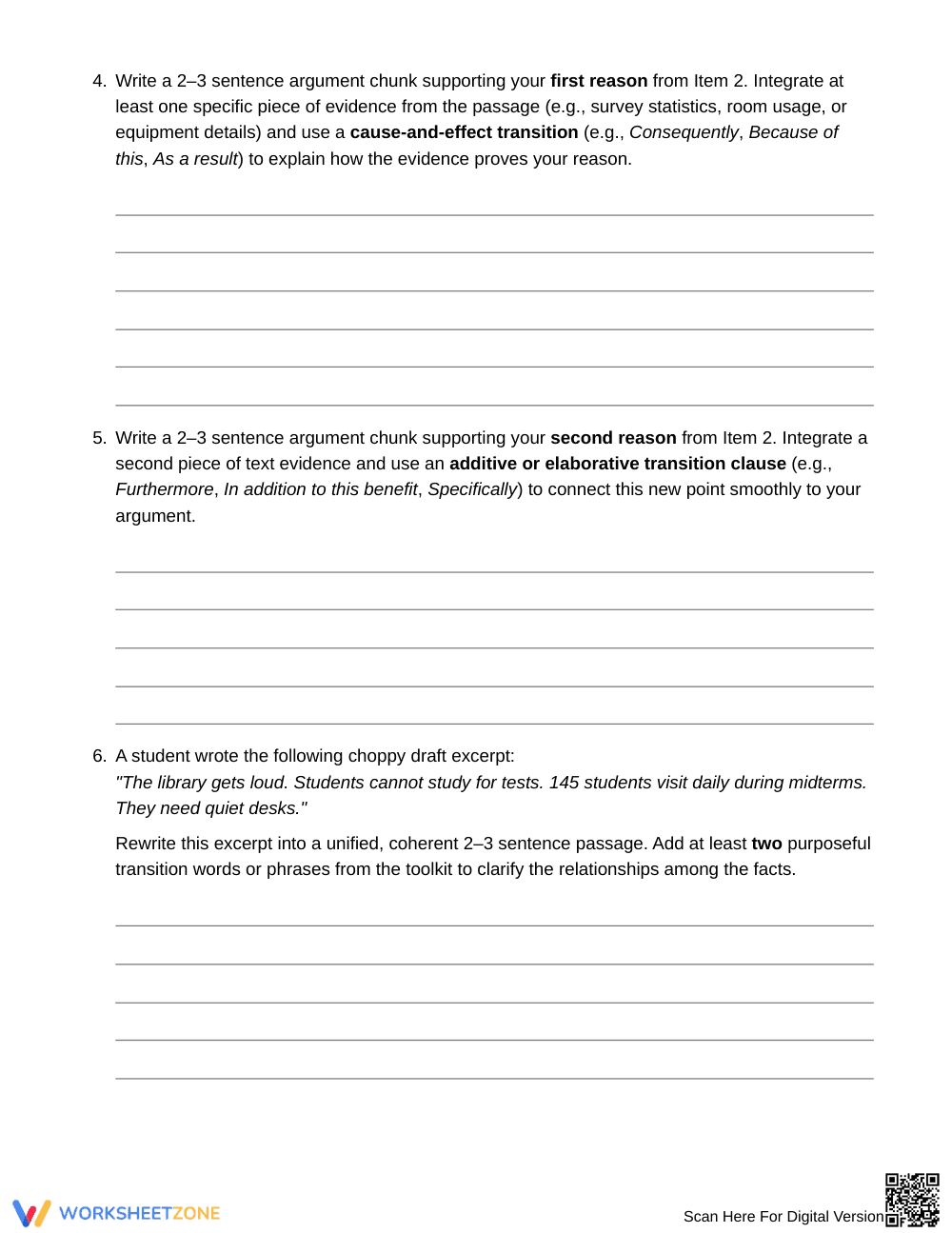
- Supported practice (Tasks 3–6): Learners identify logical connectors, write transition-linked evidence chunks, and revise choppy prose using the toolkit.
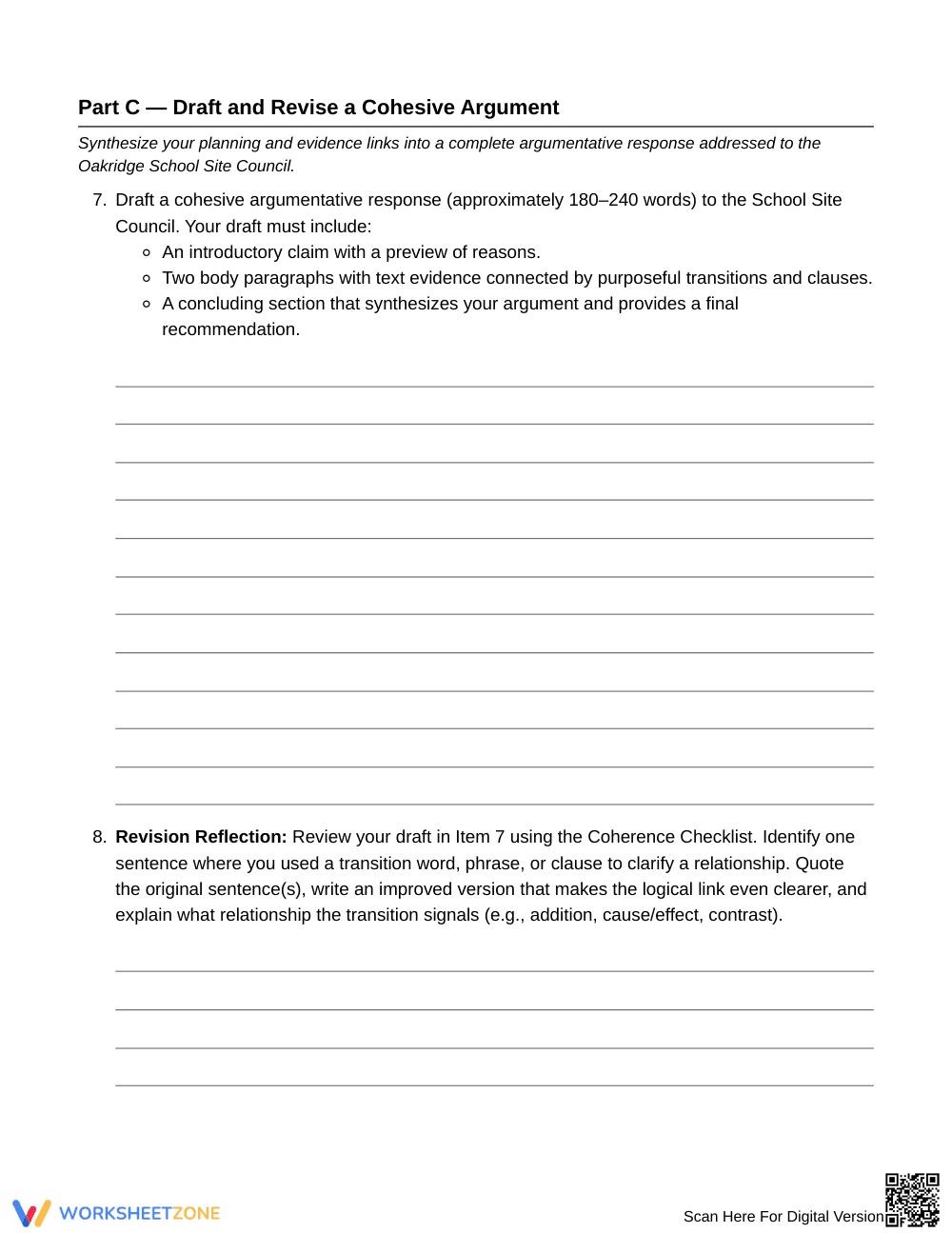
- Independent practice (Tasks 7–8): Writers draft a cohesive 180-to-240-word argument and complete a transition revision reflection.
This structure follows the gradual release of responsibility model from direct scaffolding to independent synthesis.
Standards Alignment
This worksheet directly aligns with W.6.1.c by requiring students to use transitional words, phrases, and clauses to clarify relationships between claims and reasons. It also supports W.6.1.a by guiding students to organize clear claims with supporting evidence. Both standard codes can be copied directly into lesson plans, IEP goals, or district curriculum mapping tools.
How to Use It
Use this worksheet during the drafting stage of an argumentative writing unit. Before students work independently, model Part B by combining sample facts with cause-and-effect transitions. During writing, verify that students select transitions matching the logical relationship between ideas rather than inserting words arbitrarily. The full activity requires 40 to 50 instructional minutes.
Who It's For
This worksheet serves Grade 6 ELA students developing persuasive writing skills. The categorized transition toolkit provides vital differentiation for English learners and students with IEP goals. Pair this practice directly with a mentor text analysis or an argumentative graphic organizer.
Explicit instruction in cohesive writing devices directly supports standard W.6.1.c by teaching students how to use words, phrases, and clauses to clarify logical relationships between claims and reasons. Grounded in the gradual release of responsibility framework synthesized by Fisher & Frey (2014), this instructional resource moves Grade 6 learners from guided text analysis to independent argumentative drafting. The progression begins with clear organizational modeling, advances through deliberate transition combining, and concludes with authentic persuasive synthesis. By integrating explicit sentence stems and an analytical revision reflection, the resource targets the common middle-school writing hurdle where students list factual evidence without clarifying its logical connection to the overarching claim. Research confirms that structured scaffolding, paired with immediate formative feedback on transitional clauses, substantially accelerates adolescent writing proficiency, reading-writing synthesis, and argumentative coherence across diverse educational settings and standardized assessment formats.


