

































Complete Argument-Reasoning Worksheet | Grade 10

Paste this activity's link or code into your existing LMS (Google Classroom, Canvas, Teams, Schoology, Moodle, etc.).
Students can open and work on the activity right away, with no student login required.
You'll still be able to track student progress and results from your teacher account.
This six-page worksheet sharpens Grade 10 students' ability to evaluate reasoning validity, evidence sufficiency, and logical fallacies within two conflicting informational texts about secondary school start times. Students move from identifying central claims and classifying evidence through analyzing causal logic and false dilemmas to synthesizing a balanced, fallacy-free argument of their own.
At a Glance
- Grade: 10 · Subject: English II
- Standard:
RI.9-10.8— Evaluate the argument and specific claims in a text, assessing reasoning validity and evidence sufficiency- Skill Focus: Argument-Reasoning Check (claims, evidence, fallacies, synthesis)
- Format: 6 pages · 12 problems · Answer key included · PDF
- Best For: Guided practice after direct instruction
- Time: 35–50 minutes
What's Inside
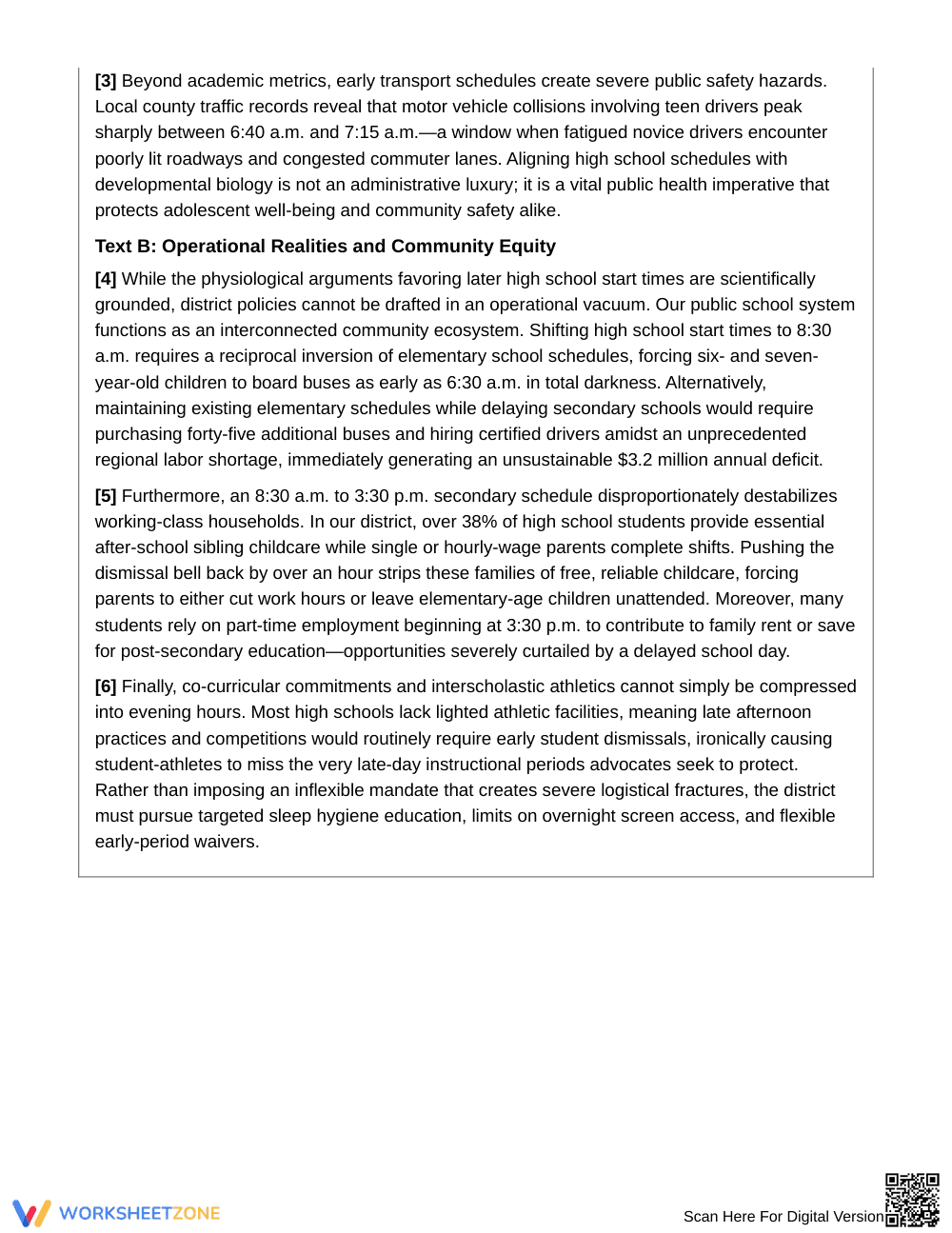
Students read two paired argumentative passages: one advocating for adolescent biological sleep schedules and another detailing operational transportation challenges. The resource contains 12 structured tasks organized across three distinct sections. A reference box defines valid reasoning, sufficient evidence, faulty causality, and false dilemmas. A three-column table scaffolds evidence classification, and a comprehensive three-page answer key provides thorough model responses for every item.
Skill Progression
- Guided practice (Part A, 3 tasks): Students identify central claims from given options and sort evidence statements into empirical data or systemic constraints using a structured graphic organizer.
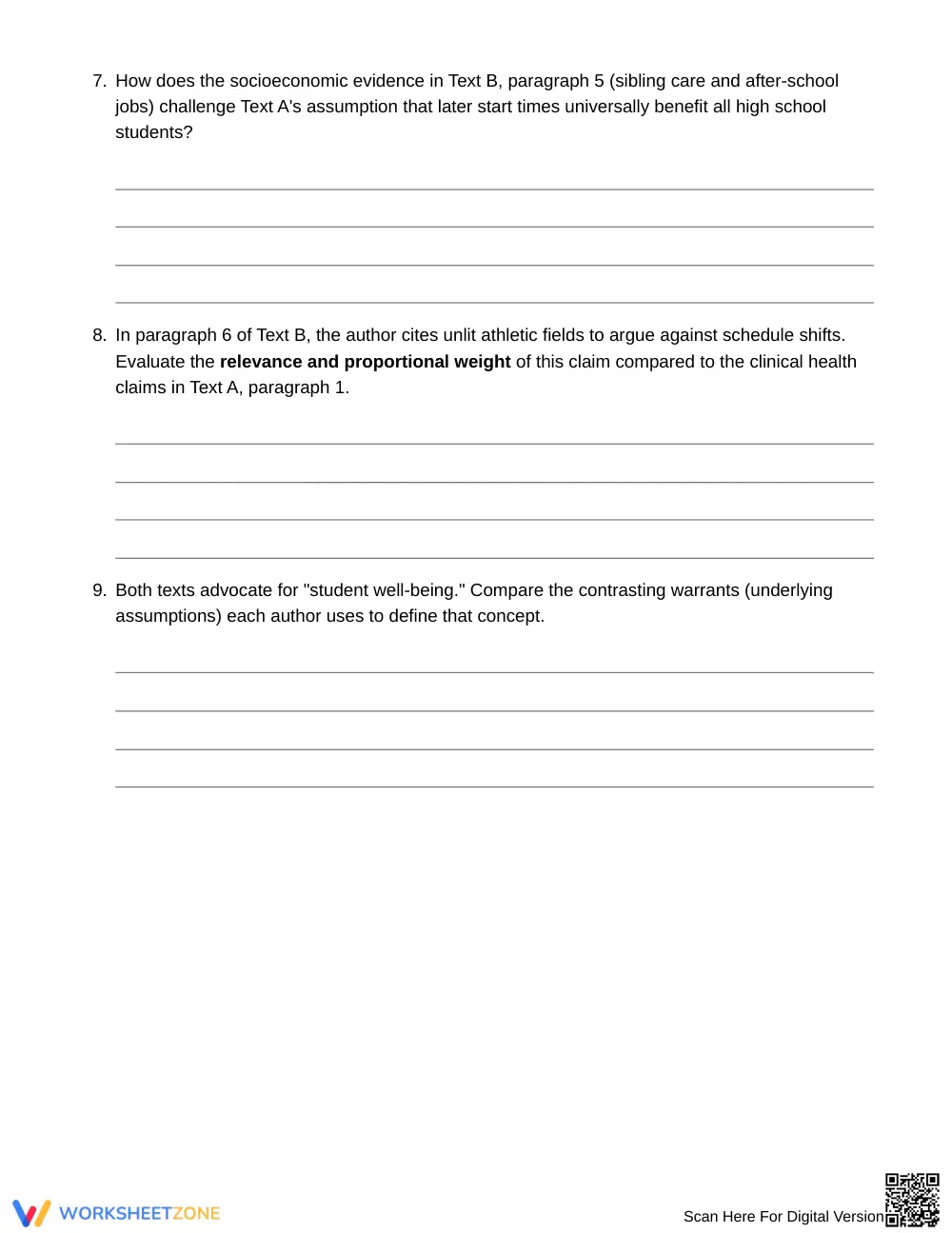
- Supported practice (Part B, 6 tasks): Learners evaluate evidence relevance, identify confounding variables in causal claims, locate specific fallacies, and evaluate warrants with scaffolded question stems and paragraph references.
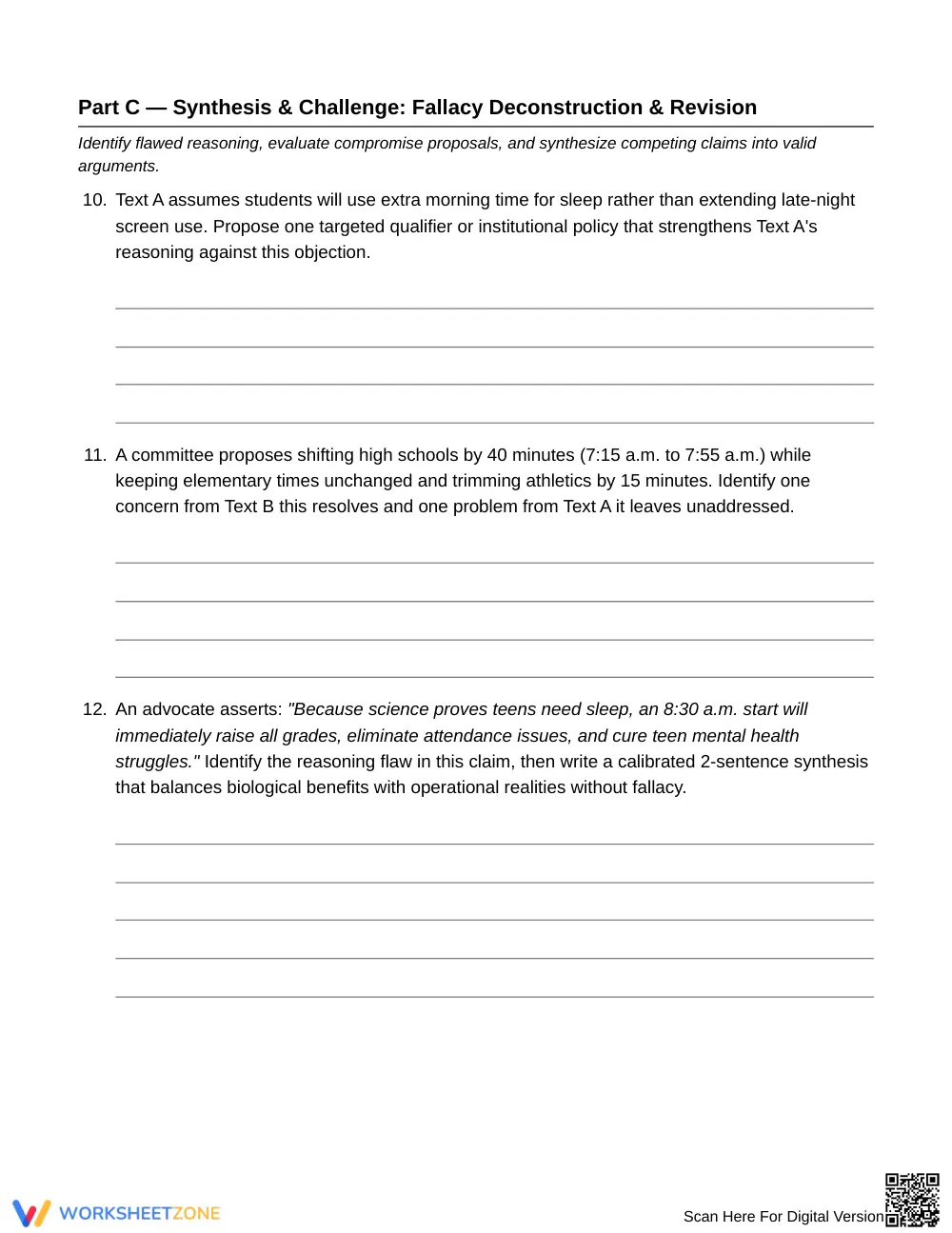
- Independent practice (Part C, 3 tasks): Students craft qualifiers to strengthen weakened claims, review compromise policies against both perspectives, and write a clear two-sentence synthesis free of logical errors.
How to Use It
Administer this printable packet following direct instruction on argumentative structures and rhetorical fallacies. Use Part A as a fast formative checkpoint before releasing students to independent analysis. Parts A and B function well during a 45-minute class period, leaving Part C for an exit ticket or homework assignment. The embedded reference box supports diverse learners, while the open synthesis prompts offer meaningful extension for advanced writers.
This Grade 10 worksheet targets RI.9-10.8, requiring students to delineate and evaluate arguments by assessing reasoning validity, evidence relevance, and the presence of logical fallacies such as false dilemma and faulty causality. Across 12 tasks, students classify evidence, identify confounding variables, and synthesize competing claims into balanced, logically sound arguments. Research from Fisher and Frey (2014) confirms that a gradual-release instructional model moving from guided identification to independent synthesis produces significantly stronger analytical writing outcomes than isolated skill drills. The worksheet architecture embeds this exact progression: foundational classification, scaffolded evaluation, and independent construction. By requiring students to name specific fallacies and propose qualifiers rather than simply labeling arguments as strong or weak, the resource builds the precise evaluative vocabulary that standardized assessments and college composition courses demand. A complete answer key supports consistent scoring and self-assessment across secondary classrooms.


