

































Complete Anti-Closure Worksheet | Grade 12 English IV

Paste this activity's link or code into your existing LMS (Google Classroom, Canvas, Teams, Schoology, Moodle, etc.).
Students can open and work on the activity right away, with no student login required.
You'll still be able to track student progress and results from your teacher account.
This Grade 12 English IV worksheet guides students to analyze how authors manipulate literary architecture to resist narrative closure. Through rigorous examination of conflicting transcripts and unvoiced recollections, high school seniors evaluate how unresolved structures withhold moral catharsis, illuminate institutional culpability, and position readers as active evaluators of historical truth.
At a Glance
- Grade: 12 · Subject: English IV
- Standard:
RL.11-12.5— Analyze how an author's choices concerning text structure create aesthetic impact and meaning- Skill Focus: Explain a Structural Choice That Prevents Closure
- Format: 6 pages · 8 complex tasks · Complete 3-page answer key · PDF
- Best For: Advanced literary analysis and synthesis practice
- Time: 45–60 instructional minutes
What's Inside
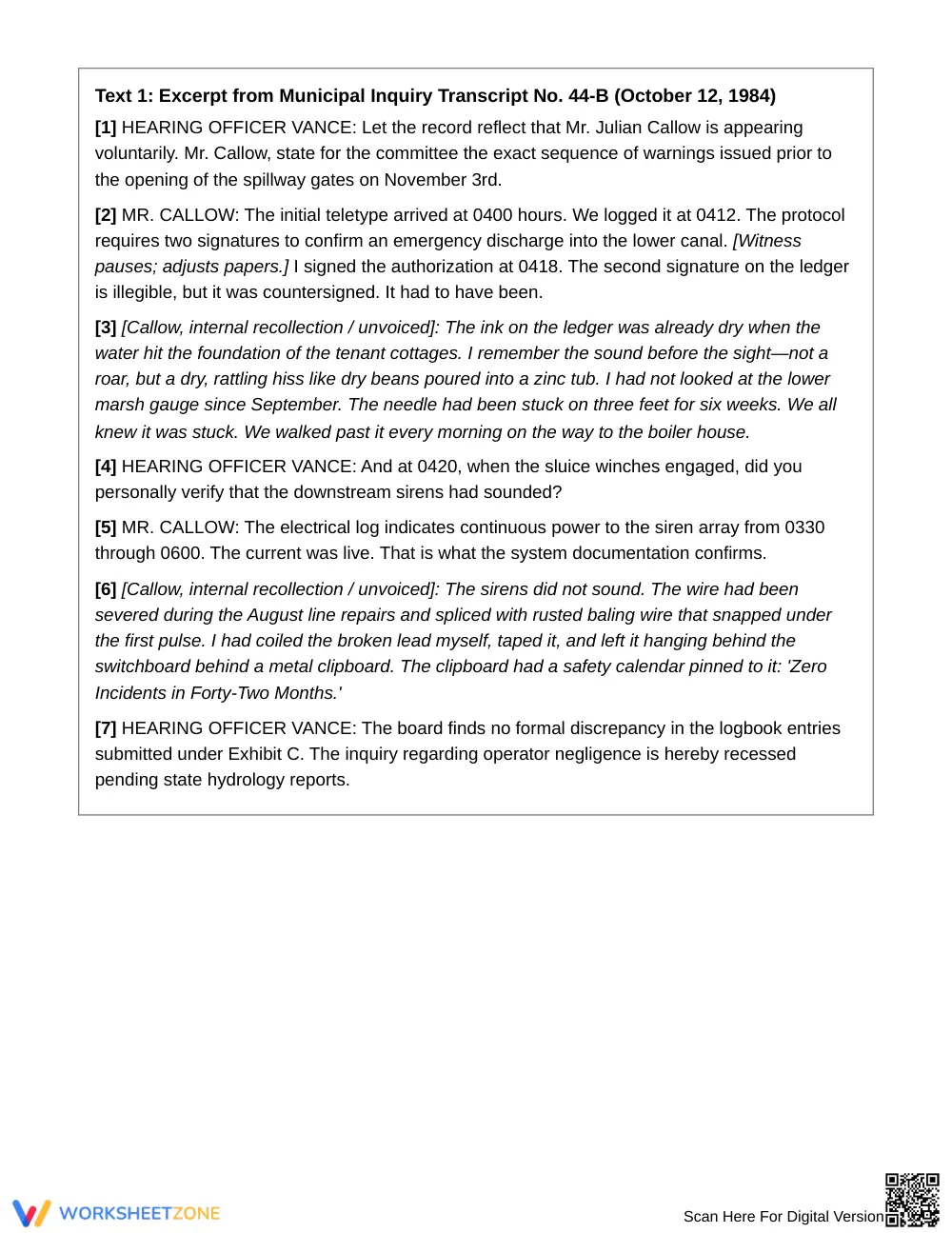
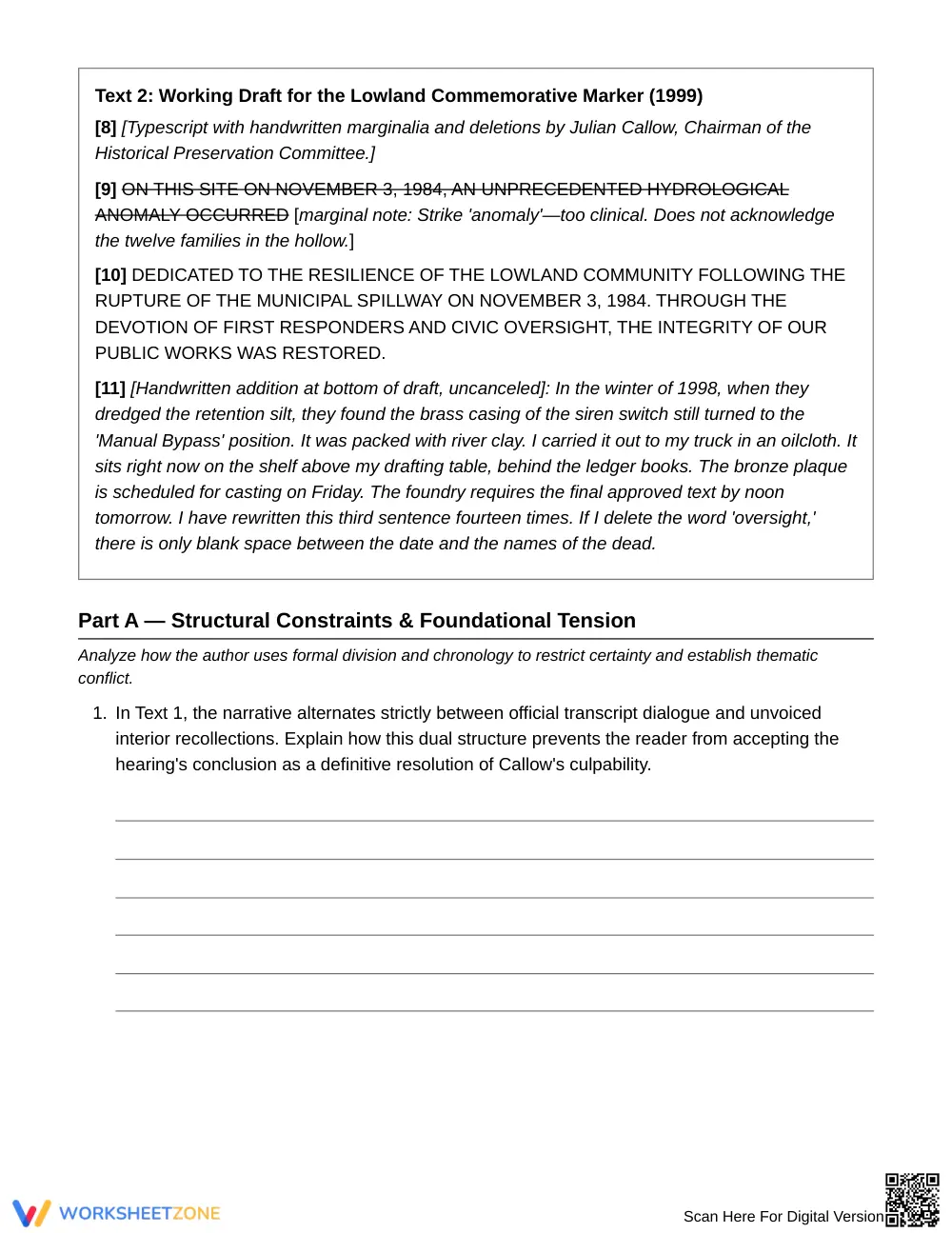
This 6-page instructional resource features an anchor Critical Framework on anti-closure and juxtaposition, followed by two paired literary artifacts: an official 1984 municipal inquiry transcript with unvoiced recollections, and a 1999 draft memorial plaque with handwritten marginalia. Students navigate 8 analytical tasks, including counterfactual structural tests and qualified thesis defenses, supported by a 3-page explanatory answer key.
Skill Progression
- Guided practice: Part A provides 2 tasks where students analyze formal division, identifying how chronological gaps and dual-voice framing restrict certainty.
- Supported practice: Part B presents 4 counterfactual testing tasks to evaluate how structural alterations—such as third-person narration or omitted marginalia—transform thematic meaning.
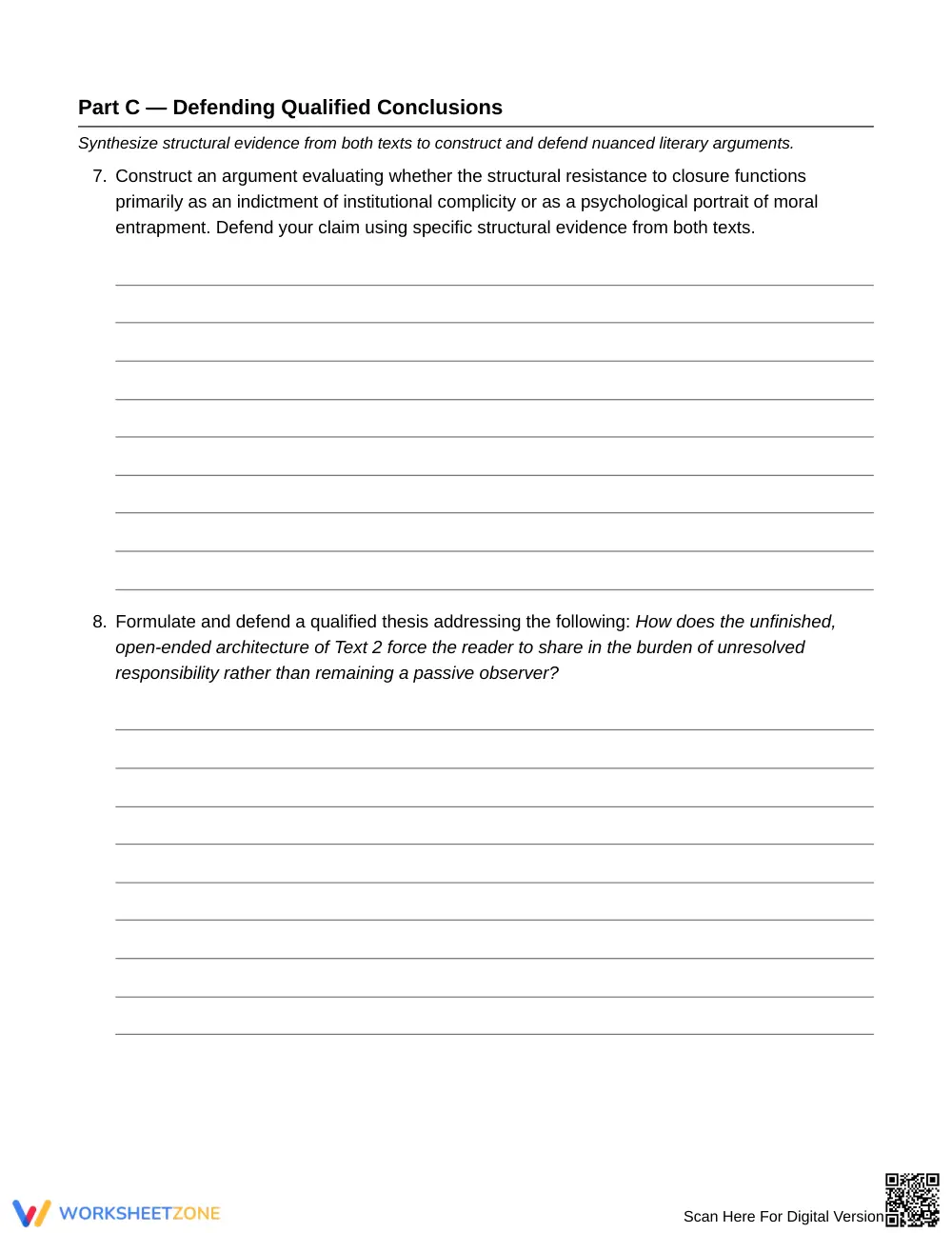
- Independent practice: Part C tasks students with 2 synthesis prompts, constructing defensible qualified arguments that evaluate institutional complicity versus psychological entrapment.
This sequence utilizes a gradual-release framework, transitioning students from structural identification to qualified evaluative argument.
Standards Alignment
This worksheet aligns directly to `RL.11-12.5`: Analyze how an author's choices concerning text structure create aesthetic impact and meaning. The writing prompts also support `W.11-12.1` by requiring students to defend qualified claims using precise textual evidence. Both standard codes can be copied directly into lesson plans, IEP goals, or district curriculum mapping tools.
How to Use It
Assign this resource after direct instruction on modern text structures to deepen analytical writing during close-reading units. Alternatively, use it as a formative assessment during a unit on non-linear narratives. During classwork, observe whether students identify Julian Callow's unvoiced confessions as structural subversions rather than simple dialogue. Completion requires 45 to 60 minutes.
Who It's For
This resource serves Grade 12 English IV and Advanced Placement Literature students mastering complex structural analysis. Scaffold counterfactual testing in Part B with small-group discussions for developing readers, while challenging advanced students to compose extended comparative essays. Pair this worksheet with modernist fiction, fragmented post-war drama, or investigative nonfiction memoirs.
According to Fisher & Frey (2014), gradual release instructional frameworks substantially deepen secondary students' comprehension of complex literary architecture by scaffolding text-dependent analysis into incremental cognitive tiers. This 6-page English IV curriculum resource operationalizes standard RL.11-12.5 by guiding Grade 12 learners through 8 rigorous tasks focused on analyzing structural choices that prevent narrative closure. By interacting with juxtaposed administrative transcripts and fractured personal reflections, students evaluate how deliberate formal disjunctions withhold moral resolution and force ongoing reader inquiry. The scaffolded progression shifts learners from foundational structural tension identification to advanced counterfactual testing and qualified argumentative defense. Supported by a comprehensive 3-page explanatory answer key, the worksheet provides teachers with a precise formative measurement tool to assess how effectively twelfth-grade students evaluate the aesthetic impact and moral consequences of complex narrative design.


