































Complete 3D Nets Error Repair Worksheet | Grade 6 Math

Paste this activity's link or code into your existing LMS (Google Classroom, Canvas, Teams, Schoology, Moodle, etc.).
Students can open and work on the activity right away, with no student login required.
You'll still be able to track student progress and results from your teacher account.
This geometry worksheet trains Grade 6 students to analyze defective two-dimensional nets, diagnose folding failures such as overlapping faces and missing bases, and write exact geometric repairs. Students build spatial reasoning by evaluating cubes, rectangular prisms, triangular prisms, and pyramids to ensure all faces connect properly into closed three-dimensional polyhedra.
At a Glance
- Grade: 6 · Subject: Math
- Standard:
6.G.A.4— Represent three-dimensional figures using nets made up of rectangles and triangles- Skill Focus: Correct Overlap and Missing-Face Errors
- Format: 5 pages · 10 problems · Answer key included · PDF
- Best For: Geometry error analysis and guided practice
- Time: 40–50 minutes
What's Inside
The 5-page printable resource contains 10 rigorous error-analysis tasks distributed across three geometric families. A detailed reference box provides visual diagrams illustrating valid fold lines alongside defective nets. The 3-page comprehensive answer key includes full verbal explanations, step-by-step repair directions, and precise dimensional measurements for every missing face.
Skill Progression
- Guided Practice (Problems 1–4): Focuses on cubes and right rectangular prisms with provided edge lengths, walking students through face-tracking to identify overlapping flaps and open bases.
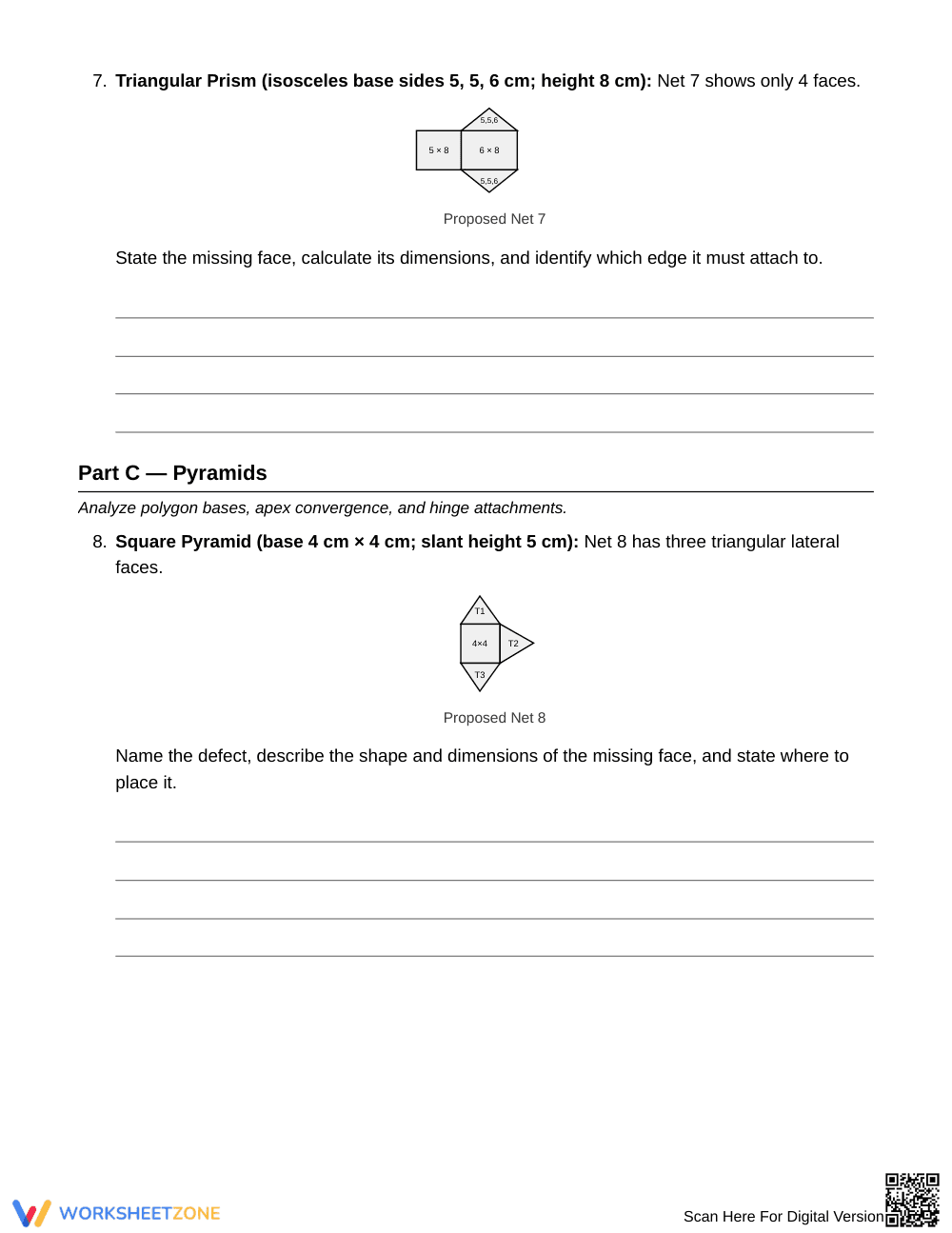
- Supported Practice (Problems 5–7): Advances to triangular prisms, requiring learners to verify base correspondence, check perimeter edge-length alignments, and calculate missing rectangular face dimensions.
- Independent Practice (Problems 8–10): Challenges students with square pyramids, regular tetrahedrons, and rectangular pyramids where they resolve apex collisions, point-vertex errors, and slanted-edge misalignments.
This structured progression uses a gradual-release model that moves students from basic prism inspection to complex polyhedral reasoning.
Standards Alignment
Primary Standard: `6.G.A.4` — Represent three-dimensional figures using nets made up of rectangles and triangles, and use the nets to find the surface area of these figures. Students apply these techniques in the context of solving real-world and mathematical problems. This standard code can be copied directly into lesson plans, IEP goals, or district curriculum mapping tools.
How to Use It
Assign this activity directly after initial instruction on three-dimensional solids and net representations. During independent or partner work, circulate the classroom to observe whether students mentally track folding paths or struggle to identify corresponding seam lengths. Expect students to complete the 10 tasks in 40 to 50 minutes.
Who It's For
This resource is designed for Grade 6 general mathematics classes, remedial geometry small groups, and students needing targeted spatial reasoning intervention. It pairs naturally with hands-on folding manipulatives, geometric anchor charts, and direct instruction lessons on surface area calculation.
According to research by Fisher and Frey (2014) on formative instructional design, engaging middle school mathematics students in targeted error-analysis tasks deepens conceptual understanding and solidifies mental spatial schemas far more effectively than repetitive rote computation alone. When learners systematically evaluate non-examples, diagnose structural flaws, and repair defective two-dimensional net patterns under standard 6.G.A.4, they develop the critical spatial visualization skills required for advanced polyhedral surface area calculations. This analytical approach encourages sixth graders to articulate precise geometric reasoning, verify corresponding seam lengths, and justify their structural corrections through formal mathematical vocabulary. By transforming passive worksheet completion into an active debugging exercise, educators help students identify common geometric misconceptions surrounding edge correspondence, overlapping faces, and missing polygons before those errors become entrenched habits during complex three-dimensional modeling and surface measurement units throughout the academic year.


