

































Complete 3D Net Validity Worksheet | Grade 6 Math

Paste this activity's link or code into your existing LMS (Google Classroom, Canvas, Teams, Schoology, Moodle, etc.).
Students can open and work on the activity right away, with no student login required.
You'll still be able to track student progress and results from your teacher account.
This Grade 6 geometry worksheet helps students master spatial reasoning by testing and justifying 3D net validity. Students evaluate face inventories, verify edge-matching criteria, and confirm closure across prisms and pyramids. Analyzing geometric claims and constructing counterexamples builds deep conceptual mastery of three-dimensional solids.
At a Glance
- Grade: 6 · Subject: Math
- Standard:
6.G.A.4— Represent three-dimensional figures using nets and analyze their geometric properties- Skill Focus: Justify Net Validity
- Format: 6 pages · 8 problems · Answer key included · PDF
- Best For: Geometry practice and formative assessment
- Time: 40–50 minutes
This 6-page PDF contains 8 structured geometry tasks and a reference guide detailing the three net validity rules: face inventory, edge matching, and non-overlapping closure. Students examine labeled diagrams of prisms and pyramids. A complete 3-page answer key provides thorough geometric justifications for every problem.
Skill Progression
- Guided Practice (Part A): Students evaluate 2 geometric claims about cubes and pyramids using diagrams to identify folding collisions.
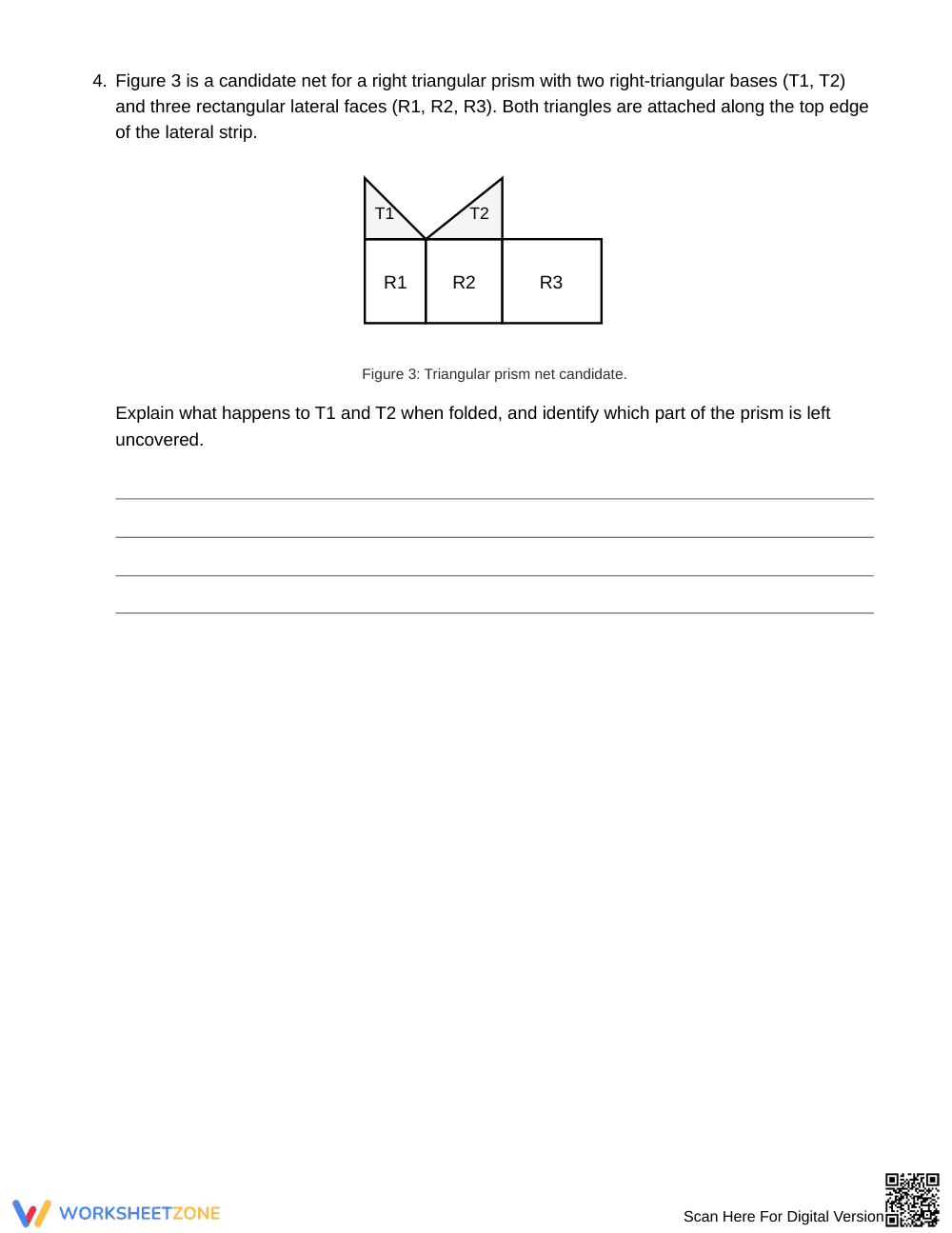
- Supported Practice (Part B): Learners examine 4 net diagrams of prisms and pyramids, verifying edge lengths, face alignment, and closure.
- Independent Practice (Part C): Students complete 2 rigorous tasks, writing a 3-point prism checklist and building counterexamples.
This structured progression follows a gradual-release model, advancing students from guided error detection to independent mathematical proof.
Standards Alignment
This resource aligns to standard 6.G.A.4: "Represent three-dimensional figures using nets made up of rectangles and triangles, and use the nets to find the surface area of these figures." Students verify net structure before calculating surface areas. Both standard codes can be copied directly into lesson plans, IEP goals, or district curriculum mapping tools.
How to Use It
Use this worksheet after introducing 3D nets during geometry units. Have students complete Part A in pairs before tackling Parts B and C independently. Observe whether students check seam edge lengths when diagnosing invalid nets. Completion takes approximately 40 to 50 minutes.
Who It's For
This resource is built for Grade 6 math classrooms, geometry interventions, and spatial reasoning enrichment. Provide cutout grid paper for tactile learners who need hands-on folding support. Pair this worksheet with a direct instruction lesson on three-dimensional surface area.
According to Fisher & Frey (2014), purposeful guided instruction requires students to evaluate common misconceptions, justify geometric reasoning, and articulate precise counterexamples before achieving independent mastery. This Grade 6 geometry worksheet targets standard 6.G.A.4 by challenging students to represent three-dimensional figures using nets and verify essential geometric conditions such as face correspondence, equal edge lengths, and non-overlapping closure. By evaluating candidate net diagrams for rectangular prisms, triangular prisms, and pyramids, learners identify structural flaws and build spatial reasoning that directly supports surface area computation. Research shows that analyzing non-examples and generating counterexamples significantly strengthens spatial visualization compared to passive diagram labeling. The scaffolded progression across 8 structured tasks equips educators with reliable formative assessment data, making this resource an effective addition to standards-based middle school mathematics instruction.


