




























Views
Downloads




Complete 3D Cross-Sections Worksheet | Grade 10 Geometry

Paste this activity's link or code into your existing LMS (Google Classroom, Canvas, Teams, Schoology, Moodle, etc.).
Students can open and work on the activity right away, with no student login required.
You'll still be able to track student progress and results from your teacher account.
This high school geometry worksheet helps students master spatial reasoning by identifying two-dimensional cross-sections of 3D solids and analyzing solids of revolution. Students calculate exact and rounded areas, evaluate dimensional scaling factors ($k$, $k^2$, $k^3$), and critique geometric arguments across 12 structured tasks.
At a Glance
- Grade: 10 · Subject: Geometry
- Standard:
HSG-GMD.B.4— Identify two-dimensional cross-sections and solids generated by rotating two-dimensional objects- Skill Focus: Analyze Cross-Sections and Dimensional Changes
- Format: 5 pages · 12 problems · Answer key included · PDF
- Best For: High school geometry spatial modeling practice
- Time: 45–60 minutes
What's Inside
This 5-page geometry printable provides 12 problems across three progressive parts. It features a Quick Reference guide covering cross-section orientations, solid-of-revolution principles, and scaling factors. Geometric diagrams aid spatial visualization, and a 2-page answer key provides step-by-step solutions with exact radical, $\pi$, and decimal values.
Skill Progression
- Guided Practice (Part A, Problems 1–3): Students interpret labeled diagrams to identify 2D slicing planes through cylinders, rotated composite figures, and pyramid cross-sections.
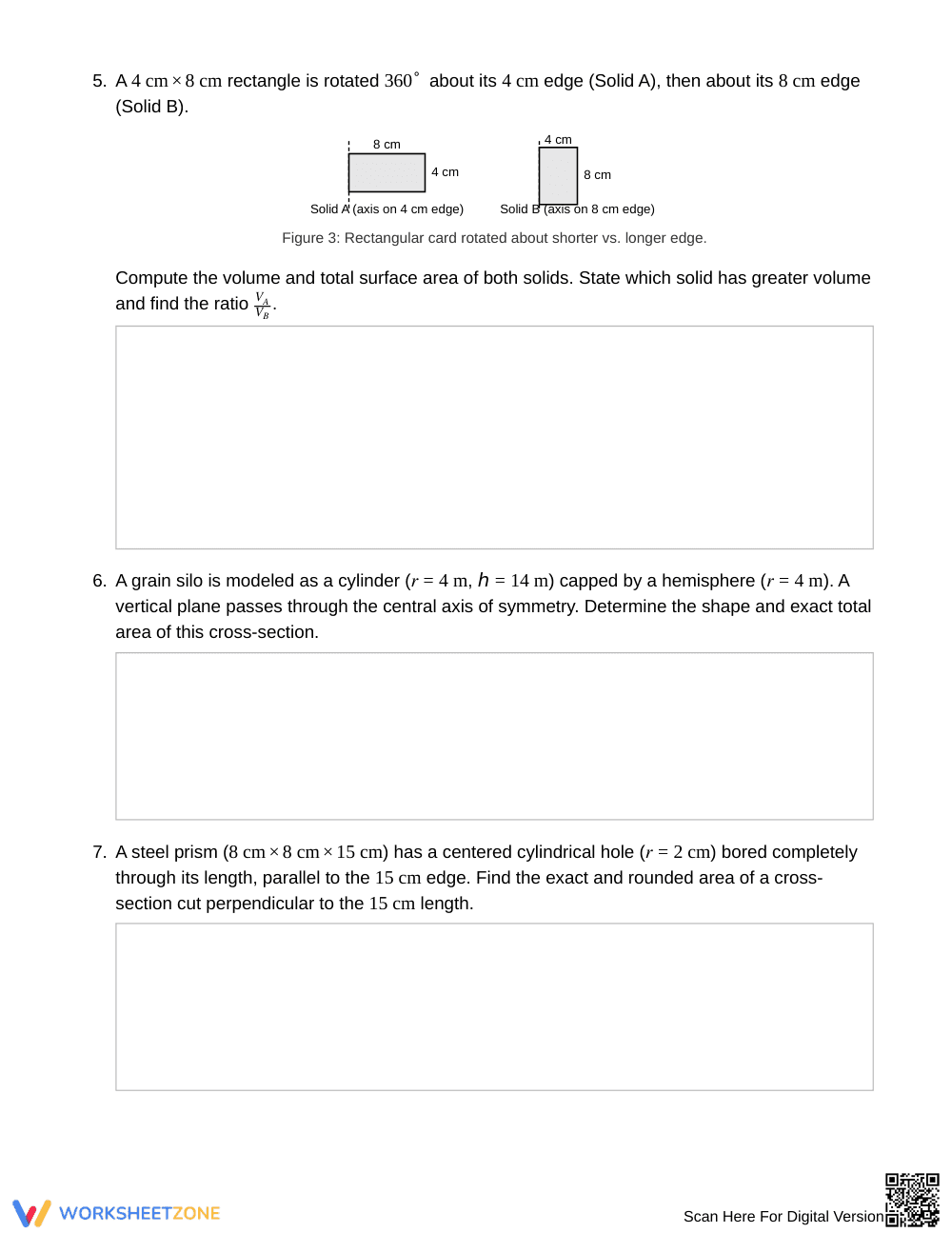
- Supported Practice (Part B, Problems 4–9): Students calculate exact and rounded areas of conical slices, find volume ratios of rotated rectangles, and analyze dimensional scaling.
- Independent Practice (Part C, Problems 10–12): Students evaluate geometric claims, refute cube slicing misconceptions, and analyze non-linear volume transformations.
This progression follows the gradual-release model, moving students from visual identification to independent mathematical justification.
Standards Alignment
This worksheet aligns directly with primary standard `HSG-GMD.B.4`: Identify the shapes of two-dimensional cross-sections of three-dimensional objects, and identify three-dimensional objects generated by rotations of two-dimensional objects. It also supports `HSG-MG.A.1` through geometric modeling applications. Both standard codes can be copied directly into lesson plans, IEP goals, or district curriculum mapping tools.
How to Use It
Use this worksheet after direct instruction on 3D geometry during independent practice or collaborative problem-solving. During instruction, observe students on Part A to ensure they distinguish parallel slices from oblique cuts before moving to computation in Part B. Expected completion time is 45 to 60 minutes.
Who It's For
This resource serves Grade 10 Geometry students developing spatial reasoning. For intervention, provide physical geometric solids or modeling clay; for advanced learners, assign Part C proofs as extension tasks. Pair this worksheet with a teacher-led 3D rotation demonstration or interactive dynamic geometry software.
According to Fisher & Frey (2014), structuring mathematical tasks through purposeful gradual release ensures that students develop both conceptual understanding and procedural fluency when tackling multi-step spatial reasoning problems. This 5-page worksheet targets standard `HSG-GMD.B.4` by guiding Grade 10 students through 12 structured tasks focused on analyzing two-dimensional cross-sections and dimensional changes in three-dimensional solids. Learners begin by identifying planar slices and solids of revolution from labeled diagrams, advance to calculating area and volume ratios under non-linear scale factors, and culminate by refuting common misconceptions through written geometric proofs. The scaffolded transition from visual reference boxes to error-analysis justification directly reinforces spatial visualization and algebraic modeling. Complete with exact radical solutions, π notations, and rounded decimals, this resource provides the systematic practice and rigorous feedback loops necessary for high school students to achieve full mastery of geometric dimensional analysis.


