
































Comparing Fractions With Same Numerator: Essential Guide

Paste this activity's link or code into your existing LMS (Google Classroom, Canvas, Teams, Schoology, Moodle, etc.).
Students can open and work on the activity right away, with no student login required.
You'll still be able to track student progress and results from your teacher account.
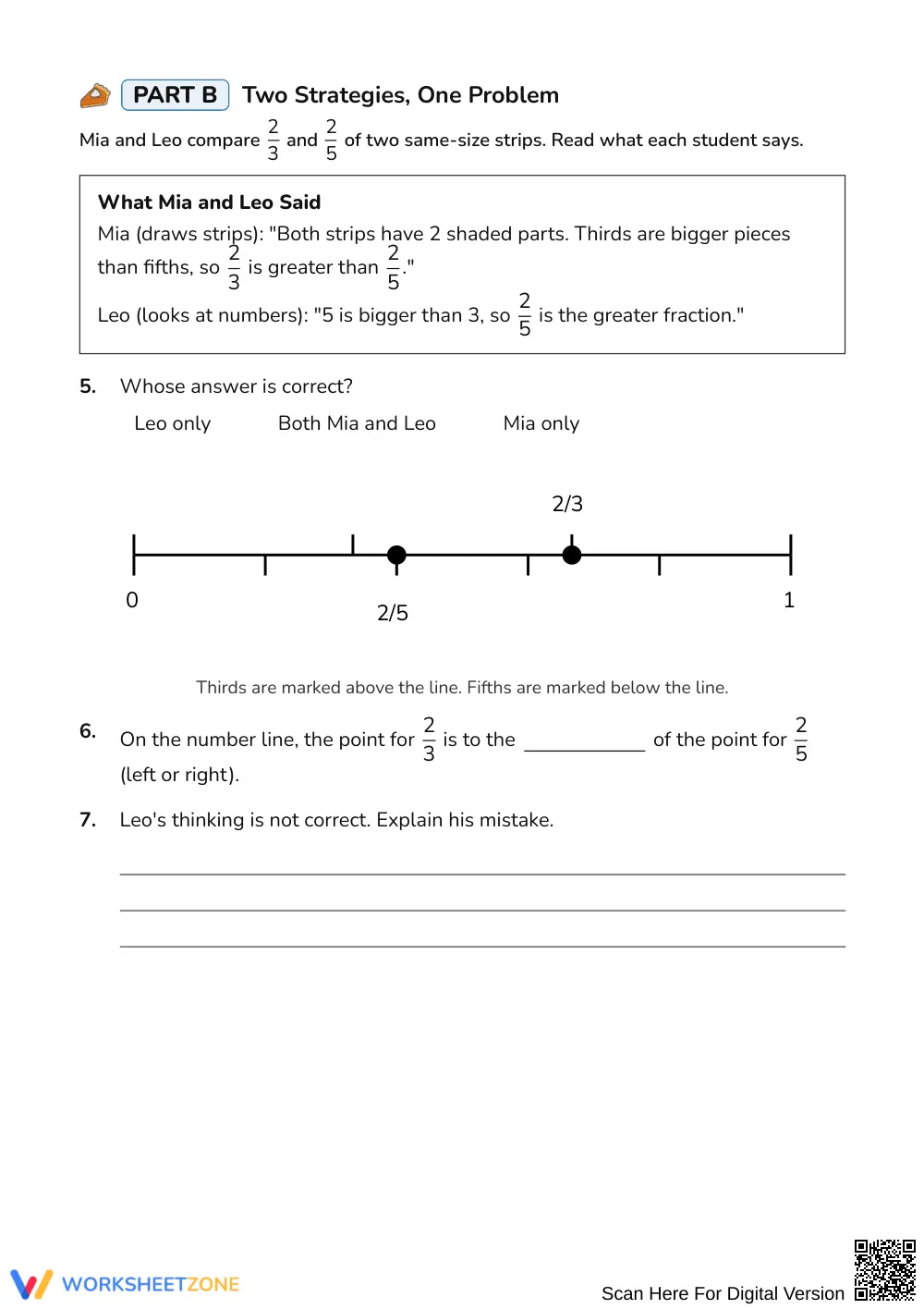
This four-page math worksheet helps third-grade students compare fractions with equal numerators using visual models and reasoning. Students analyze fraction strips, critique student solution methods, diagnose misconceptions about denominators, and justify comparisons across fourteen structured practice problems.
At a Glance
- Grade: 3 · Subject: Elementary Math
- Standard:
3.NF.A.3— Compare two fractions with the same numerator by reasoning about their size.- Skill Focus: Comparing fraction solution strategies and denominator reasoning
- Format: 4 printable pages · 14 structured problems · Full answer key included · PDF
- Best For: Conceptual fraction practice and peer error analysis
- Time: 30–45 minutes
What's Inside
Four student pages feature fourteen problems organized into four distinct parts. Tasks include fraction strip diagrams, dual-strategy dialogue prompts, a dual-scale number line, and an error-correction challenge. Students write inequality comparisons and compose written explanations. A complete four-page answer key provides worked explanations and sample answers.
Skill Progression
- Guided practice (Part A, 4 problems): Students examine fraction strips to observe that larger denominators create smaller parts, completing inequalities with visual support.
- Supported practice (Parts B and C, 6 problems): Students critique student reasoning, analyze number line locations, identify denominator misconceptions, and compare visual drawing versus numeric efficiency.
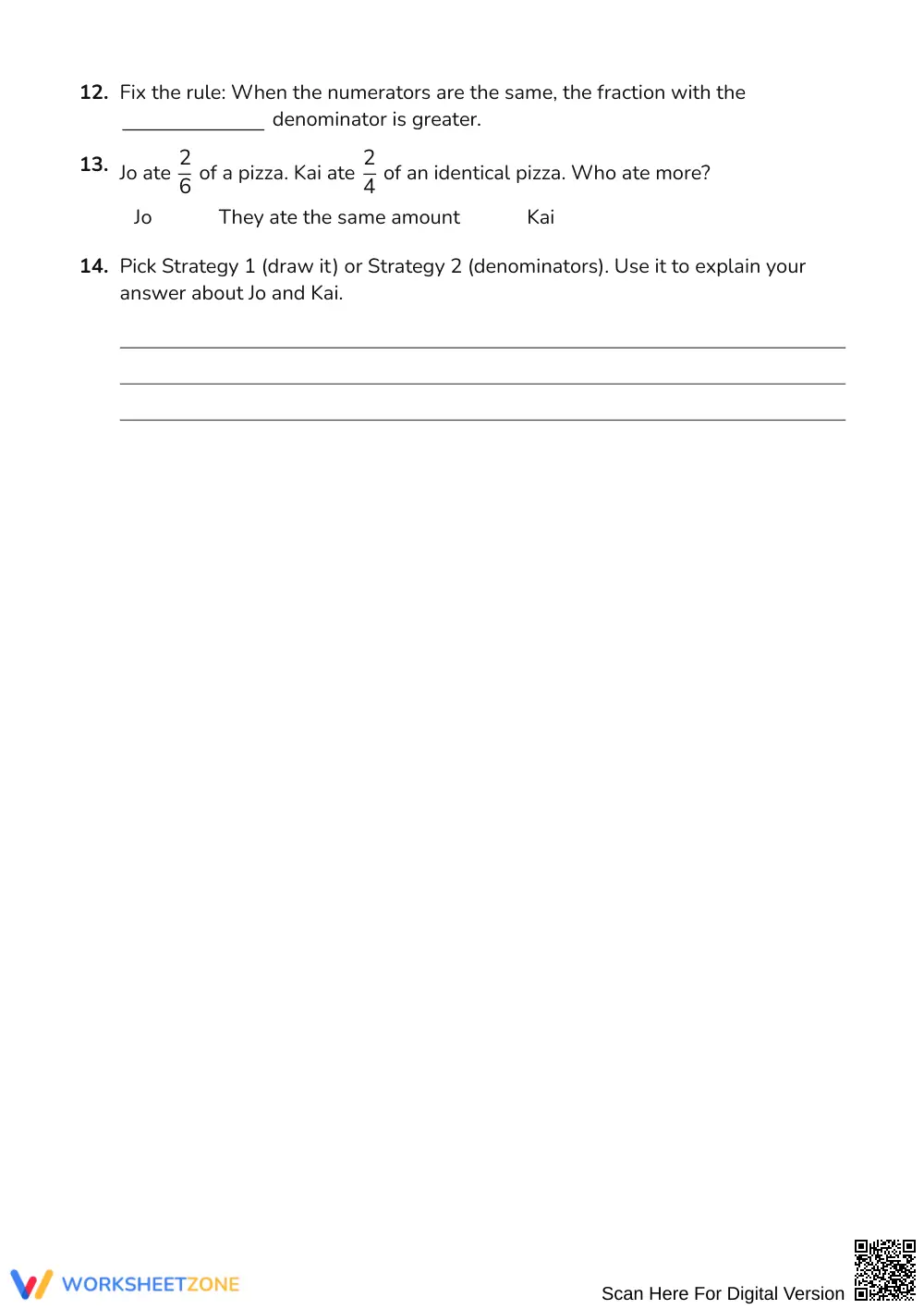
- Independent practice (Part D, 4 problems): Students correct a flawed comparison rule, apply denominator reasoning to a pizza word problem, and defend their conclusions.
This sequence follows a gradual-release model, moving learners from scaffolded visual models to independent mathematical reasoning.
Standards Alignment
The core content aligns to `3.NF.A.3`, focusing on comparing two fractions with the same numerator by reasoning about their size. The tasks also develop mathematical practice standard `CCSS.MATH.PRACTICE.MP3` as students construct viable arguments and critique peer reasoning. Both standard codes can be copied directly into lesson plans, IEP goals, or district curriculum mapping tools.
How to Use It
Use this worksheet after introducing unit fractions and denominator concepts. Assign Parts A and B for partner discussions where students debate Mia and Leo's methods. Reserve Parts C and D for independent assessment. During instruction, check whether students recognize the inverse relationship between denominator size and piece size. Completion takes 30 to 45 minutes.
Who It's For
Designed for Grade 3 math classrooms, this resource also supports fourth-grade intervention. Visual strips assist learners who need concrete reinforcement, while strategy critique challenges advanced thinkers. Pair this worksheet with fraction tile manipulatives or an interactive number line lesson.
According to Fisher & Frey (2014), evaluating peer reasoning and identifying mathematical misconceptions accelerates conceptual transfer faster than repetitive procedural computation alone. This Grade 3 mathematics resource addresses standard 3.NF.A.3 by guiding elementary students to compare fractions with the same numerator through structured error analysis and strategy comparison. Rather than treating fraction comparison as an isolated trick, the tasks require learners to explain why larger denominators produce smaller partition sizes within an identical whole. Students contrast visual area models against symbolic denominator analysis, addressing the common developmental error where children assume larger denominators denote larger fractions. By moving through scaffolded dialogue critique, rule correction, and applied word problem justification, the four-page progression ensures learners build robust mental representations. Educators can utilize the included fourteen problems and comprehensive answer key to verify that third-grade students achieve durable conceptual understanding aligned with standards.


