































Comparing Fractions With Same Numerator: Essential Check

Paste this activity's link or code into your existing LMS (Google Classroom, Canvas, Teams, Schoology, Moodle, etc.).
Students can open and work on the activity right away, with no student login required.
You'll still be able to track student progress and results from your teacher account.
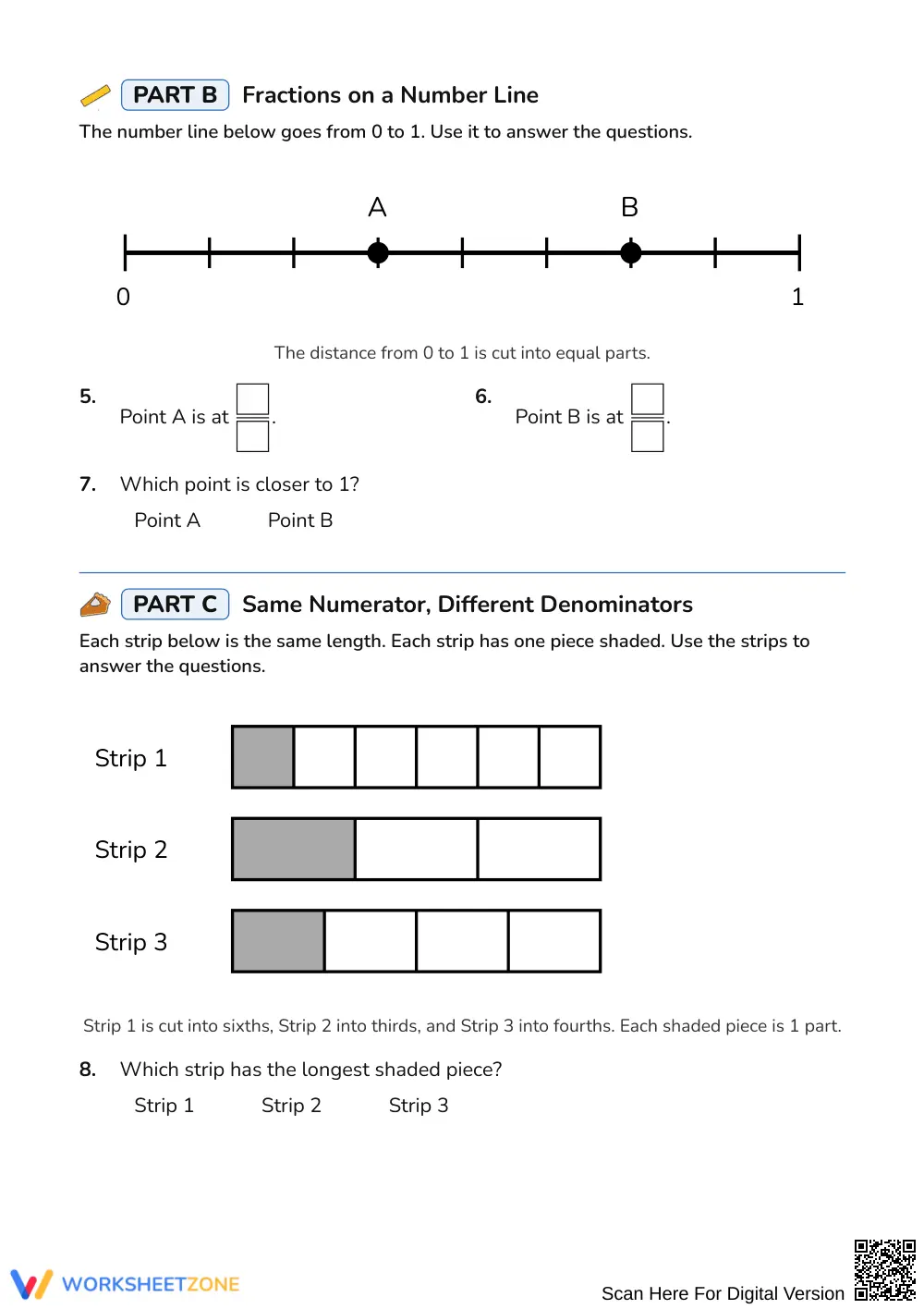
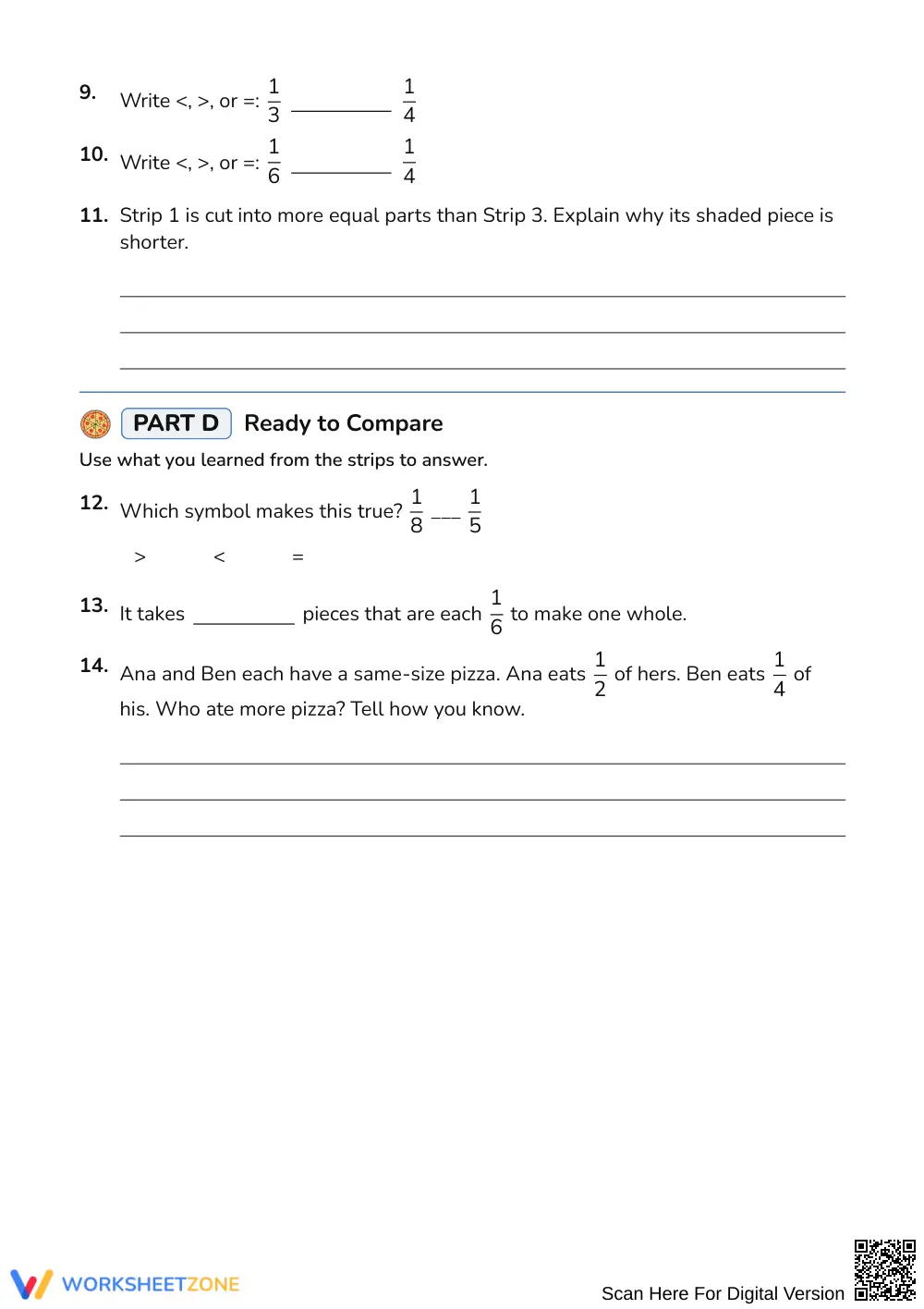
This Grade 3 math worksheet equips learners to compare fractions with the same numerator by verifying foundational fractional reasoning. Students examine visual area models, identify denominator values on a number line, and articulate why larger denominators create smaller parts. The diagnostic progression prepares elementary mathematicians for formal fraction comparisons.
At a Glance
- Grade: 3 · Subject: Math
- Standard:
3.NF.A.3— Compare two fractions with the same numerator by reasoning about their size- Skill Focus: Prerequisite visual models and notation for same-numerator comparison
- Format: 3 pages · 19 problems · Answer key included · PDF
- Best For: Diagnostic prerequisite check and small-group review
- Time: 25–35 minutes
Across 3 printable pages, students complete 19 targeted tasks organized into four focused parts. The worksheet features visual fraction bars, a 0-to-1 number line, partitioned length strips, multiple-choice items, inequality statements, and written-response explanations. A complete 3-page answer key provides clear model explanations and visual solutions for immediate verification.
Skill Progression
- Guided Practice (Part A, 4 problems): Students examine shaded fraction bars and identify what denominators represent, establishing core conceptual understanding with visual models.
- Supported Practice (Parts B & C, 8 problems): Learners plot points on number lines and compare partitioned strips, applying inequality symbols and explaining why more partitions create smaller shares.
- Independent Practice (Part D, 7 problems): Students solve abstract inequalities, decompose wholes, and answer a pizza word problem requiring written mathematical justification.
This sequence follows a gradual-release model, transitioning students from guided visual analysis to independent reasoning.
Standards Alignment
This resource aligns directly with `3.NF.A.3`, which requires students to explain equivalence and compare fractions by reasoning about their size. It additionally supports standard `3.NF.A.1` by reinforcing unit fractions and denominator concepts. Both standard codes can be copied directly into lesson plans, IEP goals, or district curriculum mapping tools.
How to Use It
Administer this worksheet before direct instruction to pinpoint misconceptions about denominator values. Alternatively, use it during small-group intervention for students who assume larger denominators indicate larger shares. During formative observation, check whether students recognize that equal wholes yield smaller pieces when partitioned more times. Expected completion time is 25 to 35 minutes.
Who It's For
This resource serves Grade 3 general education students, Tier 2 math intervention groups, and special education students requiring visual scaffolds before comparing abstract fractions. Pair this worksheet directly with physical fraction tile manipulatives or a dedicated fraction anchor chart illustrating unit fraction sizes.
Developing conceptual fluency with fraction comparisons requires structured visual models before students encounter abstract inequality rules. According to Fisher & Frey (2014), gradual-release instructional designs that scaffold visual representations into independent written explanations significantly increase long-term mathematical retention. This Grade 3 worksheet directly targets standard 3.NF.A.3 by guiding learners to compare fractions with the same numerator by reasoning about piece size rather than memorized tricks. By progressing from partitioned fraction bars to number lines and contextual word problems, students confront the common misconception that a larger denominator denotes a larger quantity. Instead, learners observe through 19 structured tasks that dividing a whole into more equal parts produces smaller individual shares. Educators can integrate these 3 pages into diagnostic assessments or targeted intervention blocks, ensuring all learners master essential fraction foundations before attempting complex fraction operations.


