































Comparing Fractions With Same Numerator: Complete Guide

Paste this activity's link or code into your existing LMS (Google Classroom, Canvas, Teams, Schoology, Moodle, etc.).
Students can open and work on the activity right away, with no student login required.
You'll still be able to track student progress and results from your teacher account.
This Grade 3 math worksheet strengthens conceptual understanding of fraction magnitude by guiding students to compare fractions sharing identical numerators. Through concrete visual models and written mathematical explanations, learners prove why larger denominators yield smaller unit parts, eliminating the common misconception that larger numbers automatically create larger fraction values.
At a Glance
- Grade: 3 · Subject: Math
- Standard:
3.NF.A.3— Compare two fractions with the same numerator by reasoning about their size- Skill Focus: Comparing same-numerator fractions using visual models and justification
- Format: 3 pages · 14 problems · Answer key included · PDF
- Best For: Small group intervention and independent practice
- Time: 25–35 minutes
What's Inside
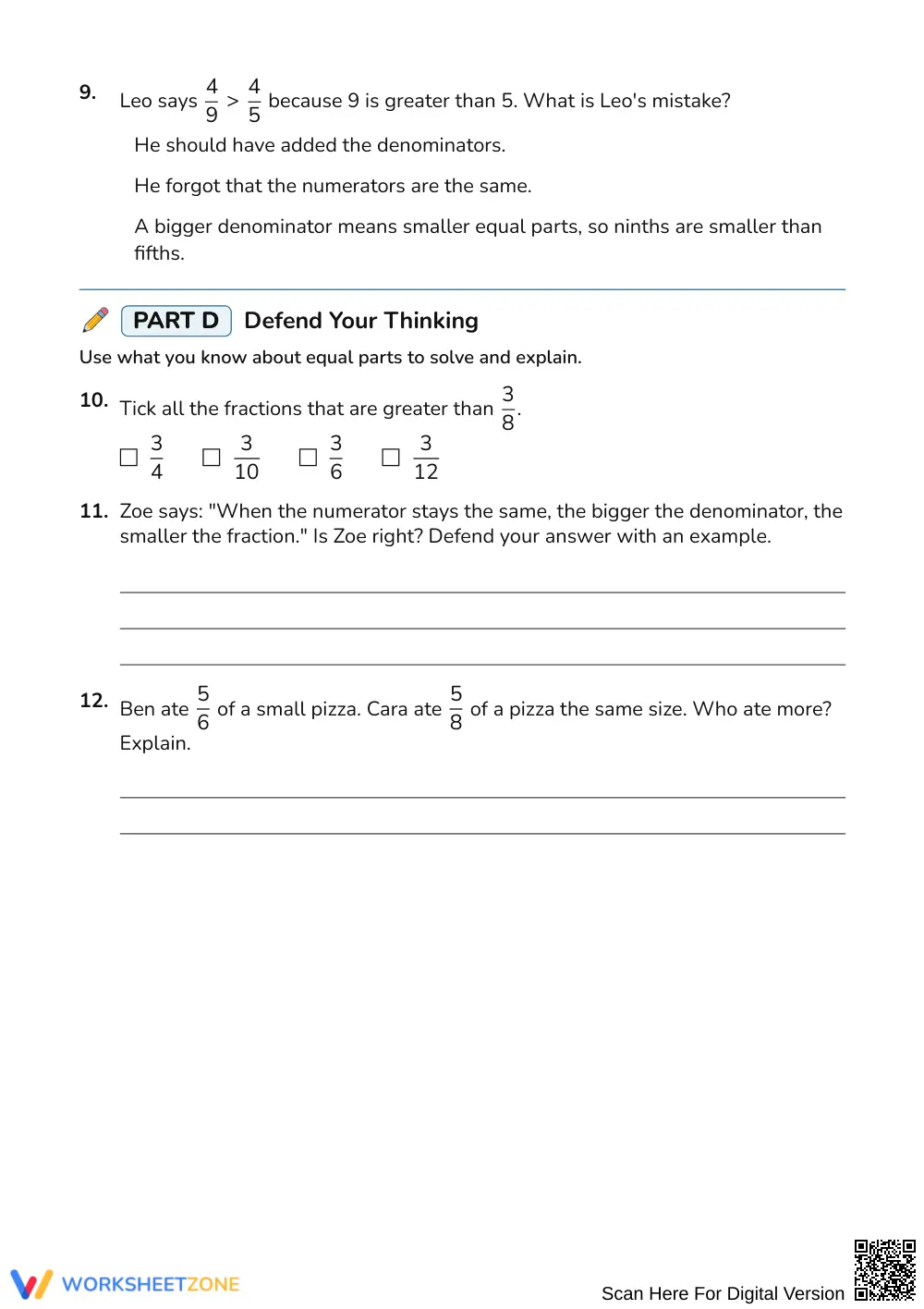
This 3-page printable resource includes 14 structured tasks distributed across four sequential sections. Students analyze shaded fraction strips, trace distances on comparative number lines, evaluate true-or-false statements with error analysis, and construct written defenses for word problems. A comprehensive 3-page answer key provides complete written justifications and visual solutions for swift teacher evaluation.
Skill Progression
- Guided practice: Tasks 1–4 introduce concrete shaded fraction strips where students observe equal lengths and explain why different subdivisions change unit piece sizes.
- Supported practice: Tasks 5–8 transition to dual number lines and error analysis prompts, requiring learners to evaluate partition jumps and identify misconceptions.
- Independent practice: Tasks 9–14 challenge students to solve multi-select questions, defend generalizations in their own words, and solve contextualized word problems.
This gradual-release structure systematically guides learners from concrete visual representations to independent mathematical justification.
Standards Alignment
This activity targets 3.NF.A.3, specifically comparing two fractions with the same numerator by recognizing that comparisons are valid only when referring to the same whole. Supporting standard 3.NF.A.2 reinforces fraction placement and interval length on number line diagrams. Both standard codes can be copied directly into lesson plans, IEP goals, or district curriculum mapping tools.
How to Use It
Implement this resource during mid-unit instruction as a collaborative partner task after introducing fraction strips, or deploy it during post-lesson independent practice to verify mastery. During work time, observe whether students rely on counting denominator digits or articulate part size; use task 8 to target whole-number bias. Expected completion time is 25 to 35 minutes.
Who It's For
Designed primarily for third-grade general education students, this worksheet also supports fourth-grade math intervention groups rebuilding fraction foundations. Pair these exercises with hands-on fraction tile manipulatives or a classroom anchor chart contrasting numerators and denominators to aid English language learners and students with processing accommodations.
Third-grade students frequently struggle with fraction comparison because whole-number intuition suggests that larger numerical values represent greater quantities. Standard 3.NF.A.3 addresses this conceptual roadblock by requiring learners to compare fractions with identical numerators through size-based reasoning and visual representation. Grounded in the gradual-release framework established by Fisher & Frey (2014), this 3-page instructional resource incorporates 14 tasks structured to transition students from concrete fraction strips and number lines to written justifications. By actively analyzing student errors and defending mathematical claims, children replace rote rule memorization with durable mental models of fractional parts. The included answer key supports immediate feedback and targeted interventions, ensuring teachers can systematically measure student mastery of partitioning principles. Consequently, this standards-aligned material equips elementary educators with reliable diagnostic evidence while fostering rigorous mathematical discourse and conceptual fluency in early fraction comprehension.


