
































Comparing Fractions With Same Numerator: Complete Guide

Paste this activity's link or code into your existing LMS (Google Classroom, Canvas, Teams, Schoology, Moodle, etc.).
Students can open and work on the activity right away, with no student login required.
You'll still be able to track student progress and results from your teacher account.
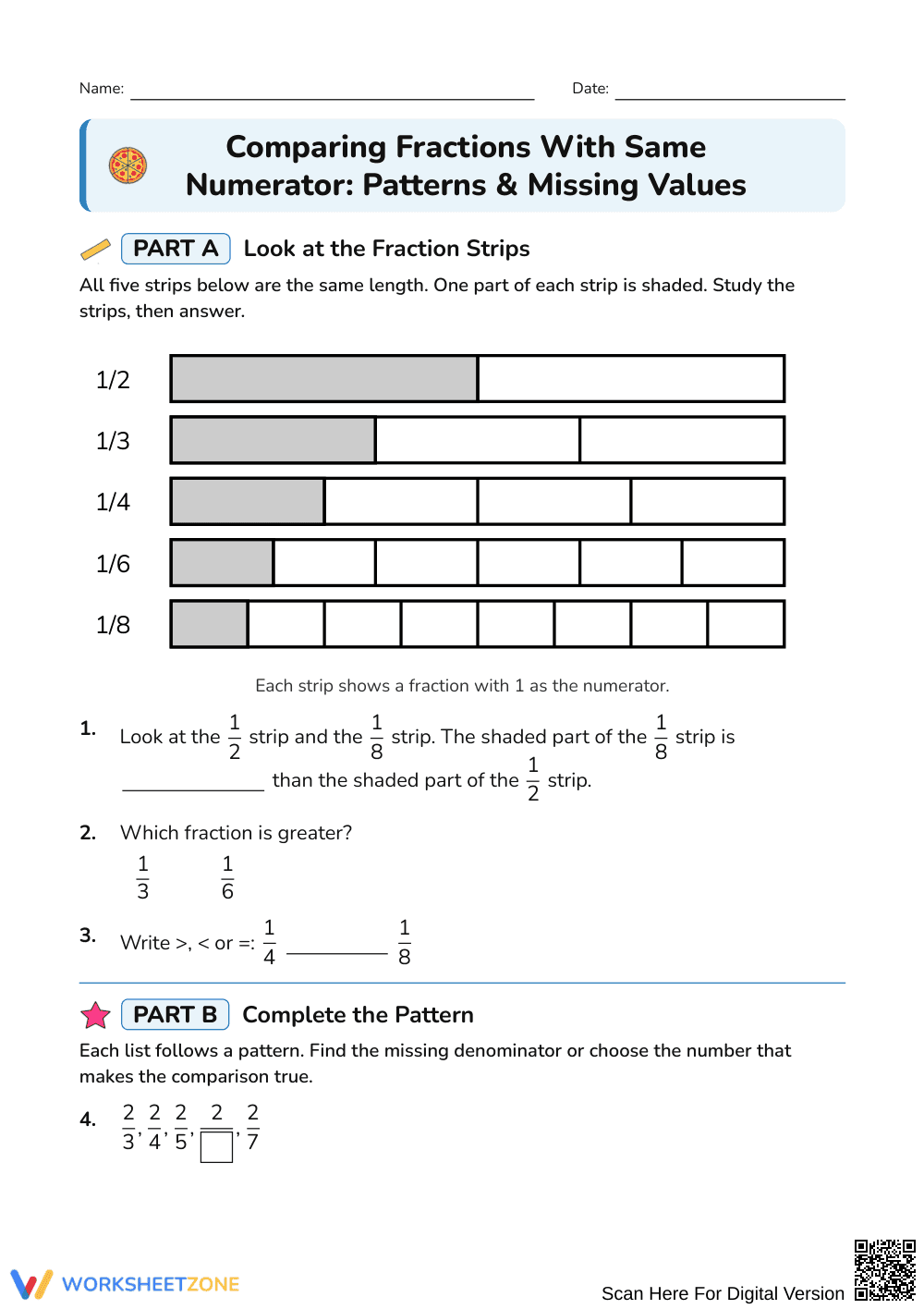
Mastering fraction comparisons requires third-grade mathematicians to realize that larger denominators create smaller equal parts. This 3-page worksheet provides targeted practice comparing fractions with identical numerators using visual models, number lines, patterns, and written reasoning. Students analyze 17 structured problems to build conceptual understanding and solidify foundational fraction number sense.
At a Glance
- Grade: 3 · Subject: Math
- Standard:
3.NF.A.3— Compare two fractions with the same numerator by reasoning about their size- Skill Focus: Comparing fractions with the same numerator using patterns and missing values
- Format: 3 pages · 17 problems · Answer key included · PDF
- Best For: Guided math small groups and independent practice
- Time: 25–35 minutes
What's Inside
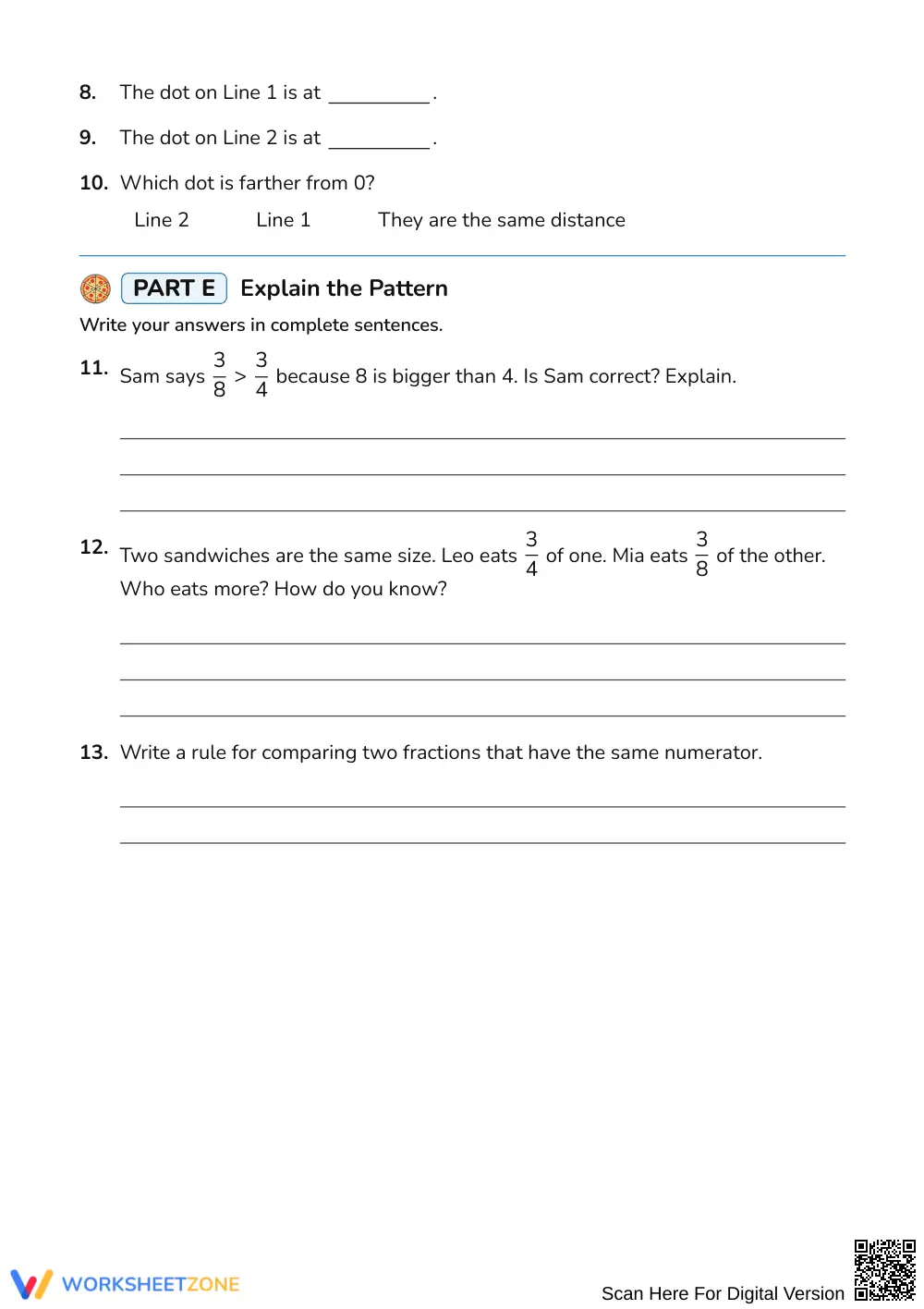
This 3-page resource features five distinct sections designed to deepen conceptual understanding. Students inspect shaded fraction strips in Part A, find missing denominators in Part B, insert inequality symbols in Part C, read number lines in Part D, and write comparison rules in Part E. A complete 3-page answer key provides explanations for immediate review.
Skill Progression
- Guided practice (Parts A & D, 4 problems): High scaffolding with equal-length fraction strips and labeled number lines establishing benchmark comparisons.
- Supported practice (Parts B & C, 8 problems): Medium scaffolding requiring learners to complete denominator patterns and insert inequality symbols.
- Independent practice (Part E, 5 problems): Low scaffolding challenging students to analyze misconceptions, solve word problems, and write rules.
This gradual-release structure moves students smoothly from visual representations to abstract reasoning across the I Do, We Do, You Do continuum.
Standards Alignment
This resource aligns with primary standard `3.NF.A.3`, requiring students to compare two fractions with the same numerator by reasoning about their size and recognizing that comparisons are valid only when referring to the same whole. It also reinforces supporting standard `3.NF.A.2` by using number lines between 0 and 1. Both standard codes can be copied directly into lesson plans, IEP goals, or district curriculum mapping tools.
How to Use It
Use Parts A and B during direct instruction as guided partner tasks to illustrate how larger denominators represent smaller parts. Assign Parts C, D, and E after direct instruction for independent practice, taking 25 to 35 minutes. Formatively observe whether students mistakenly assume larger denominators mean larger values; students holding this misconception should revisit the Part A fraction strips.
Who It's For
This worksheet serves Grade 3 general education classrooms, Tier 2 intervention groups, and resource rooms addressing fraction concepts. For students who reverse inequality symbols, pair this activity with hands-on fraction tiles or a visual anchor chart displaying unit fractions. Fast finishers can extend learning by creating original denominator patterns.
According to Fisher & Frey (2014), structured cognitive progressions that transition students from visual modeling to verbal justification significantly enhance procedural fluency and conceptual retention. Aligned to standard 3.NF.A.3, this Grade 3 mathematics activity systematically develops the ability to compare fractions with the same numerator by reasoning about unit fraction size. Third graders frequently struggle with whole-number bias, incorrectly assuming that larger numerical denominators denote larger fractional values. By integrating visual fraction bars, dual number lines, missing-value pattern analysis, and written explanatory prompts, this 17-task worksheet provides the scaffolded support necessary to dismantle persistent misconceptions. Students demonstrate measurable mastery by explaining why fractions sharing identical numerators decrease in value as denominators increase. Educational practitioners can deploy this instructional resource during targeted small-group intervention, guided instruction, or formative assessment to ensure every learner achieves rigorous mathematical proficiency.


