































Compare Fractions On the Number Line: Complete Problems

Paste this activity's link or code into your existing LMS (Google Classroom, Canvas, Teams, Schoology, Moodle, etc.).
Students can open and work on the activity right away, with no student login required.
You'll still be able to track student progress and results from your teacher account.
This Grade 4 math worksheet develops student proficiency in comparing fractions with unlike denominators using visual number lines and benchmark reasoning. Across three pages, learners examine partitioned intervals, sequence relative values, and solve multi-step measurement word problems to build lasting fraction magnitude understanding.
At a Glance
- Grade: 4 · Subject: Math
- Standard:
4.NF.A.2— Compare fractions with different numerators and denominators using visual number line models and benchmarks- Skill Focus: Multi-step fraction comparison on number lines
- Format: 3 pages · 16 problems · Answer key included · PDF
- Best For: Small-group guided math and independent skill practice
- Time: 30–45 minutes
What's Inside
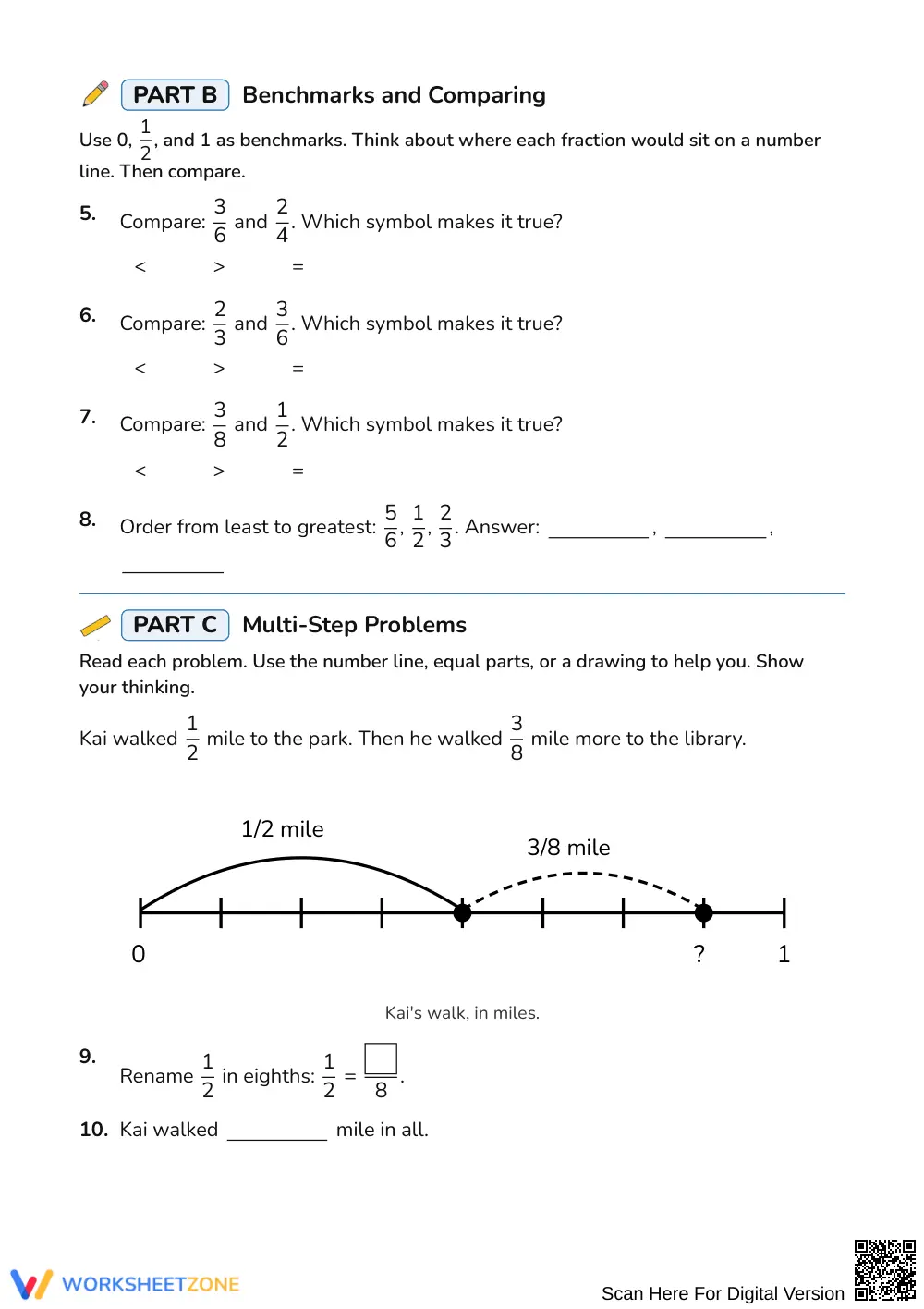
This 3-page printable packet includes 16 focused problems across three sections. Students analyze dual number lines, use benchmarks to compare fractions, and solve multi-step word problems involving equivalence and error analysis. A complete 3-page answer key provides worked explanations and visual justifications for every task.
Skill Progression
- Guided practice (Part A, 4 problems): High scaffolding with dual number lines partitioned into fourths and eighths to identify coordinates and write visual comparisons.
- Supported practice (Part B, 5 problems): Medium scaffolding using 0, 1/2, and 1 benchmarks to compare inequality symbols and order fraction sets.
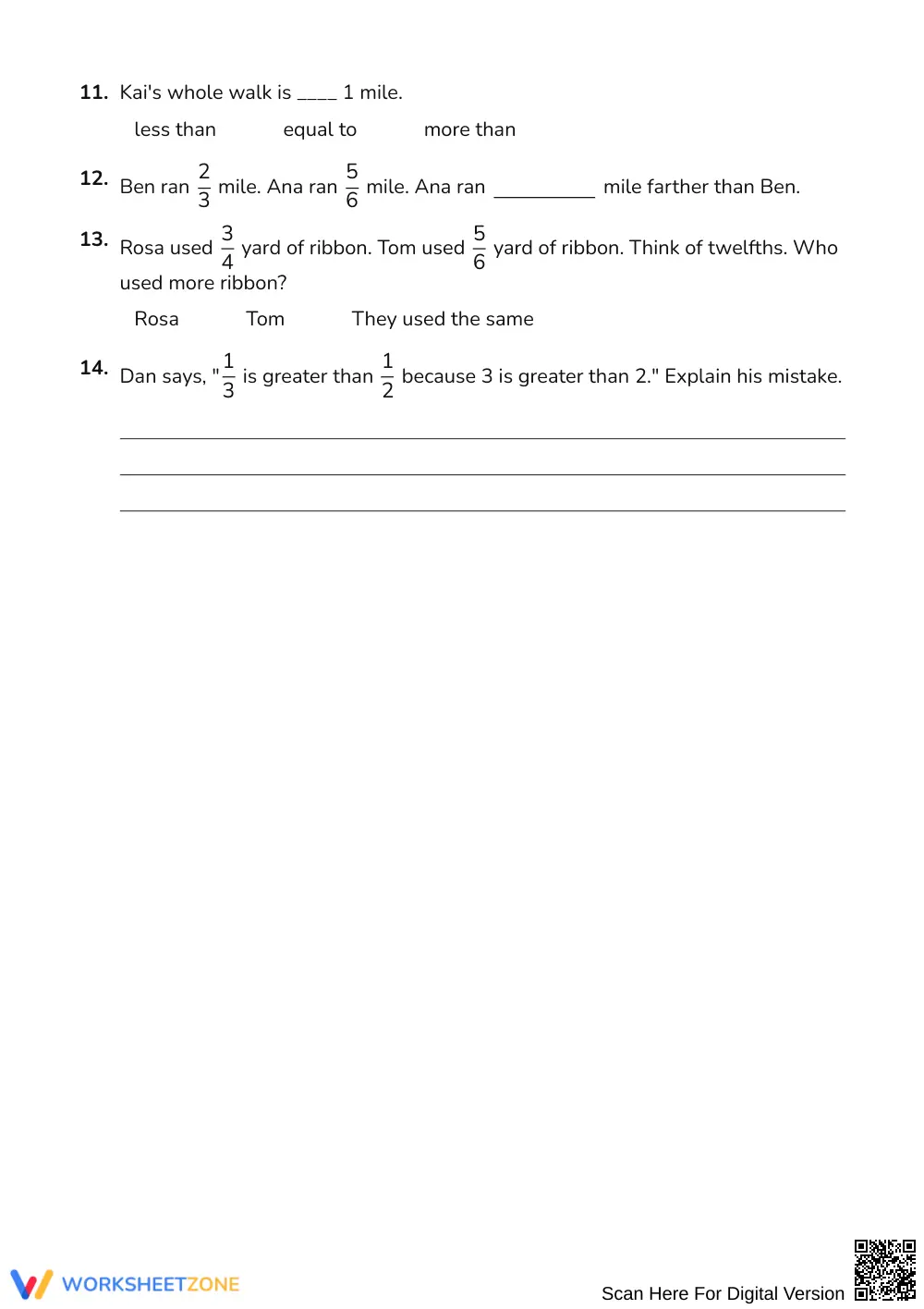
- Independent practice (Part C, 7 problems): Low scaffolding requiring multi-step word problem solutions, denominator renaming, and conceptual error analysis.
This structure follows the gradual release of responsibility model, moving students from guided visual models to independent problem solving.
Standards Alignment
Primary alignment is `4.NF.A.2`: Compare two fractions with different numerators and different denominators by creating common denominators or comparing to benchmarks like 1/2, recognizing comparisons require equal wholes. Supporting standard `4.NF.A.1` reinforces recognizing and generating equivalent fractions during multi-step problems. Both standard codes can be copied directly into lesson plans, IEP goals, or district curriculum mapping tools.
How to Use It
Use Parts A and B during direct instruction for guided partner practice to anchor benchmark reasoning. Assign Part C after direct instruction for independent evaluation. As a formative assessment check, review Dan's error analysis problem to ensure students do not compare denominators in isolation. Expected completion time is 30 to 45 minutes.
Who It's For
Designed for fourth-grade general math classes, this resource also supports fifth-grade intervention groups needing number line practice. Differentiate by providing fraction tiles for emerging learners. Pair this worksheet directly with a fraction benchmark anchor chart during direct instruction.
Research from Fisher & Frey (2014) highlights that intentional gradual-release instructional frameworks significantly strengthen conceptual retention when students tackle complex multi-step mathematical tasks. This Grade 4 instructional worksheet directly targets standard 4.NF.A.2, advancing fraction comparison on number lines through an explicit pedagogical transition from dual visual models to abstract benchmark evaluation. By systematically embedding visual interval representation, benchmark positioning, and error analysis within 16 structured problems across 3 pages, the resource ensures students do not rely on rote procedural tricks such as cross-multiplication. Instead, elementary learners develop durable mental representations of fraction magnitude, justifying how fractions with unlike denominators relate to common wholes and key benchmarks like one-half. Classroom educators utilizing this resource provide the structured cognitive bridges recommended by Fisher & Frey (2014), preparing students for advanced rational number operations through rigorous visual comparison and evidence-based mathematical justification.


