































Compare Fractions On the Number Line: Complete Check

Paste this activity's link or code into your existing LMS (Google Classroom, Canvas, Teams, Schoology, Moodle, etc.).
Students can open and work on the activity right away, with no student login required.
You'll still be able to track student progress and results from your teacher account.
This Grade 3 math worksheet reviews prerequisite skills for comparing fractions on a number line across 19 targeted tasks. Students examine equal partitions, locate benchmark values between 0 and 1, evaluate fraction strip lengths, and explain their mathematical reasoning. This diagnostic resource confirms student readiness before tackling complex fraction comparisons.
At a Glance
- Grade: 3 · Subject: Math
- Standard:
3.NF.A.3— Compare two fractions with the same numerator or denominator using visual models- Skill Focus: Comparing fractions using number lines and visual models
- Format: 3 pages · 19 problems · Answer key included · PDF
- Best For: Prerequisite diagnostic checks and targeted intervention
- Time: 25–35 minutes
What's Inside
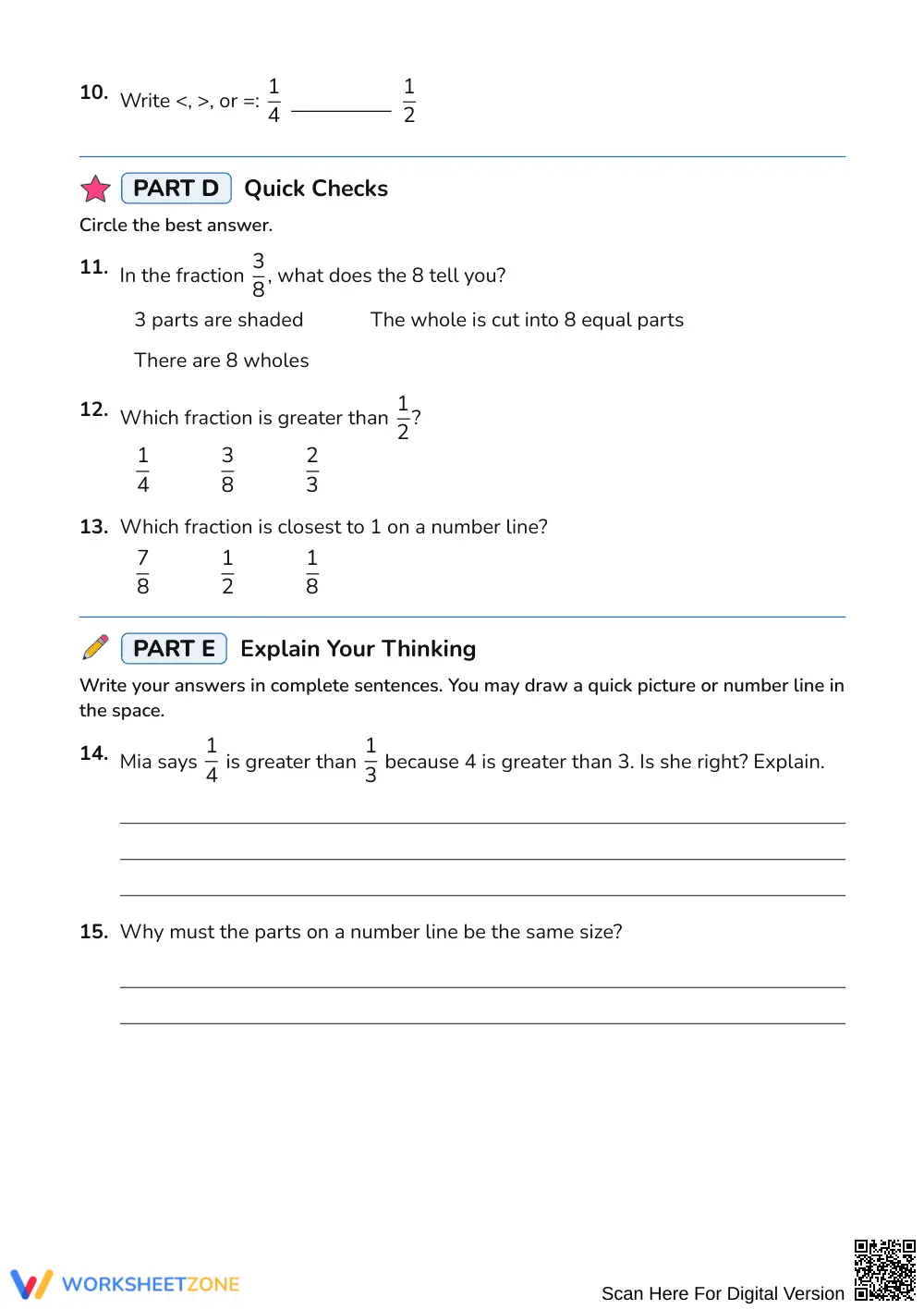
Spanning 3 student-facing pages, this resource contains 19 varied items organized into five sequential parts. Students read partitioned number lines, compare shaded fraction bars, analyze dual scales, solve multiple-choice checks, and write mathematical explanations. A complete 3-page answer key provides clear solutions and sample explanations for fast grading.
Skill Progression
- Guided Practice (Part A & Part B, 6 problems): High visual support guides students to read partitioned number lines and compare side-by-side fraction bars.
- Supported Practice (Part C & Part D, 10 problems): Medium scaffolds prompt learners to analyze aligned number lines and answer multiple-choice questions on denominators and benchmarks.
- Independent Practice (Part E, 3 problems): Minimal scaffolding requires students to evaluate common denominator misconceptions and justify why number line intervals must remain equal.
This sequence follows the gradual release of responsibility model, moving students from visual identification to conceptual justification.
Standards Alignment
This worksheet directly addresses `3.NF.A.3`: Explain equivalence of fractions in special cases, and compare fractions by reasoning about their size. It also reinforces foundational skills under supporting standard `3.NF.A.2`, which focuses on representing fractions on a number line. Both standard codes can be copied directly into lesson plans, IEP goals, or district curriculum mapping tools.
How to Use It
Administer this worksheet before direct instruction on fraction comparison to evaluate foundational readiness with partitioning and fraction magnitude. Teachers can also assign specific parts during small-group intervention for targeted review. Formative assessment tip: observe whether students count intervals or tick marks when identifying values on number lines. Expected completion time is 25 to 35 minutes.
Who It's For
Designed for third-grade general education math students, this resource also supports fourth graders needing prerequisite review. The clear visual models support English learners and students with IEP accommodations. Pair this worksheet directly with physical fraction strip manipulatives or an anchor chart showing equal fraction intervals.
Grounding early fraction learning in visual representations is vital for long-term mathematical success. According to EdReports 2024, standards-aligned instructional materials that consistently connect area models and linear scales build robust conceptual understanding before introducing abstract comparison algorithms. This Grade 3 math worksheet operationalizes primary standard 3.NF.A.3 by guiding learners through 19 focused diagnostic tasks that connect equal partitioning on number lines directly to fraction magnitude. Students evaluate denominator properties, compare bar models, and articulate why larger denominators yield smaller parts when dividing identical wholes. By incorporating formative diagnostic checks and structured explanatory writing prompts, the resource provides educators with reliable baseline data to identify lingering misconceptions before advancing to complex fractional reasoning. This targeted visual architecture ensures elementary students establish firm spatial benchmarks, bridging visual representations and symbolic notation efficiently across diverse instructional settings.


