































Compare Fractions On the Number Line: Complete Assessment

Paste this activity's link or code into your existing LMS (Google Classroom, Canvas, Teams, Schoology, Moodle, etc.).
Students can open and work on the activity right away, with no student login required.
You'll still be able to track student progress and results from your teacher account.
This Grade 4 fraction assessment equips students to compare fractions with like and unlike denominators using visual number lines. Learners analyze positions between 0 and 1, verify equivalent fractions, write relational symbols, and justify their reasoning in complete sentences to demonstrate conceptual understanding and procedural fluency.
At a Glance
- Grade: 4 · Subject: Math
- Standard:
4.NF.A.2— Compare two fractions with different denominators by reasoning about visual number line models- Skill Focus: Comparing and ordering fractions on number lines
- Format: 3 student pages · 14 problems · Full answer key included · Printable PDF
- Best For: End-of-unit cumulative fraction assessment
- Time: 35–45 minutes
What's Inside
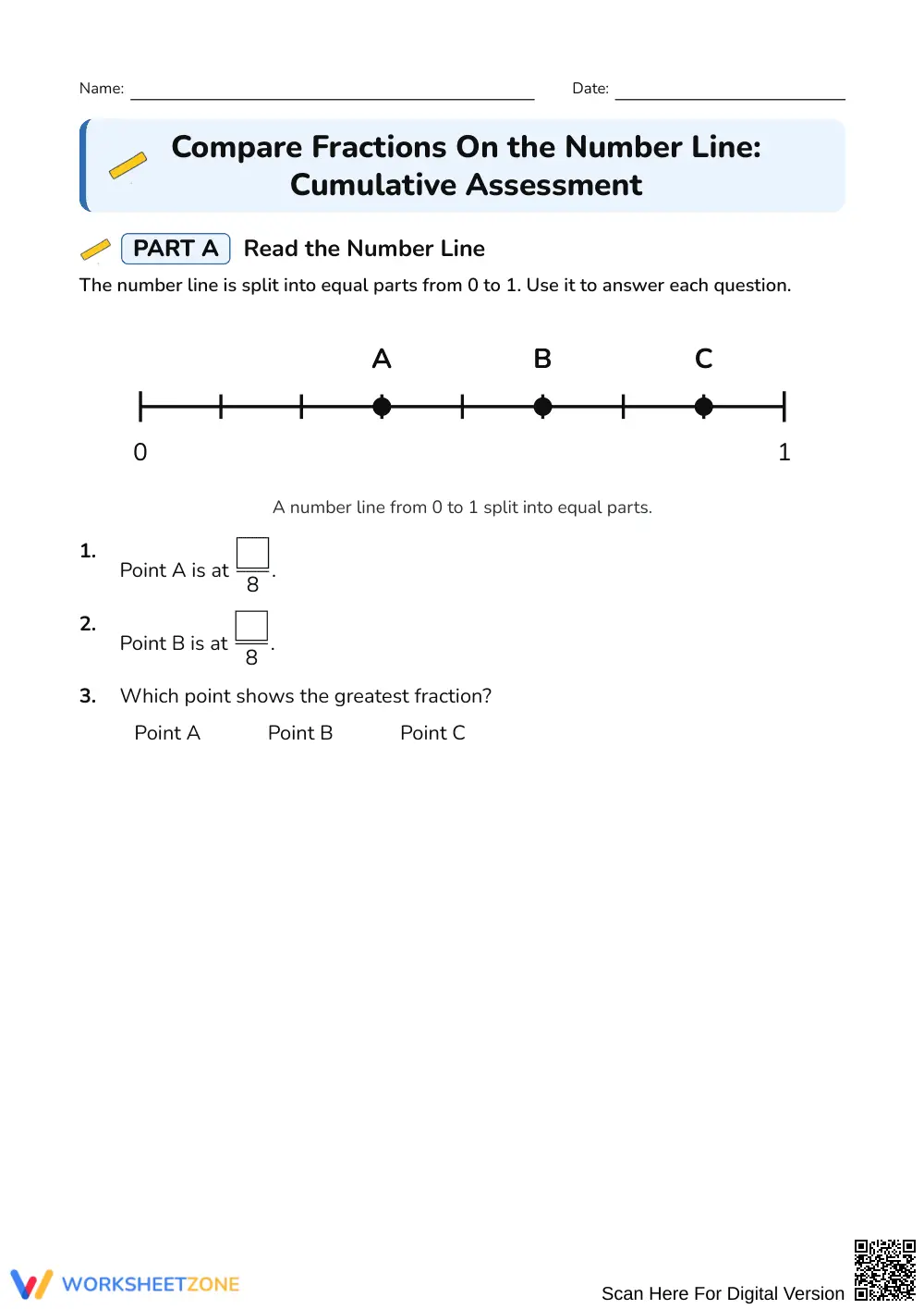
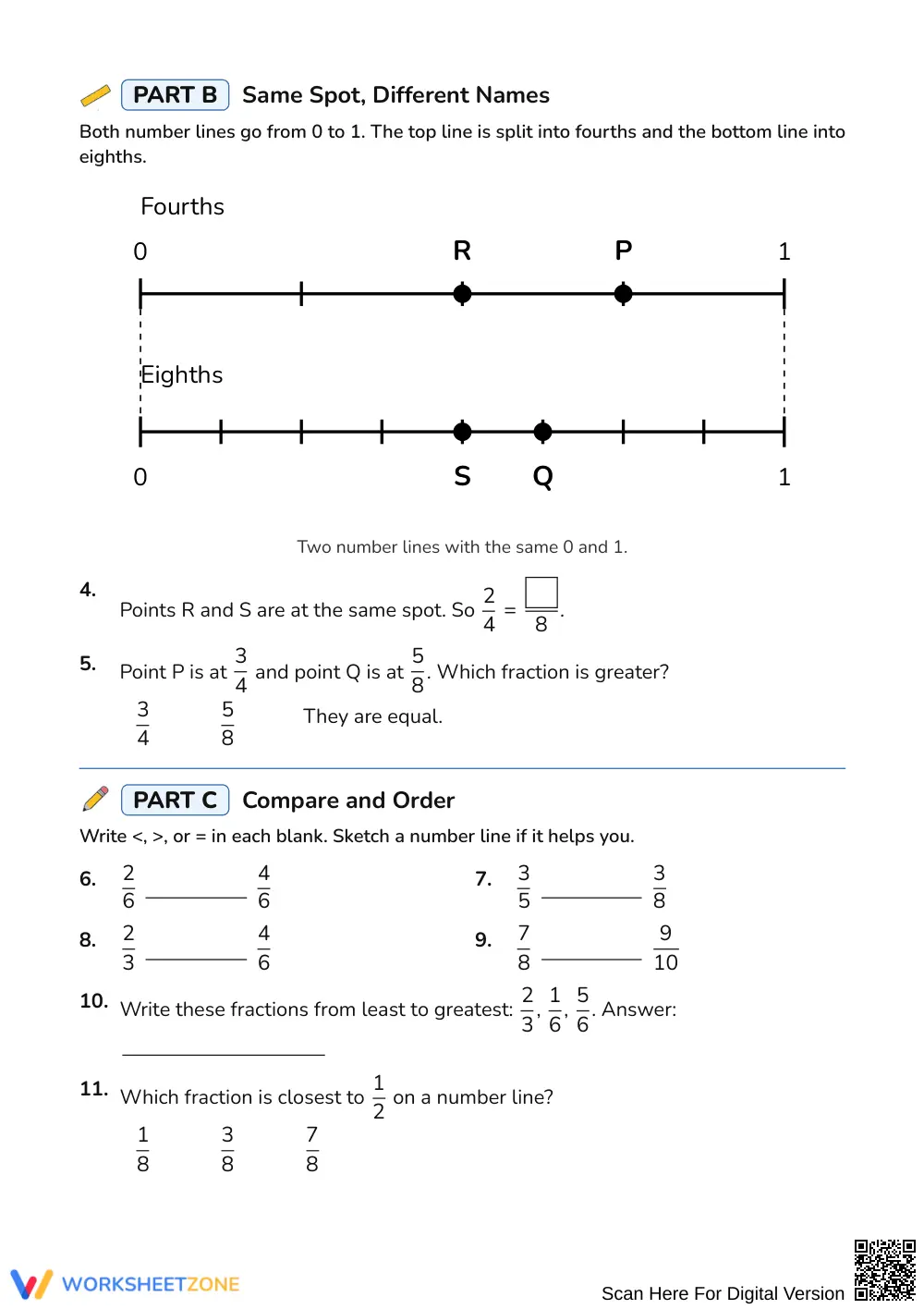
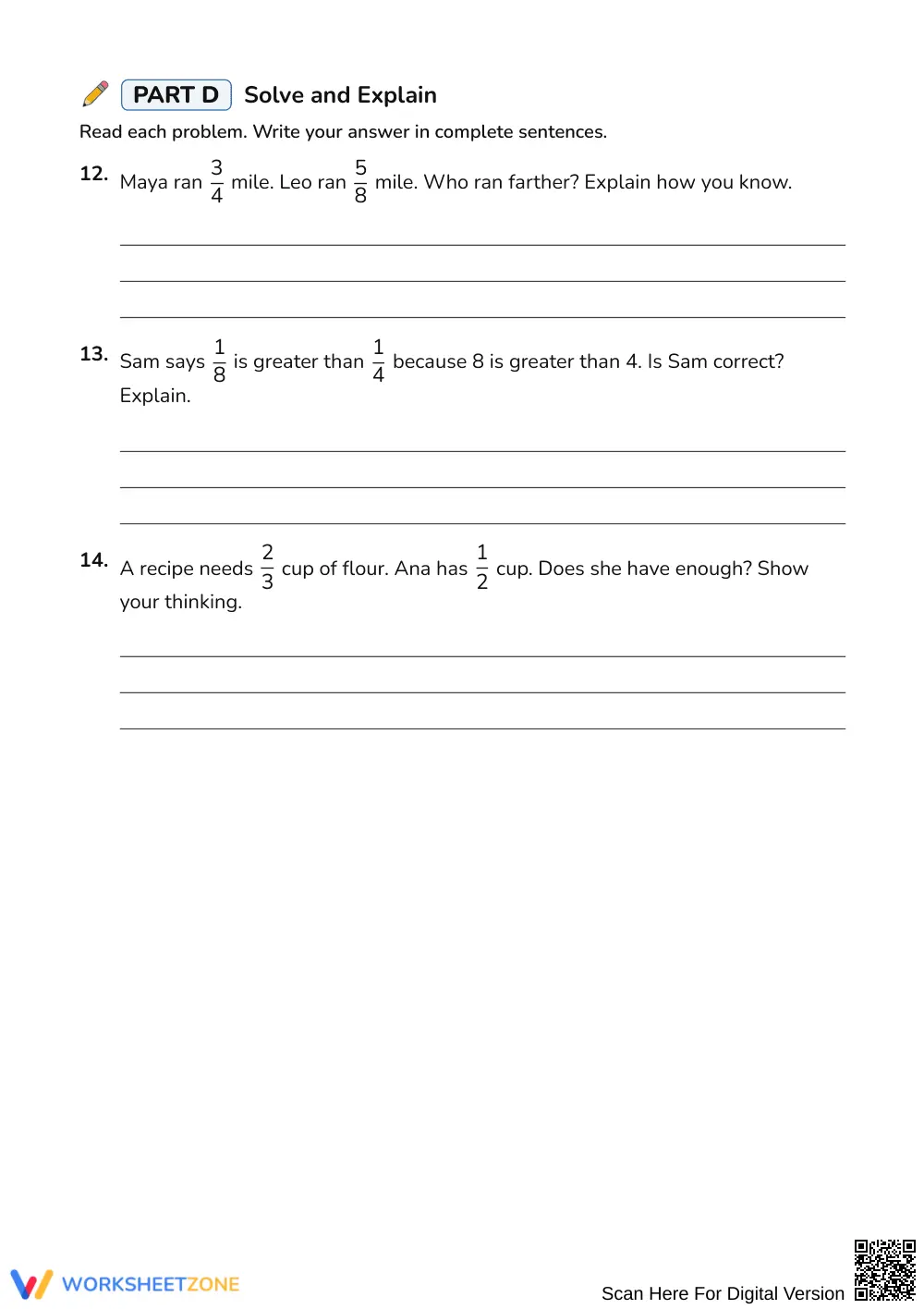
This 3-page assessment features 14 problems spanning visual number line interpretation, benchmark comparisons, symbolic inequality statements, and written contextual explanations. Students work with partitioned 0-to-1 lines and open response prompts. A comprehensive 3-page answer key provides complete solutions and model explanations for efficient grading.
Skill Progression
- Guided practice (Parts A & B, 2 tasks): High visual support with pre-partitioned number lines to identify coordinates and identify equivalent fractions.
- Supported practice (Part C, 6 tasks): Moderate support requiring students to insert <, >, or = symbols, order fractions, and identify proximity to 1/2.
- Independent practice (Part D, 3 tasks): Minimal support where students solve contextual word problems and explain mathematical reasoning in writing.
This structure follows the gradual-release framework, guiding students from scaffolded visual tasks to independent mathematical reasoning.
Standards Alignment
This worksheet aligns to `4.NF.A.2`: Compare two fractions with different numerators and different denominators, recognizing that comparisons are valid only when referring to the same whole, recording results with >, =, or <, and justifying conclusions using visual models. Supporting standard `4.NF.A.1` addresses fraction equivalence. Both standard codes can be copied directly into lesson plans, IEP goals, or district curriculum mapping tools.
How to Use It
Administer this assessment after direct instruction on fraction comparisons as a formal summative check, or divide sections across two days for small-group intervention. During completion, check whether students correctly use number line benchmarks rather than incorrectly assuming larger denominators mean greater values. Students typically complete all 14 problems in 35 to 45 minutes.
Who It's For
This resource serves fourth-grade classrooms, fifth-grade review groups, and special education students tracking IEP fractions goals. Provide fraction strips for students needing physical manipulatives, and challenge advanced learners to generate alternate equivalent fractions. Pair this worksheet with a benchmark fraction anchor chart showing fourths and eighths.
According to Fisher & Frey (2014), structured instructional progressions that guide students from concrete visual models to abstract symbolic reasoning significantly enhance conceptual retention in elementary mathematics. This Grade 4 worksheet aligns directly with standard 4.NF.A.2, requiring learners to compare fractions with unlike denominators on visual number lines. Across 14 targeted tasks, students progress through partitioned models, equivalent fraction recognition, symbolic inequality recording, and written justification. By integrating linear measurement models with open-ended explanation tasks, the assessment addresses persistent student misconceptions regarding denominator size and fraction magnitude. Teachers utilize the gradual-release structure to evaluate both procedural accuracy and mathematical discourse, confirming that learners comprehend why fractional parts decrease in size as denominators increase. The accompanying three-page answer key provides clear explanatory models, equipping educators with actionable diagnostic data to guide subsequent small-group remediation.


