































Compare Fractions on Number Lines: Complete Worked Examples

Paste this activity's link or code into your existing LMS (Google Classroom, Canvas, Teams, Schoology, Moodle, etc.).
Students can open and work on the activity right away, with no student login required.
You'll still be able to track student progress and results from your teacher account.
This Grade 4 fraction worksheet develops conceptual comparison skills through scaffolded number line models and incomplete worked examples. Fourth-grade students analyze visual intervals, complete missing reasoning steps, and justify inequality statements to build mathematical reasoning. By examining both common denominators and benchmark fractions like one-half, learners build lasting mastery over abstract fraction magnitudes.
At a Glance
- Grade: 4 · Subject: Math
- Standard:
4.NF.A.2— Compare two fractions with different numerators and denominators using number line models- Skill Focus: Comparing fractions using number lines and benchmarks
- Format: 3 pages · 14 problems · Answer key included · PDF
- Best For: Small-group intervention and guided fraction practice
- Time: 30–45 minutes
Spread across 3 structured pages, this resource features 14 sequential math tasks organized into four focused parts. Students study partitioned number line diagrams, complete missing analytical steps across three detailed worked examples, articulate conceptual written explanations, and solve independent comparison items. A complete 3-page answer key provides filled-in steps, sample explanations, and inequality solutions.
Skill Progression
- Guided practice (Parts A & B, 6 tasks): Students evaluate same-denominator intervals and compare different denominators using parallel number lines, completing missing reasoning prompts with visual scaffolding.
- Supported practice (Part C, 3 tasks): Learners use one-half as an explicit benchmark line, writing intermediate justifications to compare eighths and sixths.
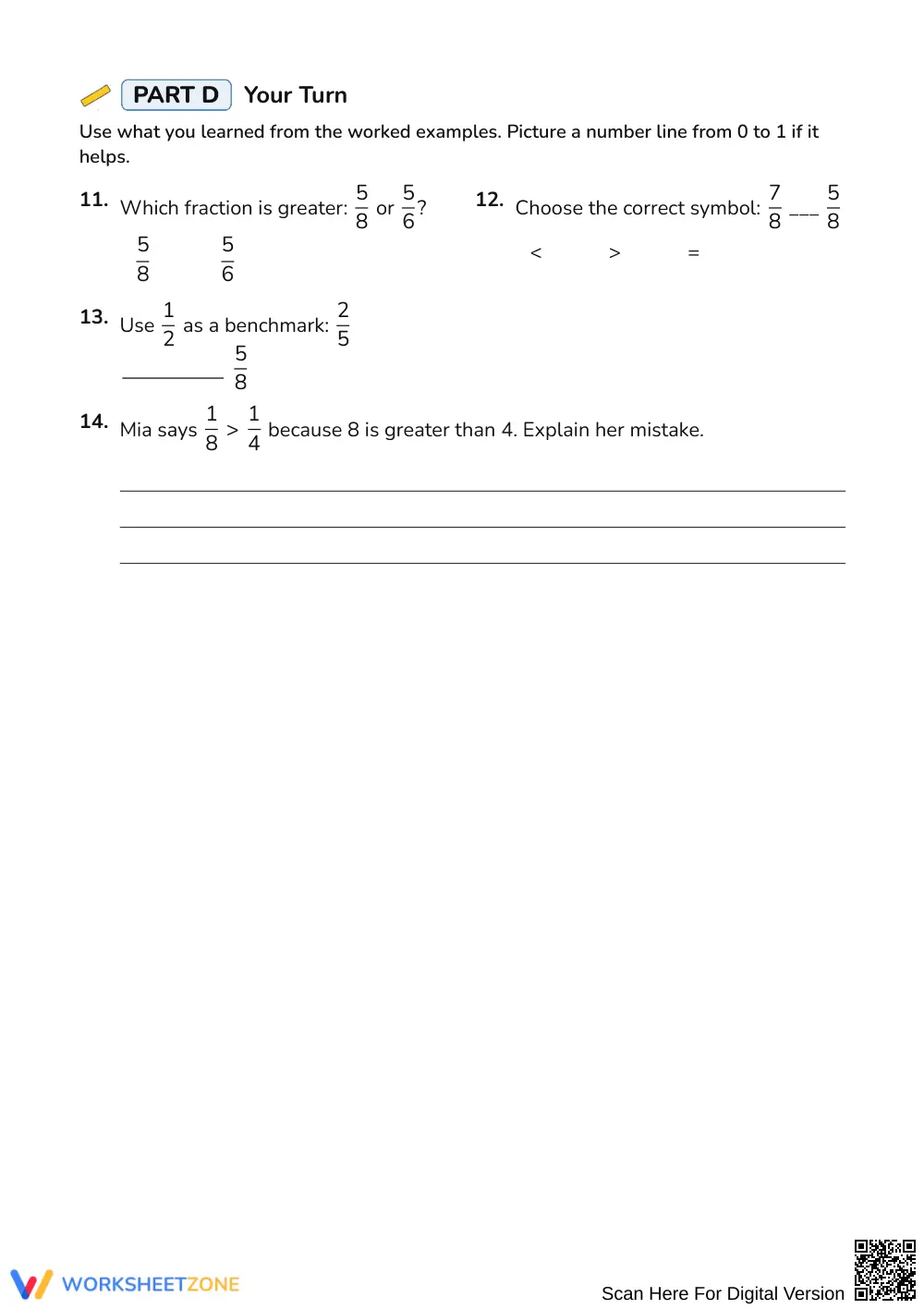
- Independent practice (Part D, 5 tasks): Students apply learned comparison strategies to choose symbols, evaluate partner reasoning, and independently explain common denominator misconceptions without visual prompts.
This sequence follows a gradual-release instructional model that transitions students smoothly from teacher-guided analysis to independent mathematical justification.
Standards Alignment
The primary standard addressed is `4.NF.A.2`: Compare two fractions with different numerators and different denominators by creating common denominators or numerators, or by comparing to a benchmark fraction such as 1/2. Supporting standard `4.NF.A.1` reinforces how visual fraction models represent equivalent parts of a whole. Both standard codes can be copied directly into lesson plans, IEP goals, or district curriculum mapping tools.
How to Use It
Implement this worksheet during core direct instruction or as targeted intervention following an introductory lesson on fraction equivalence. For formative assessment, observe Part B to verify whether students recognize that more equal pieces create smaller unit fractions, noting any confusion when comparing denominators. The entire 3-page packet requires approximately 30 to 45 minutes of instructional time.
Who It's For
This resource supports general education fourth-grade math classrooms, tiered math intervention groups, and special education students requiring visual representation of fraction size. Pair this worksheet directly with a concrete fraction tile demonstration or a classroom number line anchor chart during your guided practice block.
According to Fisher & Frey (2014), structured gradual release frameworks substantially improve student retention in elementary mathematics when guided worked examples precede independent problem solving. This Grade 4 instructional resource directly aligns with standard `4.NF.A.2` by requiring students to compare fractions with varying numerators and denominators through structured visual reasoning on number lines. Rather than relying on rote algorithmic tricks, learners examine interval partitions, complete missing logical deductions, and evaluate benchmark relationships relative to one-half. Evidence synthesized by Fisher & Frey (2014) shows that scaffolded steps reduce cognitive load, allowing fourth-grade mathematicians to internalize how partition density affects unit size before completing unprompted comparison items. Furthermore, justifying each step in writing solidifies mathematical communication standards and reinforces rigorous reasoning across diverse elementary learning environments. The final error-analysis prompt deepens conceptual clarity by challenging persistent whole-number bias misconceptions.


