































Compare Fractions on Number Lines: Complete Practice

Paste this activity's link or code into your existing LMS (Google Classroom, Canvas, Teams, Schoology, Moodle, etc.).
Students can open and work on the activity right away, with no student login required.
You'll still be able to track student progress and results from your teacher account.
Mastering fraction comparison requires students to visualize quantities along a continuum rather than comparing individual digits. This 2-page math worksheet provides 18 targeted exercises where fourth graders evaluate fractions with unlike denominators using number line intervals, benchmark reasoning, and written justifications.
At a Glance
- Grade: 4 · Subject: Math
- Standard:
4.NF.A.2— Compare fractions with different denominators using number line models- Skill Focus: Comparing fractions on number lines
- Format: 2 pages · 18 problems · Answer key included · PDF
- Best For: Independent accuracy practice and formative assessment
- Time: 25–35 minutes
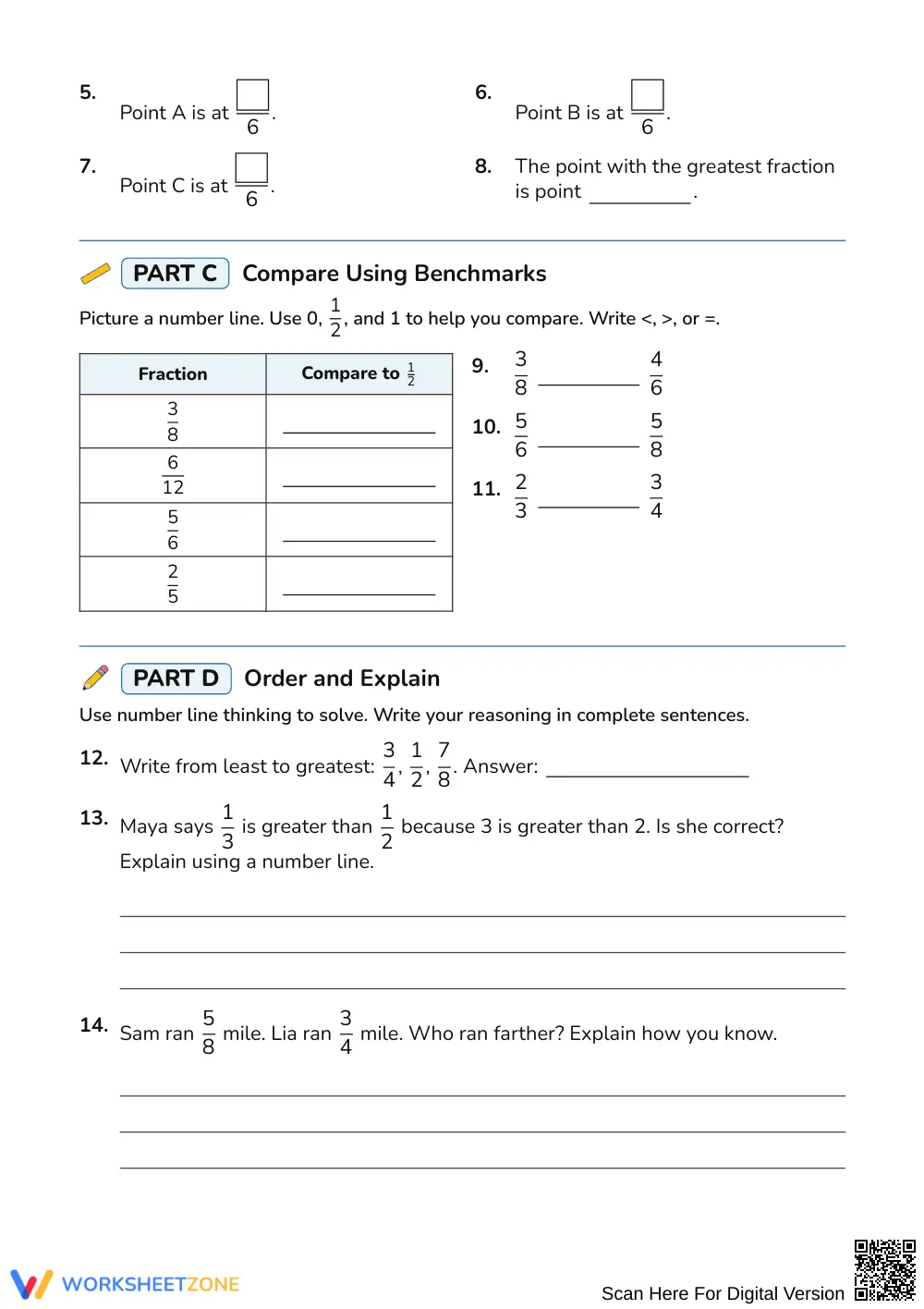
This resource features 18 structured problems across four sections on 2 student pages. Part A uses dual number lines comparing fourths and eighths. Part B requires identifying fractional points partitioned into sixths. Part C builds benchmark reasoning against 0, 1/2, and 1, and Part D prompts students to order fractions and write explanations that address common misconceptions. A complete 2-page answer key provides full solutions.
Skill Progression
- Guided practice (Parts A & B, 8 problems): Dual number lines and tick-mark coordinates scaffold direct visual fraction comparisons.
- Supported practice (Part C, 7 problems): Benchmark comparisons prompt students to evaluate fractions against one-half before comparing unlike pairs.
- Independent practice (Part D, 3 problems): Students order fractions and write explanations refuting denominator-size misconceptions.
This sequence applies gradual release, guiding learners from concrete visual models toward independent conceptual justification.
Standards Alignment
This worksheet aligns directly with `4.NF.A.2`: Compare two fractions with different numerators and denominators by reasoning about their size and referring to the same whole. It also supports `3.NF.A.2` by reinforcing fraction placement on number line diagrams. Both standard codes can be copied directly into lesson plans, IEP goals, or district curriculum mapping tools.
How to Use It
Assign this worksheet directly after introducing fraction benchmarks for independent practice, or split the pages: use Parts A and B for guided small-group review and Parts C and D for an exit ticket. During completion, check whether students still assume larger denominators indicate larger values. Expect student completion within 25 to 35 minutes.
Who It's For
This activity serves general education fourth-grade classrooms, math intervention groups, and students pursuing IEP fraction goals. Provide fraction strips for learners who need tactile scaffolding, or challenge advanced students to plot values on blank lines. Pair this sheet with a benchmark fraction anchor chart showing halves, fourths, and eighths.
According to Fisher & Frey (2014), structured independent practice solidifies conceptual understanding only when preceded by systematic visual modeling and progressive cognitive release. This Grade 4 mathematics resource operationalizes standard 4.NF.A.2 by guiding students through comparing fractions on the number line across 18 scaffolded tasks. Fourth-grade students often struggle with the counterintuitive relationship between denominator magnitude and fractional part size, mistakenly assuming larger digits denote greater value. By anchoring fraction comparisons in spatial measurement models rather than rote algorithmic rules, this worksheet helps learners accurately evaluate fractions with unlike denominators against benchmark values like one-half. Students demonstrate mastery not merely through inequality symbols, but through written justification and sequencing tasks that make mathematical reasoning visible. Educators receive a targeted instructional tool that builds durable mathematical competence, reinforces foundational number sense, and accurately documents individual student progress toward essential fraction standards.


