


























Views
Plays

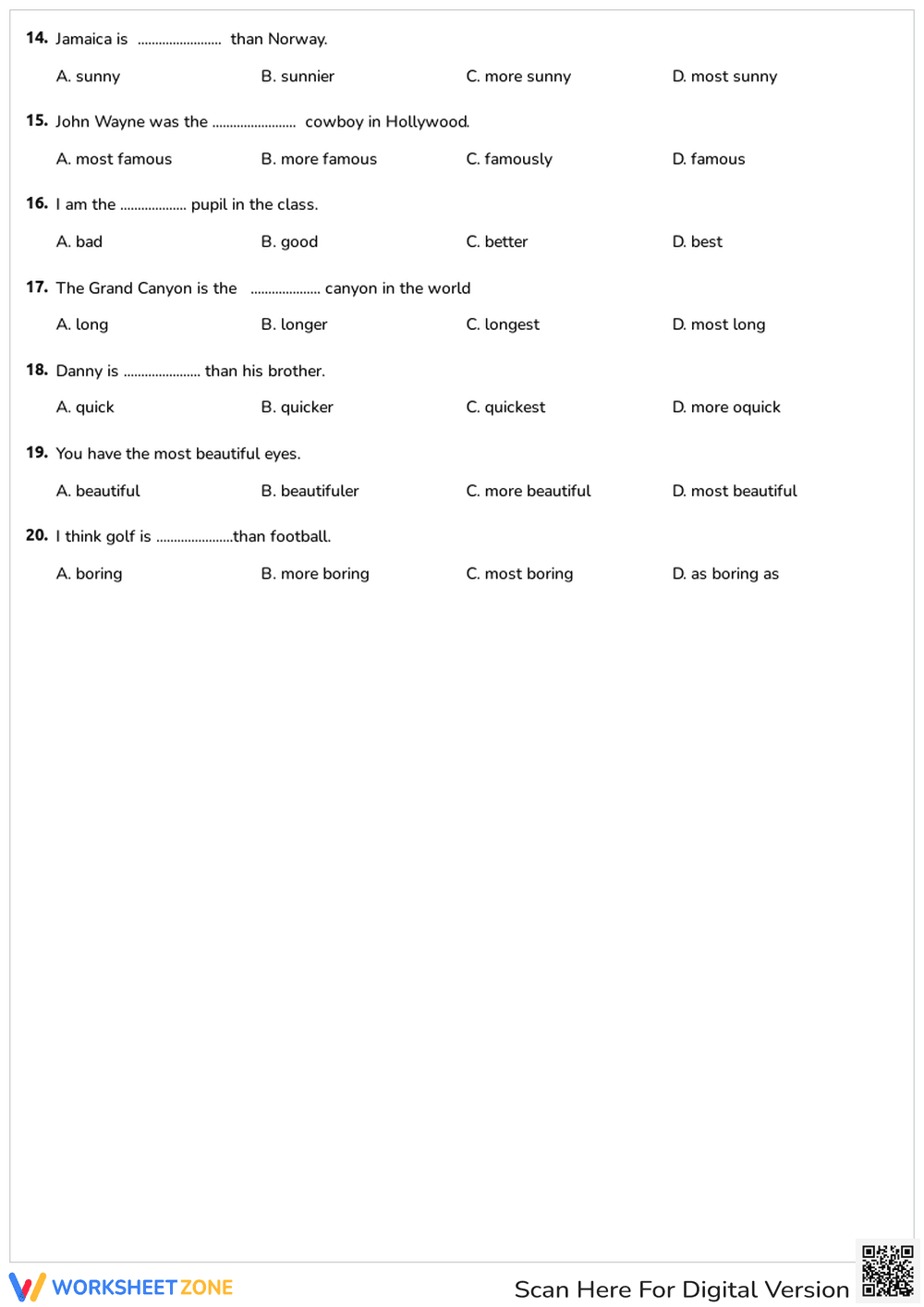

Grade 3 Comparatives & Superlatives — Printable Worksheet
Paste this activity's link or code into your existing LMS (Google Classroom, Canvas, Teams, Schoology, Moodle, etc.).
Students can open and work on the activity right away, with no student login required.
You'll still be able to track student progress and results from your teacher account.
This ready-to-use grammar worksheet helps students master comparative and superlative adjectives by applying them in context. By completing these targeted exercises, learners will strengthen their understanding of adjective forms and improve their sentence-level writing skills. The clear, multiple-choice format makes it an ideal tool for quick assessment or independent practice.
At a Glance
- Grade: 3 · Subject: ELA
- Standard:
CCSS.ELA-LITERACY.L.3.1.G— Form and use comparative and superlative adjectives.- Skill Focus: Comparative and Superlative Adjectives
- Format: 2 pages · 20 problems · PDF
- Best For: Independent practice and formative assessment
- Time: 15–20 minutes
Inside this resource, educators will find a comprehensive two-page quiz featuring 20 multiple-choice questions. Each task requires students to read a complete sentence and select the correct adjective form—base, comparative, or superlative—to complete the thought accurately. The structured layout provides clear options for each question, minimizing confusion and allowing students to focus entirely on the grammatical rules at hand.
This worksheet is designed for a smooth, zero-prep classroom experience:
- Print (1 minute): Simply download the PDF and print the two-page assessment. No special formatting or cutting is required.
- Distribute (1 minute): Hand out the worksheets to students for immediate use. The instructions are intuitive and self-explanatory.
- Review (3 minutes): The multiple-choice format allows for rapid grading or whole-class review. Total teacher prep time is under two minutes, making this an excellent emergency sub plan or quick morning work activity.
This resource is directly aligned to CCSS.ELA-LITERACY.L.3.1.G: Form and use comparative and superlative adjectives and adverbs, and choose between them depending on what is to be modified. It also supports general language acquisition and vocabulary development. Both standard codes can be copied directly into lesson plans, IEP goals, or district curriculum mapping tools.
Teachers can deploy this worksheet in multiple instructional moments. Use it as an independent practice activity immediately following direct instruction on adjective suffixes and irregular forms. Alternatively, assign it as a formative assessment at the end of a grammar unit to gauge mastery. While students work, observe whether they struggle more with irregular adjectives or standard suffix rules to guide your future mini-lessons. Expected completion time is 15 to 20 minutes.
This worksheet is primarily designed for third-grade students, though it serves as an excellent review for fourth and fifth graders needing foundational grammar reinforcement. The multiple-choice scaffolds make it accessible for English Language Learners (ELLs) who benefit from seeing the options written out. Pair this activity with a classroom anchor chart detailing the spelling rules for adding suffixes to base words.
Mastering grammar mechanics like CCSS.ELA-LITERACY.L.3.1.G, where students form and use comparative and superlative adjectives, is a critical stepping stone for developing sophisticated writing skills. According to Fisher & Frey (2014), providing students with structured, targeted practice on specific grammatical conventions significantly improves their ability to transfer those skills into their own independent writing. When learners repeatedly encounter and evaluate correct adjective forms in context, as they do in this 20-question format, they build the automaticity required for fluent communication. This focused repetition reduces cognitive load during the drafting process, allowing students to concentrate on higher-order tasks like organization and idea generation. By integrating this targeted practice into regular instruction, educators ensure that foundational language standards are firmly established, paving the way for more complex literacy achievements.


