




























Views
Downloads
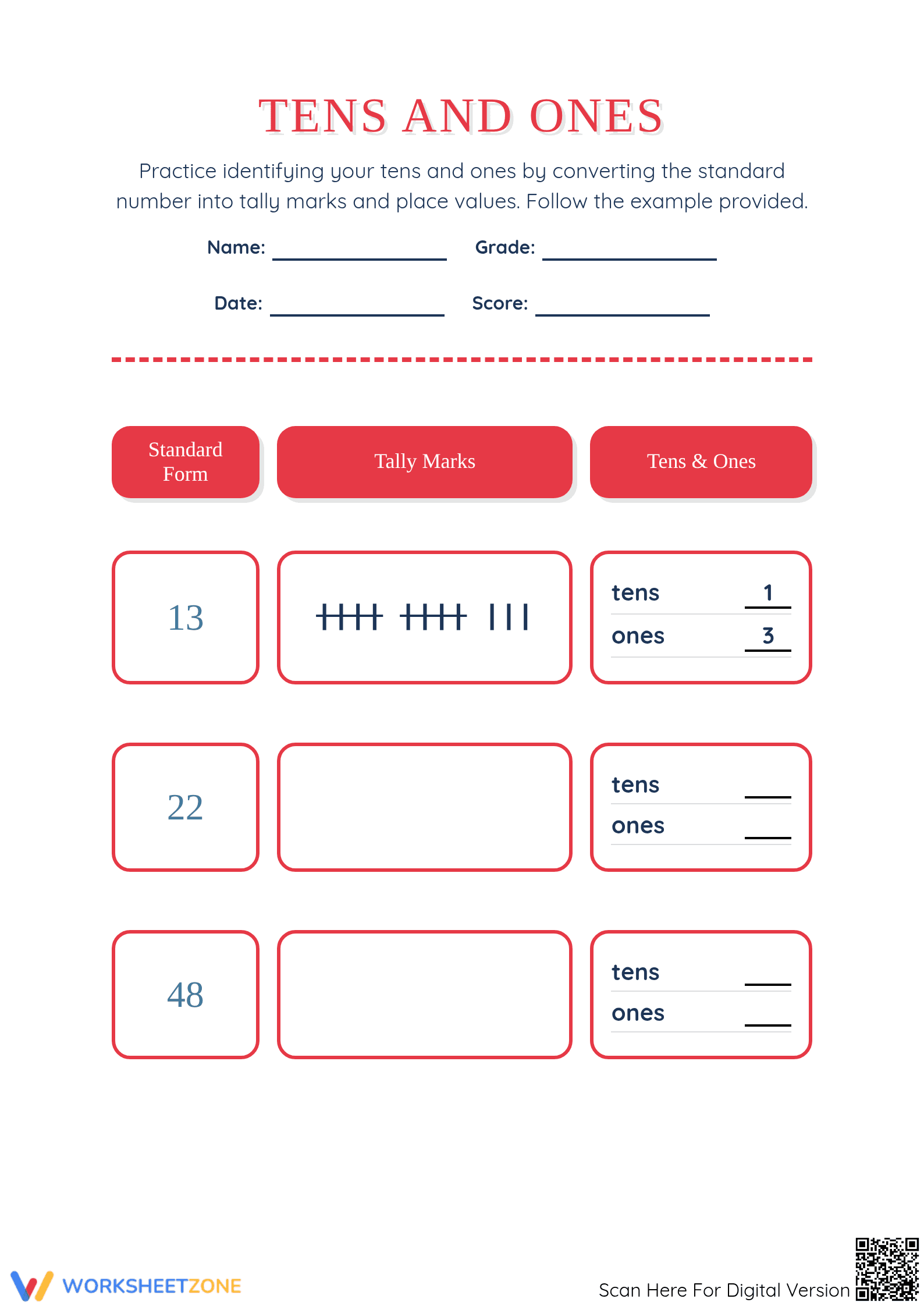


Printable Tens and Ones Math Worksheet | Grade 1 Essential

Paste this activity's link or code into your existing LMS (Google Classroom, Canvas, Teams, Schoology, Moodle, etc.).
Students can open and work on the activity right away, with no student login required.
You'll still be able to track student progress and results from your teacher account.
This Printable Tens and Ones Math Worksheet provides Grade 1 students with focused practice in decomposing two-digit numbers into their constituent place values. By bridging the gap between standard numerical forms, tally marks, and explicit tens and ones counts, learners build a robust conceptual foundation for base-ten understanding and early algebraic thinking.
At a Glance
- Grade: 1 · Subject: Mathematics
- Standard:
1.NBT.B.2— Represent two-digit numbers as groups of tens and ones using tallies- Skill Focus: Place Value Decomposition & Tally Mark Representation
- Format: 3 pages · 11 problems · Answer key included · PDF
- Best For: Independent math centers and homework practice
- Time: 15–20 minutes
What's Inside
This three-page instructional resource features 11 structured problems designed to reinforce place value concepts. Each task presents a standard form number ranging from 10 to 82 and requires the student to generate the corresponding tally mark representation and identify the specific number of tens and ones. The first page includes a clear worked example to model the expected response format, ensuring students can work independently.
Zero-Prep Workflow
The workflow for this resource is designed for maximum teacher efficiency. First, print the three-page PDF in less than one minute. Second, distribute the sheets to your students during your math block. Finally, use the provided answer key for rapid review or peer-grading. With a total preparation time of under two minutes, this worksheet is an ideal solution for unexpected substitute plans or as a transition activity.
Standards Alignment
The primary alignment for this resource is 1.NBT.B.2, which dictates that students must understand the meaning of digits in the tens and ones places. By requiring students to draw tally marks, it also supports data representation skills through visual counting. These standard codes can be copied directly into lesson plans, IEP goals, or district curriculum mapping tools to ensure compliance with mathematics frameworks.
How to Use It
Use this worksheet as a formative assessment after an introductory lesson on place value. Distribute it during independent work time to observe which students struggle with the transition from visual tallies to numerical place value labels. This completion usually takes 15 to 20 minutes. Alternatively, assign individual pages as targeted homework to reinforce classroom learning and encourage discussion about number structure.
Who It's For
This resource is specifically tailored for first-grade students but serves as an excellent intervention tool for second graders needing additional support with base-ten concepts. The clear, uncluttered layout and comic headers appeal to young learners while providing the white space necessary for drawing tally marks. It pairs naturally with physical manipulatives like base-ten blocks or a classroom place value anchor chart.
Place value mastery is the single most critical predictor of later success in multi-digit arithmetic and algebraic reasoning. According to EdReports (2024), curriculum materials that emphasize the decomposition of numbers into tens and ones are essential for developing the number sense required by the Common Core State Standards. This worksheet directly addresses 1.NBT.B.2 by requiring students to translate between standard numerical symbols, visual representations, and explicit place value counts. This multi-modal approach aligns with the research-based Concrete-Representational-Abstract instructional sequence, providing the representational bridge students need to internalize the value of digits. By engaging with 11 varied problems across three pages, students receive the repetitive practice necessary for fluency while maintaining engagement through a clean, accessible layout. Educators can confidently cite this resource as a standards-aligned tool for building foundational mathematical literacy in early elementary settings.


