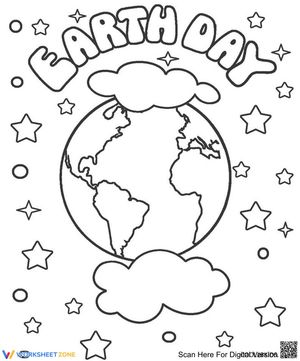
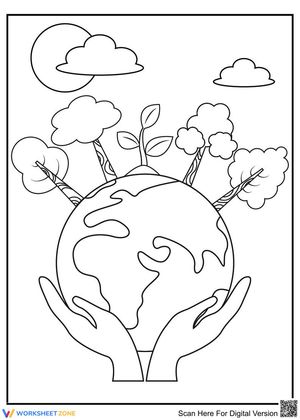
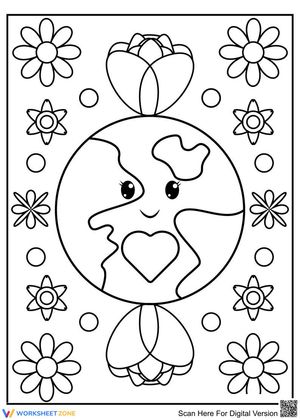
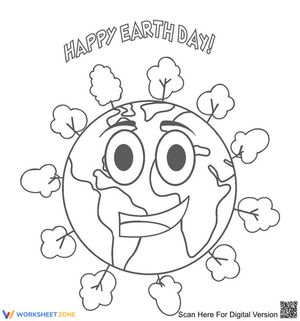
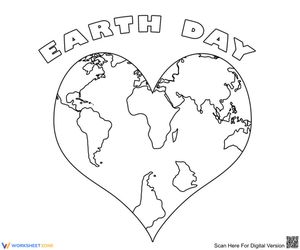
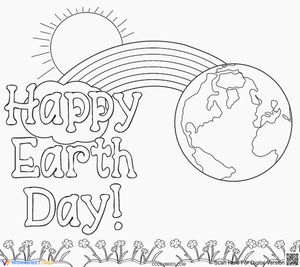
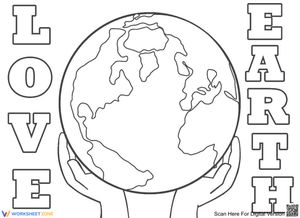
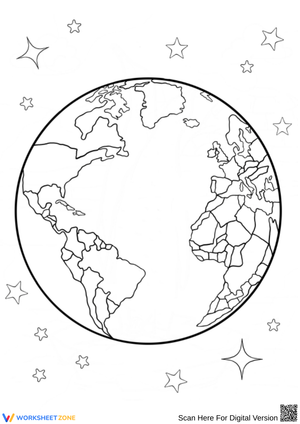
Most Earth coloring pages show a rounded globe with land shapes separated from open ocean space, ready for a marker or pencil. Some designs use a smiling cartoon face on the globe, while others go realistic with thin continent borders and small mountain or forest icons. Clouds usually appear as loose swirls drifting across the surface, and many sheets add a sun, stars, or a simple space backdrop behind the planet to give the page some depth without crowding the main outline.
What's Inside the Collection
The set mixes several styles so every age finds a fit: a grinning cartoon Earth for quick coloring, a labeled continents-and-oceans map for geography practice, an Earth-in-space scene with stars and a rocket or moon, and an Earth paired with plants, recycling symbols, or a watering can for an eco-themed sheet. Some pages isolate a single hemisphere for a bigger, easier-to-color view, while others show the full globe floating against a dark sky for a more dramatic look.
Matching the Right Page to Age and Skill
Toddlers and preschoolers do best with thick-outline globes that have big, simple continent shapes and no fine detail to stay inside. Grade schoolers can handle labeled continents and oceans, which double as a light geography review while they color. Teens and adults often prefer the realistic space-view pages, where finer coastlines, cloud texture, and shading opportunities make the printable feel less like a kids' worksheet and more like a relaxing art project.
Frequently Asked Questions
1. What colors work best for oceans and continents?
Classic choices are blue or teal shades for oceans, green and brown for land, and white or light gray for cloud swirls. A light blue or black background works well for space scenes with stars. Colored pencils let you blend ocean shades near coastlines, while markers give continents bold, even color that reads clearly from across a room or bulletin board.
2. Can this double as a geography lesson?
Yes. Pages that outline the 7 continents and 5 oceans let kids trace and name each landmass while coloring, which reinforces basic world geography without a formal lesson feel. Parents and teachers can pair the page with a quick discussion about continent names or ocean locations, turning a coloring break into a light, low-pressure geography review for young learners.
3. What is a surprising fact about Earth's colors?
Earth looks blue from space because oceans cover roughly 71 percent of its surface, far more than the green and brown land shown on most coloring pages. That is why realistic space-view printables lean heavily on blue tones with only small patches of land poking through swirling white clouds, giving colorers a true sense of how watery the planet actually looks from orbit.












 Interactive Worksheet Maker
 Quiz Maker
 Word Search Maker
 Crossword Puzzle Maker
 Word Scramble Generator
 Sentence Scramble Generator
 Handwriting Worksheet Generator
 Name Tracing Generator
 Fill In The Blank Generator