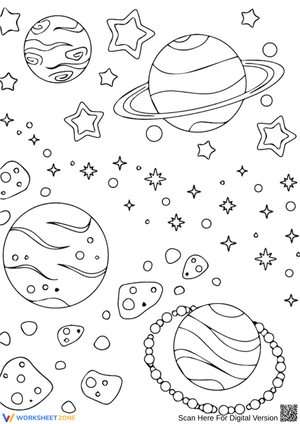
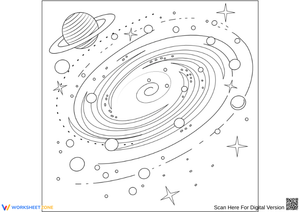
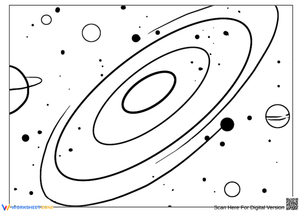
These galaxy coloring pages capture the swirling structure that makes galaxies so recognizable: curling spiral arms, dense star clusters, and soft nebula clouds rendered in clean black line art. Some sheets center on a single barred spiral galaxy similar to the Milky Way, while others scatter dozens of pinprick stars across an open background. Comets streak past ringed planets, and wispy gas clouds curl around bright starbursts near the center of the page. The linework stays bold enough for younger colorists to follow easily, yet leaves plenty of open space for older kids and adults who want to add fine shading, blended gradients, or metallic gel pen highlights on top.
What's Inside This Space Coloring Collection
The set mixes spiral galaxies, starry night skies, ringed planets, comets, and small astronaut scenes so browsers can print a single sheet or build a full space-themed pack for a bedroom or party table. A few designs pair a swirling galaxy with a rocket ship or telescope for extra storytelling detail, while others keep the frame simple with just stars and dust clouds drifting across the page. Younger kids can pick large-swirl designs with thick outlines and fewer small shapes, while teens and adults can choose denser patterns packed with tiny stars and layered nebula shapes for a longer, more detailed coloring session.
Printing Setup and Shading Tips for Dark Backgrounds
Because galaxy scenes often include large black or heavily shaded areas, print on heavier 28 to 32-lb paper so ink and marker don't bleed through or warp the sheet. Choose the 'best' or 'high quality' print setting rather than draft mode to keep fine star dots and thin spiral lines crisp instead of blurry. When coloring, layer dark blue, purple, and black first to build the background, then add pops of yellow, pink, or white gel pen for stars and glowing nebula centers. Blending colored pencils in small circular strokes creates a soft, smoky nebula effect, while a white gel pen dotted on top mimics scattered starlight across the page.
Frequently Asked Questions
1. What colors work best for shading a nebula?
For a realistic glow, start with a base layer of navy, indigo, or deep purple across the background, then blend in magenta or teal toward the center of the nebula cloud. Add bright yellow or white for star cores and small scattered dots throughout the page. Colored pencils blended with light pressure create a soft, cloudy look, while markers give bolder contrast for a poster-style finish. Metallic or glitter gel pens work well as a final layer for tiny stars.
2. What printer settings work best for dark designs?
Galaxy coloring pages often include large shaded or black areas, so choose the 'best' or 'photo' quality setting instead of draft mode to keep fine details sharp and readable. Printing on 28 to 32-lb paper prevents markers and gel pens from bleeding through thin, standard copy paper. Keep toner or ink cartridges full before a big print run, since dense star fields and nebula shading use noticeably more ink than typical simple line art pages.
3. What is a surprising fact about the Milky Way?
The Milky Way, our home galaxy, stretches about 100,000 light-years across and holds roughly 100 billion stars, yet it's just one of more than 100 billion galaxies scientists estimate exist in the observable universe. Some galaxies are dwarf-sized with only a few million stars, while giant elliptical galaxies can hold over a trillion. That huge range in scale is part of why galaxy coloring pages come in so many shapes and star densities.












 Interactive Worksheet Maker
 Quiz Maker
 Word Search Maker
 Crossword Puzzle Maker
 Word Scramble Generator
 Sentence Scramble Generator
 Handwriting Worksheet Generator
 Name Tracing Generator
 Fill In The Blank Generator