


























Views
Downloads

Farm Animals Coloring Page | Essential Grade K-2 Ready
Paste this activity's link or code into your existing LMS (Google Classroom, Canvas, Teams, Schoology, Moodle, etc.).
Students can open and work on the activity right away, with no student login required.
You'll still be able to track student progress and results from your teacher account.
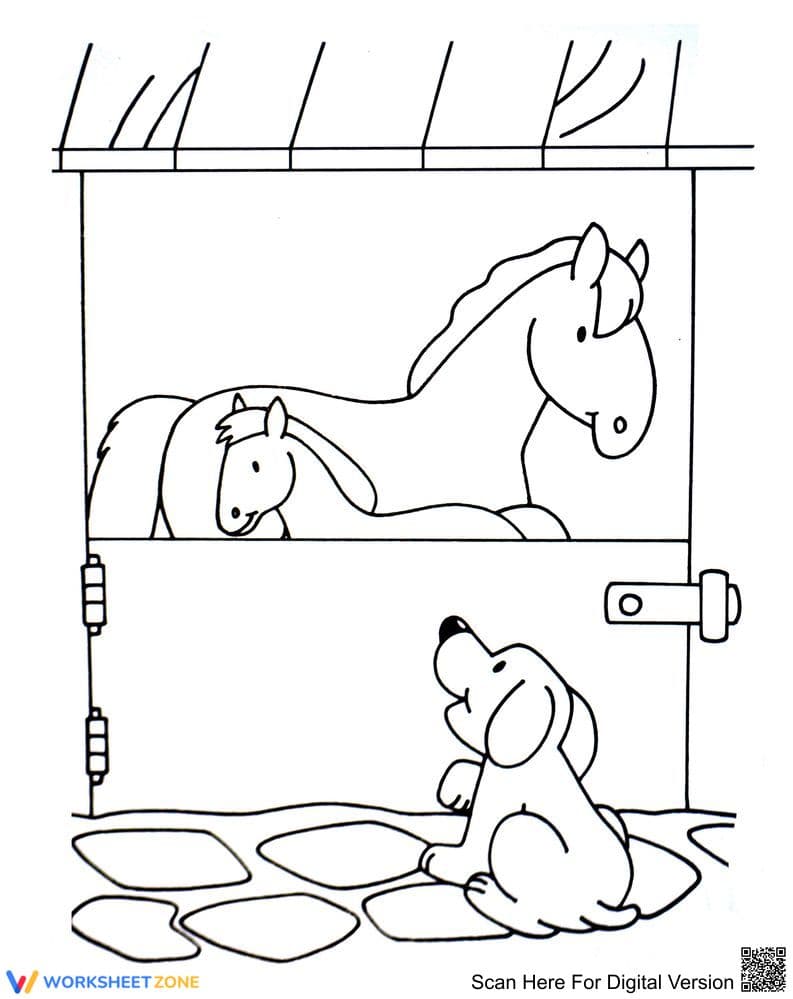
This farm animals coloring worksheet provides early learners with a creative outlet to develop fine motor control. By engaging with the scene of horses and a dog, students practice focus and artistic expression while reinforcing animal vocabulary. It serves as a bridge between creative play and structured classroom activity.
At a Glance
- Grade: K-2 · Subject: Arts & English
- Standard:
CCSS.ELA-LITERACY.SL.K.5— Add visual displays to descriptions to provide additional detail and clarity- Skill Focus: Fine motor skills & animal identification
- Format: 1 page · 1 task · No answer key needed · PDF
- Best For: Morning work or early finishers
- Time: 15–20 minutes
Inside this resource, you will find a single-page illustration featuring a horse and foal in a stable alongside a friendly dog. The clear, bold outlines are designed for young children mastering their grip and spatial awareness. The scene encourages narrative thinking, as students can imagine the conversation happening between the animals while they work.
The zero-prep workflow for this worksheet is designed for maximum efficiency. First, print the single PDF page (30 seconds). Second, distribute the sheets along with crayons or colored pencils to your students (1 minute). Third, review the completed work by asking students to describe the colors they chose or the story they imagined (1 minute). Total teacher preparation time is under 2 minutes, making it an ideal choice for unexpected schedule changes or sub plans.
This worksheet aligns with `CCSS.ELA-LITERACY.SL.K.5`, which encourages students to use visual displays to enhance their descriptions. While primarily an artistic task, it supports language development by providing a concrete visual for oral storytelling. Both standard codes can be copied directly into lesson plans, IEP goals, or district curriculum mapping tools.
Use this worksheet as a calming transition activity after recess or as a thematic extension during a unit on farm life. For a formative assessment, observe how students handle the coloring tools; look for proper pencil grip and the ability to stay within lines as indicators of fine motor development. Completion typically takes 15 to 20 minutes depending on the student's detail level.
This resource is ideal for Kindergarten and First Grade students, as well as English Language Learners (ELL) who benefit from visual aids to learn animal names. It pairs naturally with a read-aloud book about farms or an anchor chart identifying different animal body parts like manes, hooves, and tails.
Research from Fisher & Frey (2014) emphasizes the importance of visual literacy and the role of drawing in the gradual release of responsibility model. By providing students with a structured visual task like this coloring page, educators support the development of pre-writing skills and cognitive focus. The use of thematic imagery, such as the farm animals depicted here, helps anchor new vocabulary in a familiar context, which is essential for early literacy acquisition. According to the NAEP, students who engage in integrated arts and literacy activities often show higher levels of engagement and retention. This worksheet facilitates that integration by allowing students to interact with the standard CCSS.ELA-LITERACY.SL.K.5 through a low-stakes, high-interest medium. It ensures that even the youngest learners can participate in standards-aligned work while building the physical stamina required for more intensive writing tasks later in their academic careers.


