




























Views
Downloads
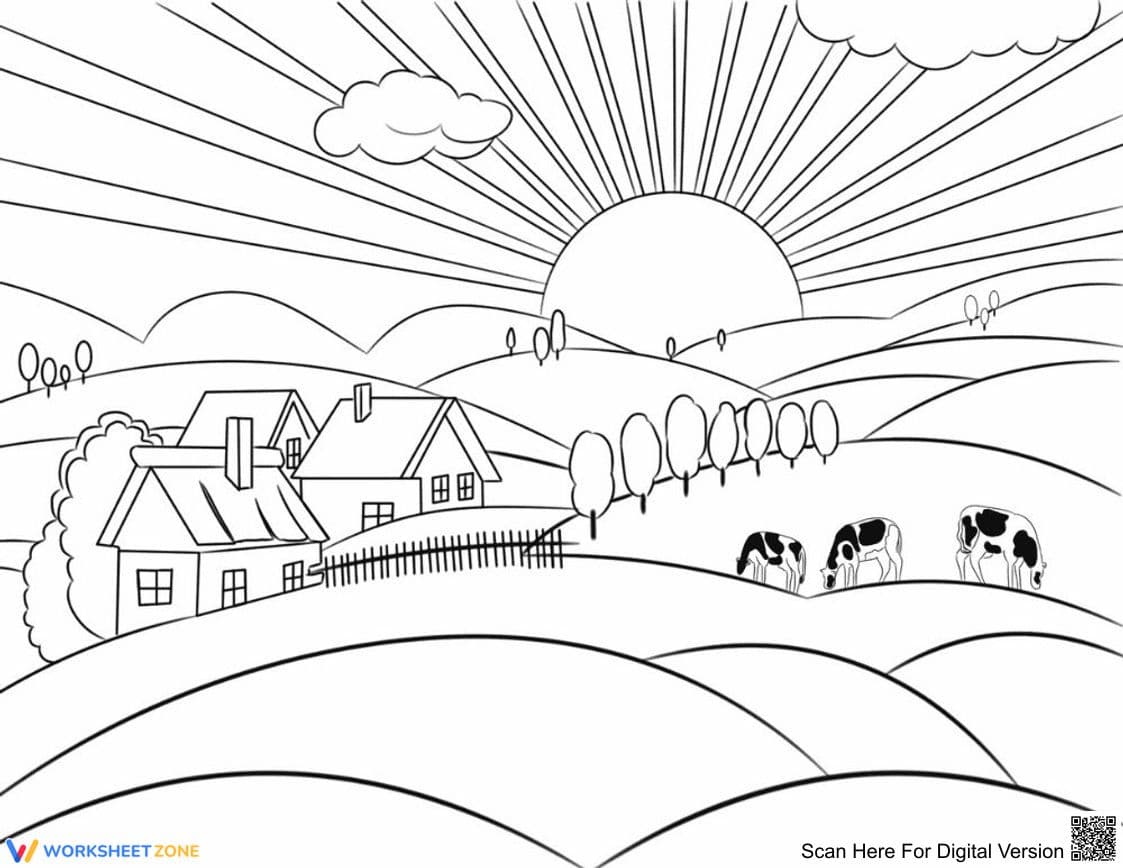

Dawn at the Farm Coloring Page | Essential Grade K-2

Paste this activity's link or code into your existing LMS (Google Classroom, Canvas, Teams, Schoology, Moodle, etc.).
Students can open and work on the activity right away, with no student login required.
You'll still be able to track student progress and results from your teacher account.
This Dawn at the Farm coloring page provides early learners with a creative outlet to develop fine motor control and visual spatial awareness. By focusing on a detailed landscape, students engage with environmental themes while practicing the precision required for handwriting and artistic expression. It serves as a perfect supplement to farm-themed units or morning routines.
At a Glance
- Grade: Kindergarten · Subject: Arts & ELA
- Standard:
CCSS.ELA-LITERACY.SL.K.5— Add drawings or visual displays to descriptions to provide additional detail- Skill Focus: Fine motor skills & color theory
- Format: 1 page · 1 task · No answer key · PDF
- Best For: Morning work or early finishers
- Time: 15–20 minutes
This single-page PDF features a high-quality line art illustration of a rural farm at sunrise. The scene includes two farmhouse structures, a wooden fence, rolling hills, and three cows grazing in the pasture. The prominent sun with radiating beams encourages students to experiment with warm colors as suggested in the prompt, helping them distinguish between different palettes in visual arts.
The zero-prep design ensures this resource is ready for immediate classroom use. First, print the required number of copies in less than 1 minute. Second, distribute the pages during a transition period or as part of a literacy center. Third, review the completed work by having students describe the colors they chose, taking approximately 5 minutes of instructional time. This workflow is ideal for substitute teacher folders.
This resource aligns with `CCSS.ELA-LITERACY.SL.K.5`, which encourages students to use visual displays to enhance their descriptions. By coloring the dawn scene, students create a visual representation of a specific time of day, supporting vocabulary development related to nature and the environment. This standard code can be copied directly into lesson plans, IEP goals, or district curriculum mapping tools.
Use this worksheet as a calming activity after recess or as a creative extension following a read-aloud about farm life. Teachers can observe pencil grip and pressure as a formative assessment of fine motor development. Expect students to spend 15 to 20 minutes completing the scene with a variety of media like crayons or colored pencils. It works well as a quiet-time task.
This activity is designed for Kindergarten through 2nd-grade students, including those in special education settings who benefit from high-contrast visual tasks. It pairs naturally with farm-themed picture books or anchor charts detailing the parts of a farm. The clear lines make it accessible for students still developing their grip strength.
Research by Fisher & Frey (2014) emphasizes the importance of visual representation in the gradual release of responsibility model, noting that artistic expression helps solidify conceptual understanding in early childhood. This farm-themed coloring page supports `CCSS.ELA-LITERACY.SL.K.5` by allowing students to engage with descriptive concepts through a non-verbal medium. Integrating fine motor practice with thematic content has been shown to improve engagement and retention in 1st-grade populations. According to the NAEP, students who participate in integrated arts and literacy activities demonstrate higher levels of motivation. This worksheet provides a structured yet flexible environment for students to explore color theory and environmental details. By using this resource, educators provide a 1-page tool that bridges the gap between creative play and academic standards, ensuring that even filler activities contribute to the development of essential motor skills and visual literacy.


