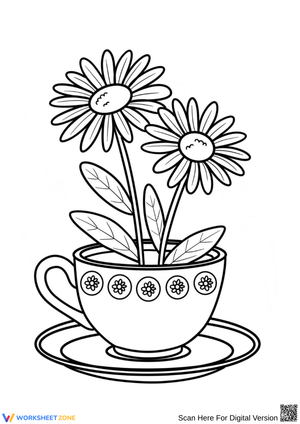
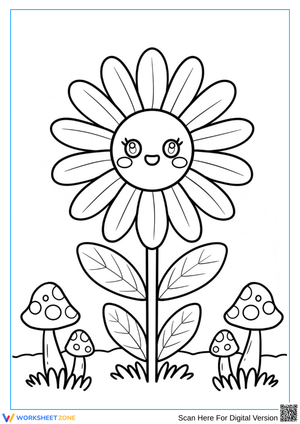
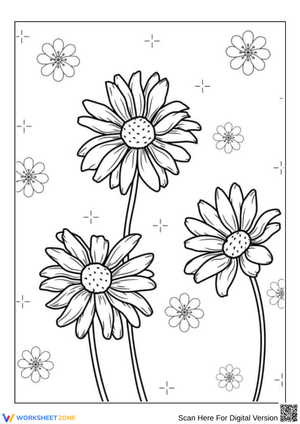
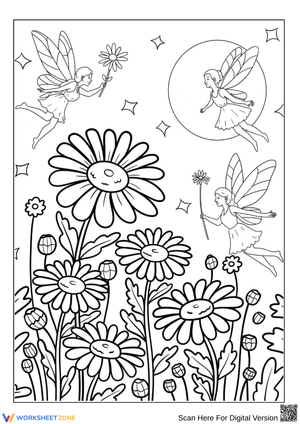
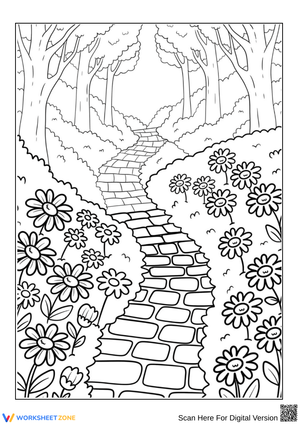
A daisy's shape makes it one of the friendliest flowers to color: a ring of long white petals circling a round yellow center. That radial layout gives kids and beginners clean lines to fill in without tricky curves or tiny details. The white ray petals and the disc-shaped middle are actually two flower types in one bloom, so shading them differently, cream petals against a golden center, adds contrast without extra effort. Bold outlines on our daisy coloring pages keep the design readable even after heavy crayon or marker strokes, which is why this flower stays a go-to subject for quick, satisfying coloring sessions.
What's Inside the Daisy Collection
This set ranges from single close-up blooms to busier scenes. You'll find one daisy centered on a page for a fast project, small daisy chains and bouquets tied with ribbon, and full daisy fields with grass, butterflies, or bees sharing the space. Some sheets pair daisies with garden borders or simple pots, useful for spring cards or journal covers. Each printable page is sized for standard US Letter paper, so the line art prints crisp and full-frame whether you're using an inkjet printer at home or a school copier.
Matching Pages to Age and Skill Level
Toddlers and preschoolers do best with the single bold-outline daisy designs, since fewer petals and a big open center mean less room to go outside the lines. Grade-schoolers can handle daisy chains and paired flower-and-bug scenes that add a bit of storytelling. Teens and adults looking for a slower, more relaxing activity should reach for the detailed garden and bouquet pages, which include layered petals, background texture, and smaller spaces that reward colored pencils or fine-tip markers over crayons.
Frequently Asked Questions
1. How difficult are daisy coloring pages for kids versus adults?
Single-bloom pages with thick outlines suit toddlers and early grade-schoolers since there's little detail to manage. Adult and teen versions swap in daisy fields, bouquets, or garden scenes with layered petals and background elements, giving older colorers more surface area and finer lines to fill without feeling babyish.
2. What colors work best for a realistic daisy?
Keep petals white, cream, or the palest yellow with light gray shadow lines near the base for depth. The center disc looks most realistic built from golden yellow with small strokes of orange or brown toward the middle, mimicking the tiny disc florets that make up a real daisy's core.
3. What occasions suit daisy coloring pages best?
Daisies fit spring activities, Mother's Day cards, and Easter baskets thanks to their cheerful, simple look. Classrooms use them for bulletin boards or quiet-time worksheets, while adults often pick the more detailed bouquet and garden pages for a short, screen-free coloring break at home or during travel.
4. What's a surprising fact behind the daisy's design?
The name daisy comes from the Old English 'day's eye,' since the flower opens at dawn and closes at dusk. Each bloom is really two flowers combined, white ray petals and a yellow disc center, and petal counts often follow Fibonacci-like patterns such as 13, 21, or 34, which is why petal-counting games rarely repeat the same result twice.












 Interactive Worksheet Maker
 Quiz Maker
 Word Search Maker
 Crossword Puzzle Maker
 Word Scramble Generator
 Sentence Scramble Generator
 Handwriting Worksheet Generator
 Name Tracing Generator
 Fill In The Blank Generator