


























Views
Downloads

Printable Close Reading Annotations | Grade 4 ELA
Paste this activity's link or code into your existing LMS (Google Classroom, Canvas, Teams, Schoology, Moodle, etc.).
Students can open and work on the activity right away, with no student login required.
You'll still be able to track student progress and results from your teacher account.
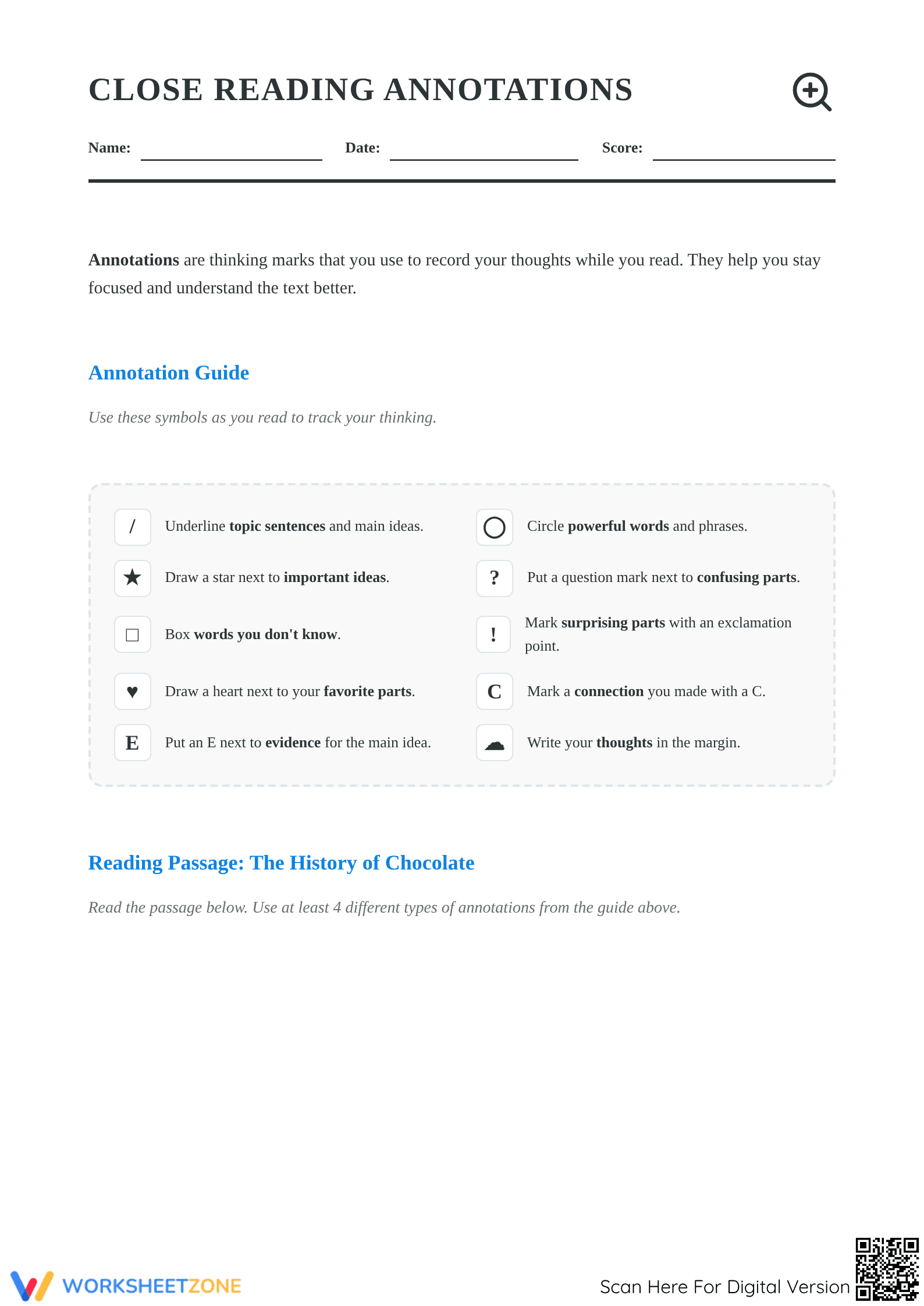
This Grade 4 and 5 ELA worksheet equips students with essential close reading annotation skills to improve comprehension. By introducing a clear set of thinking marks, students learn to actively engage with texts, identify main ideas, and note confusing parts while reading a nonfiction passage about the history of chocolate.
At a Glance
- Grade: 4 · Subject: ELA
- Standard:
CCSS.ELA-LITERACY.RI.4.1— Refer to details and examples in a text- Skill Focus: Close Reading Annotations
- Format: 3 pages · 5 problems · Answer key included · PDF
- Best For: Independent practice and sub plans
- Time: 20–30 minutes
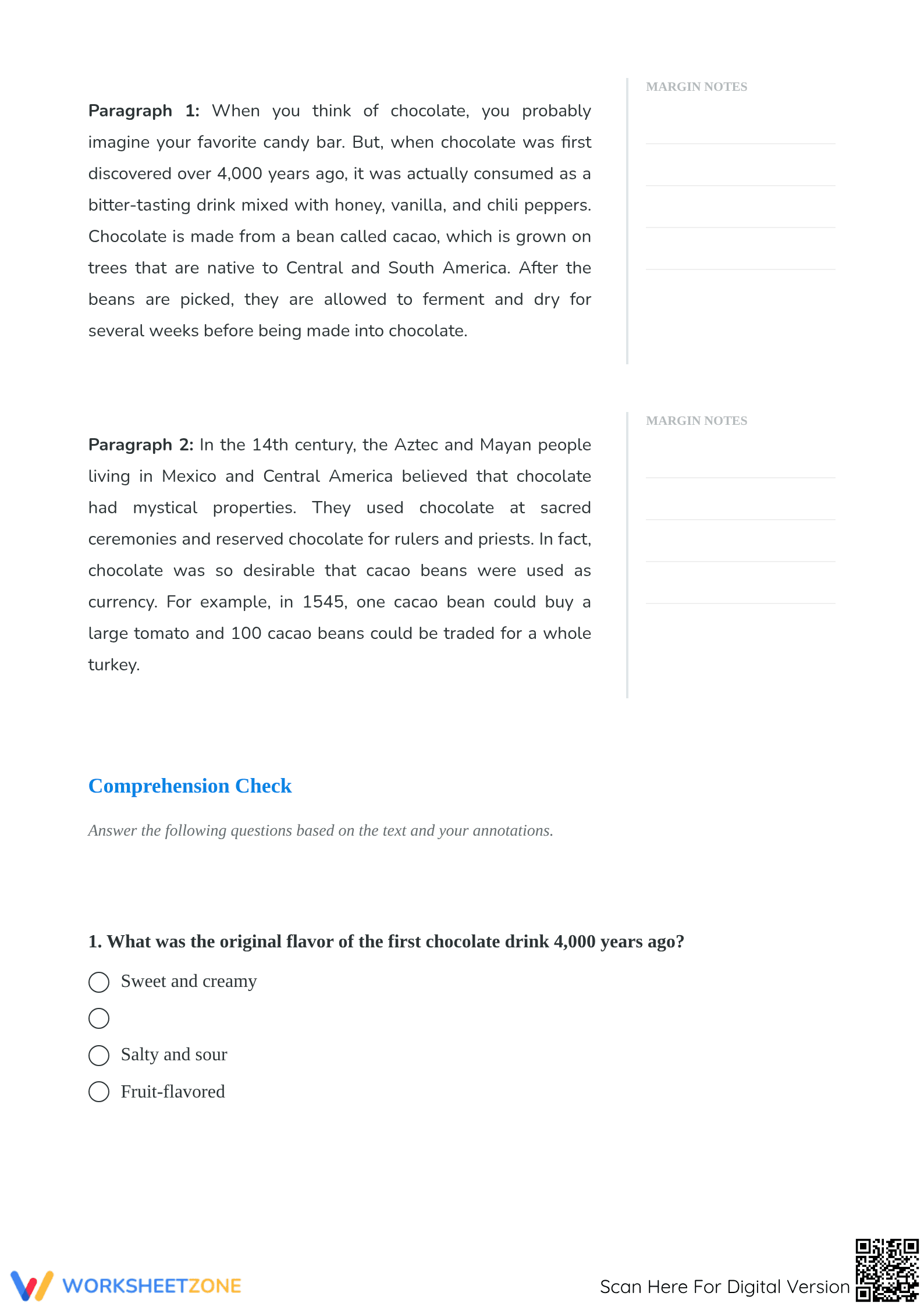
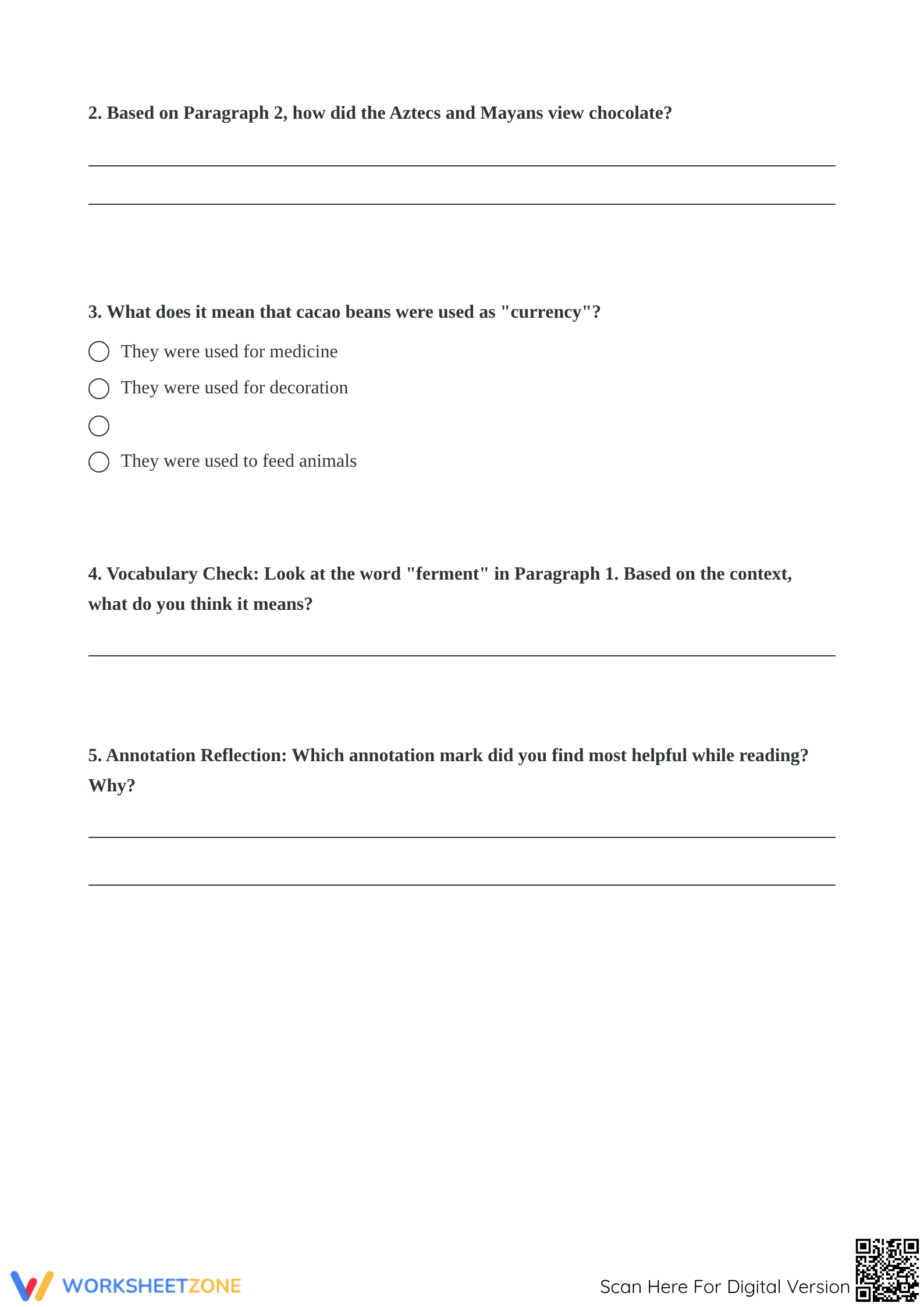
Inside this resource, educators will find a three-page activity designed to build active reading habits. The first page features a clear Annotation Guide with ten specific symbols. The following pages contain a two-paragraph informational text about chocolate, complete with margin space for notes, followed by five comprehension questions including multiple-choice, short answer, and vocabulary checks. A complete answer key is provided.
Zero-Prep Workflow
This self-explanatory worksheet is designed for immediate use with minimal setup.
- Print (1 min): Download the PDF and print the three-page packet. The built-in guide means no extra anchor charts are needed.
- Distribute (1 min): Hand out the packets. Instructions are clear enough for immediate independent work.
- Review (3 mins): Use the included key to quickly check the five questions and review annotation marks.
With a total prep time under two minutes, this is highly suitable for emergency sub plans.
Standards Alignment
This worksheet is aligned to CCSS.ELA-LITERACY.RI.4.1, requiring students to refer to details and examples in a text when explaining what it says explicitly. It also supports RI.5.1 by encouraging fifth graders to quote accurately. Both standard codes can be copied directly into lesson plans, IEP goals, or district curriculum mapping tools.
How to Use It
Use this during the "We Do" phase of a reading lesson to model applying the annotation guide, then have students complete the rest independently. Alternatively, assign it as a standalone literacy center. As a formative assessment observation tip, walk around and check if students are actively using the symbols, particularly the question mark for confusing parts. Expected completion time is 20 to 30 minutes.
Who It's For
This worksheet is designed for fourth and fifth-grade students developing reading comprehension. The explicit visual symbols provide strong scaffolding for students who struggle with focus. Pair this resource with a direct instruction lesson on finding the main idea or a unit on Mesoamerican history.
Developing active reading habits is critical for upper elementary students transitioning to more complex informational texts. This resource directly targets CCSS.ELA-LITERACY.RI.4.1, helping students refer to details and examples in a text. According to Fisher & Frey (2014), teaching students to annotate texts significantly improves their ability to monitor their own comprehension and extract key information, leading to deeper engagement with the material. By providing a structured annotation guide alongside a high-interest passage about the history of chocolate, this worksheet bridges the gap between passive reading and active critical thinking. The explicit instruction of thinking marks allows educators to visibly assess a student's cognitive process during reading. This evidence-based approach ensures that learners are not just decoding words, but actively constructing meaning, which is essential for long-term academic success across all subject areas.


