


























Views
Downloads
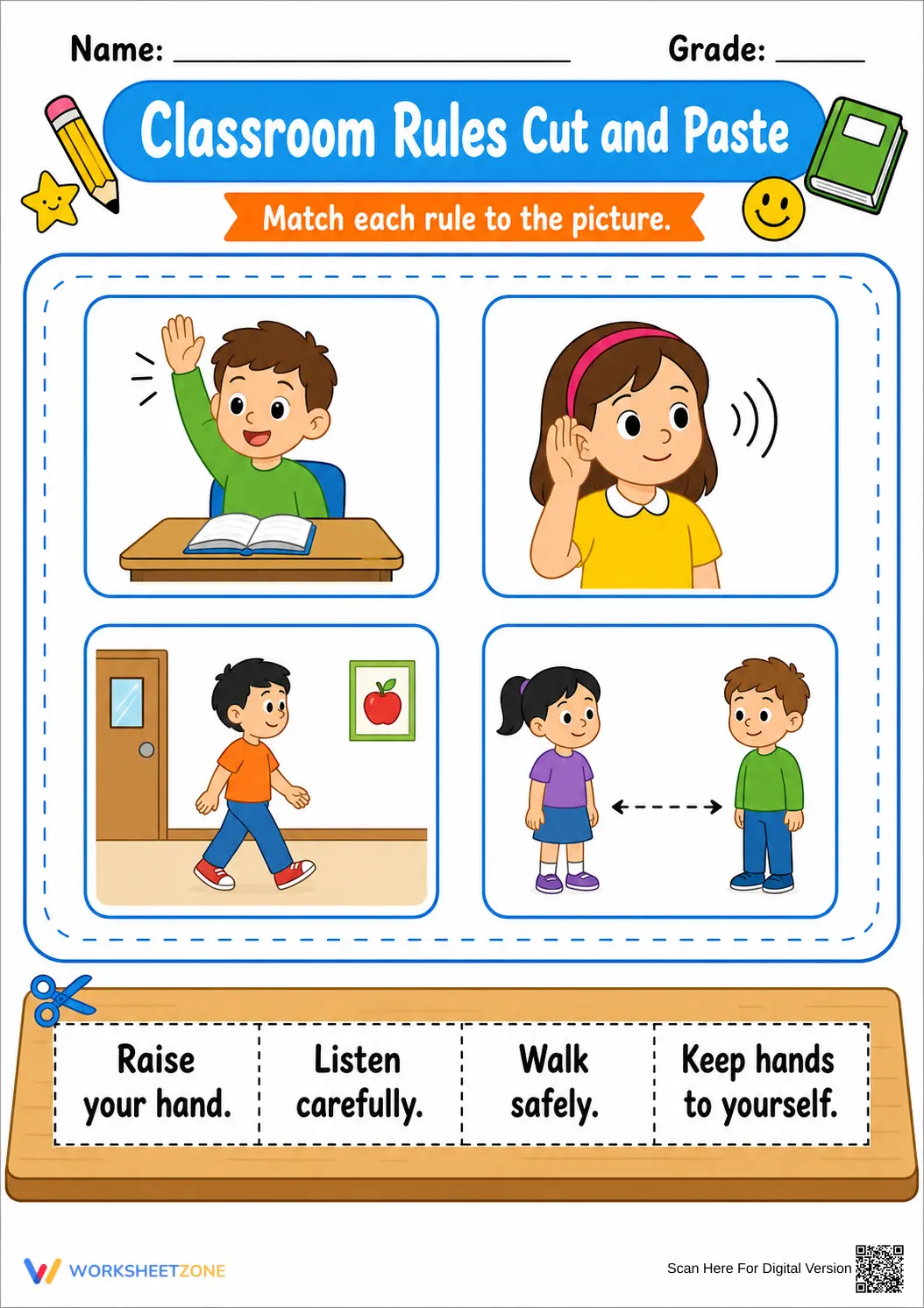

Classroom Rules Cut and Paste | Grade K-2 Essential
Paste this activity's link or code into your existing LMS (Google Classroom, Canvas, Teams, Schoology, Moodle, etc.).
Students can open and work on the activity right away, with no student login required.
You'll still be able to track student progress and results from your teacher account.
This Grade K-2 classroom rules worksheet helps young learners identify and internalize essential school expectations through a hands-on matching activity. By connecting visual cues to written text, students build a foundation for positive behavior and social-emotional success. This resource ensures students understand how to contribute to a safe and respectful learning environment from day one.
At a Glance
- Grade: K-2 · Subject: Social Studies
- Standard:
CCSS.ELA-LITERACY.SL.K.1— Follow agreed-upon rules for discussions and carry out tasks in the classroom- Skill Focus: Classroom Expectations
- Format: 1 page · 4 problems · Answer key included · PDF
- Best For: Back-to-school routines and behavior management
- Time: 15–20 minutes
This single-page PDF features a clean, bulletin-board style layout with four distinct 2-by-2 grid boxes. Each box contains a high-quality vector illustration representing a specific rule: raising a hand, listening carefully, walking safely, and keeping hands to oneself. At the bottom, a dedicated cut-and-paste zone provides four text strips with dotted lines for easy scissor navigation. The document includes student name and grade fields for easy organization and collection.
Zero-Prep Workflow
- Print: Generate the required number of copies for your student group in seconds.
- Distribute: Hand out the sheets along with basic supplies like scissors and glue sticks.
- Review: Discuss the completed matches as a whole group to reinforce behavioral concepts and vocabulary.
Total teacher preparation time is under 2 minutes, making it an ideal choice for morning work, first-week activities, or emergency sub plans.
Standards Alignment
This activity aligns with `CCSS.ELA-LITERACY.SL.K.1`, which requires students to follow agreed-upon rules for discussions and classroom interactions. It also supports CASEL competencies for relationship skills and responsible decision-making. Both standard codes can be copied directly into lesson plans, IEP goals, or district curriculum mapping tools.
How to Use It
Use this worksheet during the first week of school as a follow-up to a direct instruction lesson on classroom procedures. It serves as an excellent formative assessment; observe students as they match the "Walk safely" strip to ensure they recognize the visual context of the hallway. Completion typically takes 15 to 20 minutes depending on fine motor skill levels.
Who It's For
This resource is designed for Kindergarten, 1st Grade, and 2nd Grade students, particularly those who benefit from visual supports and tactile learning. It is an excellent fit for English Language Learners (ELLs) who need to pair new vocabulary with clear imagery. Pair this with a "Classroom Rules" anchor chart or a read-aloud about school behavior.
Research from the RAND AIRS 2024 report emphasizes that explicit instruction in classroom routines, supported by visual and kinesthetic activities, significantly reduces behavioral disruptions in early childhood settings. This worksheet applies these findings by requiring students to physically manipulate text and images, reinforcing the cognitive connection between a rule and its practical application. By focusing on four core expectations—raising hands, listening, walking safely, and personal space—the resource avoids cognitive overload while establishing a clear framework for social-emotional learning. According to Fisher & Frey (2014), the use of non-linguistic representations, such as the icons provided here, is a high-effect size strategy for vocabulary and concept acquisition among diverse learners. This printable provides a structured, evidence-based approach to classroom management that can be integrated into any Tier 1 behavioral support system or used as a targeted intervention for students requiring additional social-emotional scaffolding.


