


























Views
Downloads
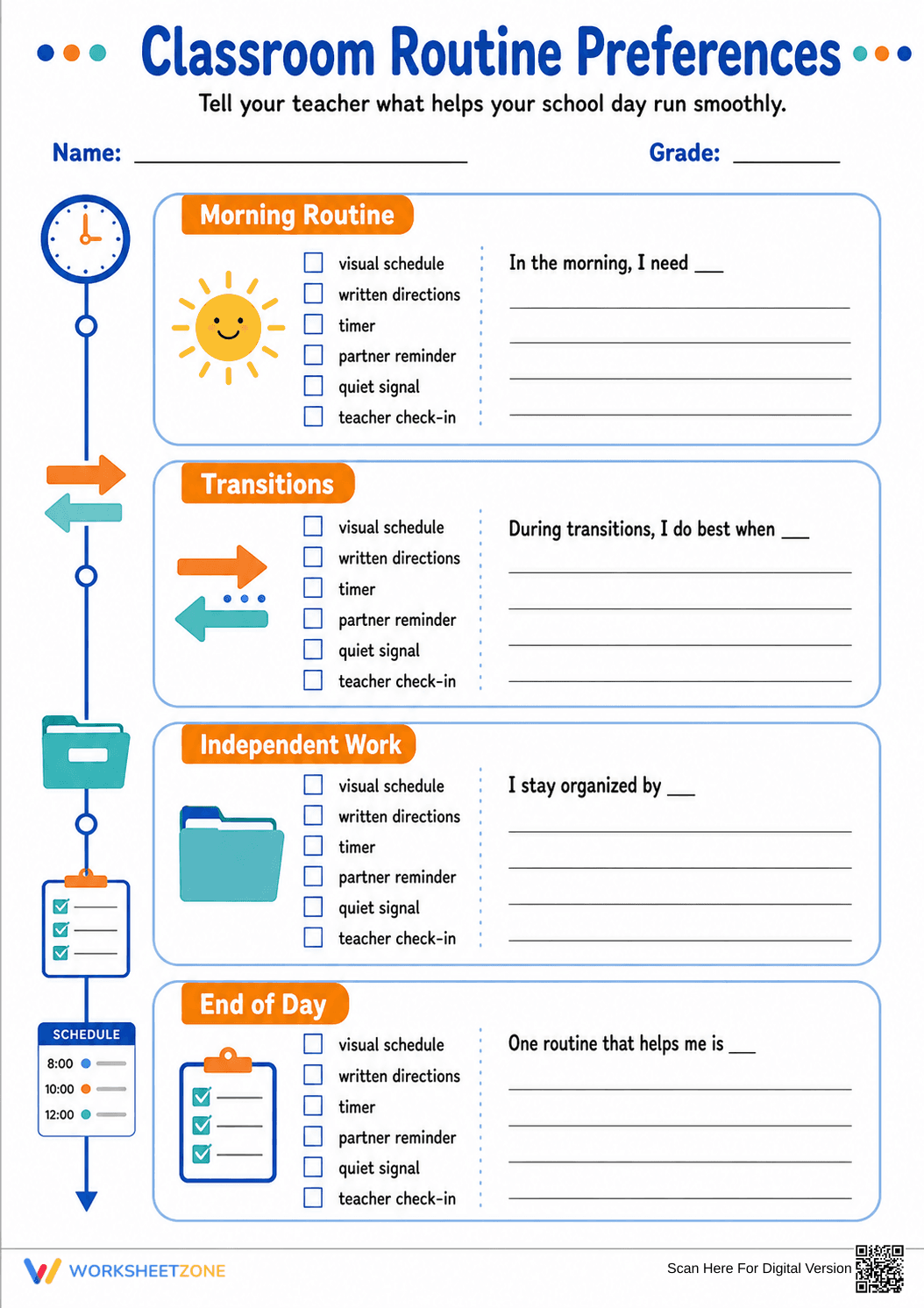

Classroom Routine Preferences Worksheet | Grade 2-5 Ready
Paste this activity's link or code into your existing LMS (Google Classroom, Canvas, Teams, Schoology, Moodle, etc.).
Students can open and work on the activity right away, with no student login required.
You'll still be able to track student progress and results from your teacher account.
This Grade 2-5 classroom routine preferences worksheet empowers students to identify and communicate the specific supports they need to succeed throughout the school day. By providing a structured format for self-advocacy, students can indicate their preferences for morning routines, transitions, and independent work. This tool ensures every learner has a voice in their classroom environment.
At a Glance
- Grade: 2–5 · Subject: Social Emotional Learning
- Standard:
CCSS.ELA-LITERACY.SL.3.1— Express personal ideas and needs clearly in collaborative classroom settings- Skill Focus: Self-advocacy and routine identification
- Format: 1 page · 28 tasks · No answer key · PDF
- Best For: Back-to-school student interest inventory
- Time: 10–15 minutes
What's Inside
The worksheet features four sections: Morning Routine, Transitions, Independent Work, and End of Day. Each includes a checklist of six supports, like visual schedules, and a ruled line for responses. The single-page layout uses icons and a timeline to guide students, providing 28 data points.
Zero-Prep Workflow
- Step 1: Print the single-page PDF for each student in the class (30 seconds).
- Step 2: Distribute during a morning meeting or homeroom period for students to complete (1 minute).
- Step 3: Review the completed surveys to adjust classroom supports and visual aids (Ongoing).
Total teacher prep time is under two minutes, making this an ideal resource for the first week of school or as a quick check-in for a substitute teacher to understand student needs.
Standards Alignment
Primary standard: `CCSS.ELA-LITERACY.SL.3.1`. Students will engage effectively in a range of collaborative discussions, building on others' ideas and expressing their own clearly. This worksheet specifically targets the ability of students to articulate their personal needs and preferences within the classroom community. Both standard codes can be copied directly into lesson plans, IEP goals, or district curriculum mapping tools.
How to Use It
Use this worksheet during the first week of school as a formative assessment of student self-awareness. Observe which students can independently identify their needs versus those who require teacher check-ins to understand the options. Alternatively, assign this before a transition to a new schedule to help students prepare for changes. Completion typically takes 10 to 15 minutes, providing immediate data for classroom environmental adjustments.
Who It's For
This resource is designed for students in Grades 2-5, including those in special education who benefit from explicit self-advocacy practice. It pairs with a classroom anchor chart or a direct instruction lesson on expectations. The simple icons make it accessible for developing readers and English language learners.
This classroom routine preferences worksheet is designed to facilitate student self-advocacy and improve classroom management by identifying individual environmental needs. By allowing students to select preferred supports—such as visual schedules, written directions, or quiet signals—teachers can create a more inclusive and responsive learning environment. This approach aligns with CCSS.ELA-LITERACY.SL.3.1, which emphasizes the importance of students expressing their own ideas and needs clearly within a collaborative setting. Research by Fisher & Frey (2014) highlights that when students are given the opportunity to articulate what helps them succeed, they develop greater metacognitive awareness and self-regulation skills. This inventory serves as a foundational tool for the beginning of the school year or during IEP transition planning, ensuring that instructional supports are tailored to the specific profiles of the learners in the room. The data collected from these 28 tasks provides actionable insights for immediate classroom implementation.


