


























Views
Downloads

Classroom Jobs Would You Rather | Essential Grade 3-5
Paste this activity's link or code into your existing LMS (Google Classroom, Canvas, Teams, Schoology, Moodle, etc.).
Students can open and work on the activity right away, with no student login required.
You'll still be able to track student progress and results from your teacher account.
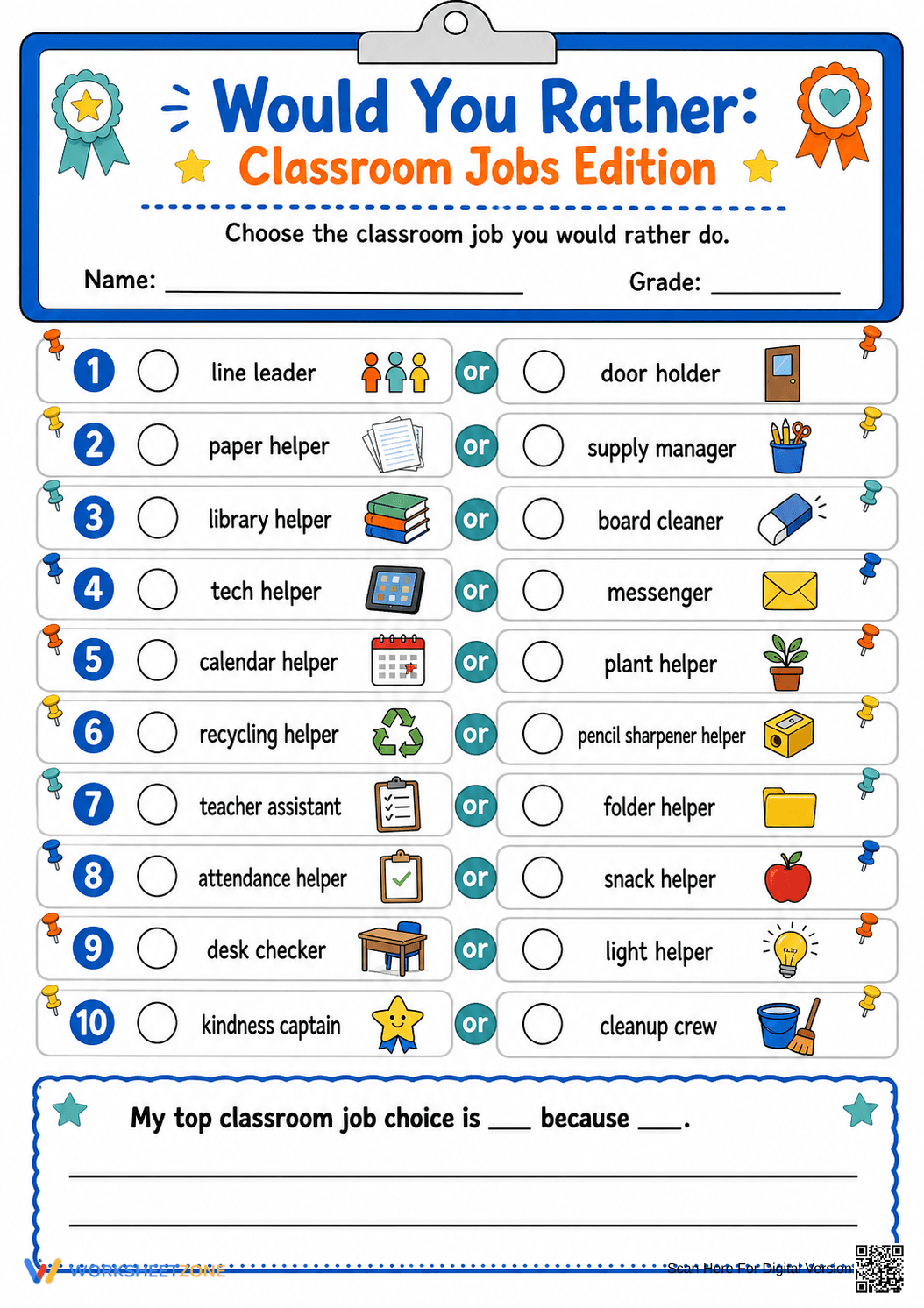
This Grade 3-5 classroom jobs worksheet facilitates student agency and opinion writing by presenting ten engaging "Would You Rather" scenarios. Students evaluate various classroom responsibilities, make definitive choices, and provide written justifications for their preferences. This activity serves as an effective tool for building classroom community while strengthening foundational speaking, listening, and writing skills.
At a Glance
- Grade: 3 (Range 2–5) · Subject: ELA
- Standard:
CCSS.ELA-LITERACY.SL.3.1— Engage effectively in a range of collaborative discussions with diverse partners- Skill Focus: Opinion formation and reasoning
- Format: 1 page · 11 tasks · Answer key not applicable · PDF
- Best For: Morning meeting or community building
- Time: 15–20 minutes
What's Inside
The worksheet features a playful clipboard-style layout containing 10 stacked choice strips. Each strip presents two classroom job options, such as "line leader or door holder" and "tech helper or messenger," accompanied by clear 2D vector icons to support visual learners. The final section includes a framed reflection area with long blank writing lines for students to explain the reasoning behind their top choice.
Zero-Prep Workflow
- Print: Select the single-page PDF and print enough copies for your entire class in under 30 seconds.
- Distribute: Hand out the sheets during a morning meeting, as a bell-ringer activity, or as part of a substitute teacher folder.
- Review: Facilitate a quick partner share or a whole-class discussion where students justify their choices before collecting the sheets for formative assessment.
Standards Alignment
This resource is primarily aligned with CCSS.ELA-LITERACY.SL.3.1, which requires students to engage effectively in collaborative discussions and express their own ideas clearly. It also supports CCSS.ELA-LITERACY.W.3.1 by asking students to write opinion pieces on topics or texts, supporting a point of view with reasons. Both standard codes can be copied directly into lesson plans, IEP goals, or district curriculum mapping tools.
How to Use It
Use this worksheet as a low-stakes icebreaker at the beginning of the school year to help students identify how they want to contribute to the classroom environment. Alternatively, assign it as a pre-writing brainstorm before a formal unit on persuasive writing. During the activity, observe which students struggle to make a choice or provide a reason, as this offers a formative assessment of their decision-making and justification skills. Expect completion within 15 to 20 minutes.
Who It's For
This resource is designed for students in Grades 2 through 5. It is particularly beneficial for English Language Learners (ELLs) due to the heavy use of visual icons that provide context for the job titles. It pairs naturally with a classroom job anchor chart or a direct instruction lesson on the importance of community responsibility and civic duty within the school setting.
According to Fisher & Frey (2014), structured oral language practice through "would you rather" scenarios provides a low-stakes entry point for students to practice evidence-based reasoning. This worksheet aligns with CCSS.ELA-LITERACY.SL.3.1 by requiring students to make a definitive choice and then justify that choice in writing. By focusing on classroom jobs, the activity bridges the gap between social-emotional learning and academic writing standards. Research from the NAEP indicates that students who engage in regular classroom discussion and opinion-sharing activities demonstrate higher proficiency in persuasive writing tasks. This resource provides 10 distinct opportunities for students to evaluate preferences before transitioning to a formal written reflection. The inclusion of visual icons supports vocabulary acquisition for English Language Learners, ensuring that the skill of justifying a position is accessible to all learners in a diverse Grade 3-5 classroom setting.


