


























Views
Downloads

Grade K-1 Beginning Sounds — Printable No-Prep Worksheet
Paste this activity's link or code into your existing LMS (Google Classroom, Canvas, Teams, Schoology, Moodle, etc.).
Students can open and work on the activity right away, with no student login required.
You'll still be able to track student progress and results from your teacher account.
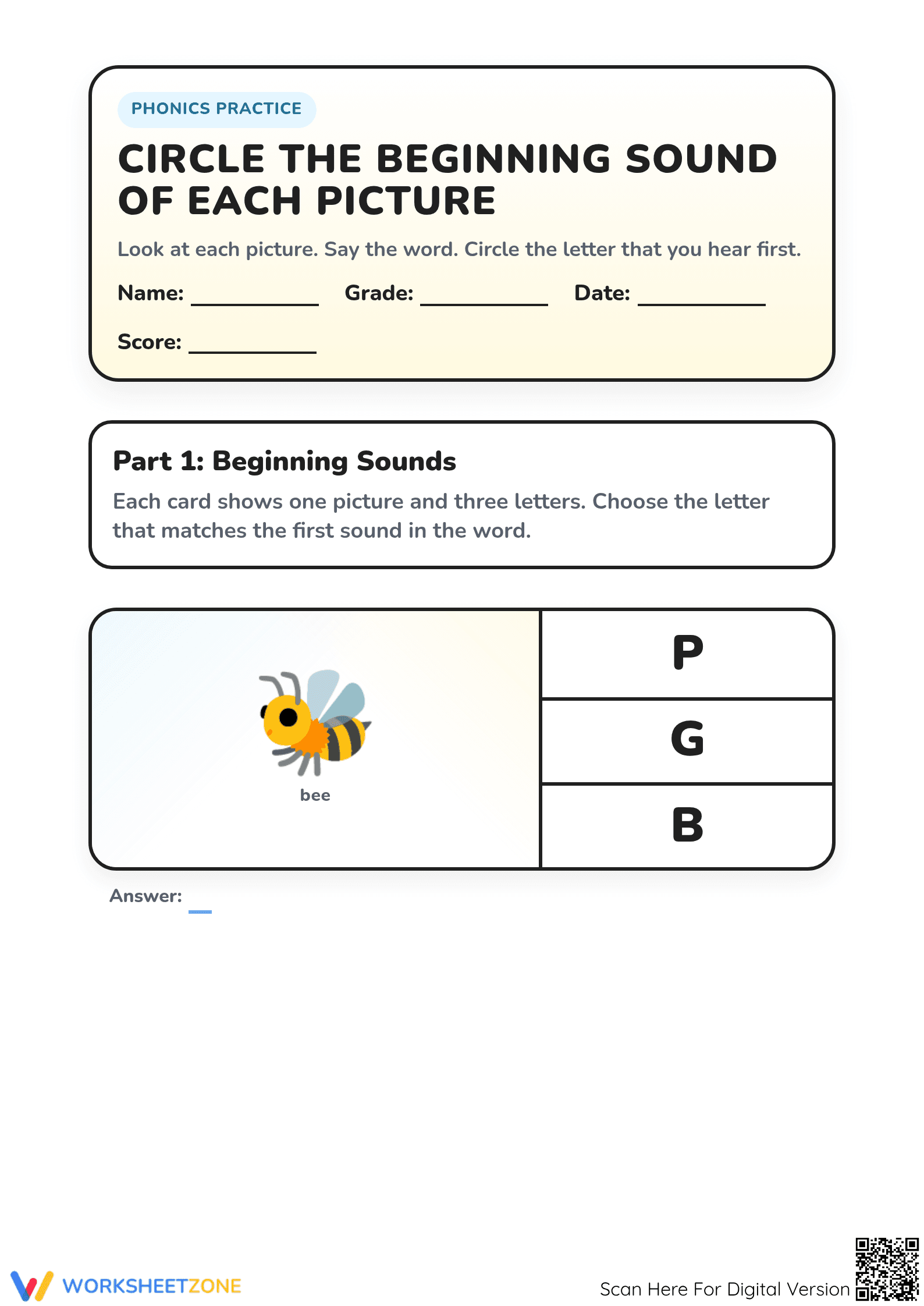
Students build a rock-solid foundation for reading by identifying the initial phonemes in familiar words. This beginning sounds worksheet directs learners to say the name of an object and isolate its first sound before selecting the corresponding letter. This focused phonics practice accelerates the transition from speech to print for emergent readers.
At a Glance
- Grade: K–1 · Subject: ELA
- Standard:
RF.K.3.A— Produce the primary sound for each consonant and demonstrate letter-sound correspondence- Skill Focus: Initial phoneme identification
- Format: 2 pages · 4 problems · Answer key included · PDF
- Best For: Early literacy morning work and phonics centers
- Time: 5–10 minutes
What's Inside
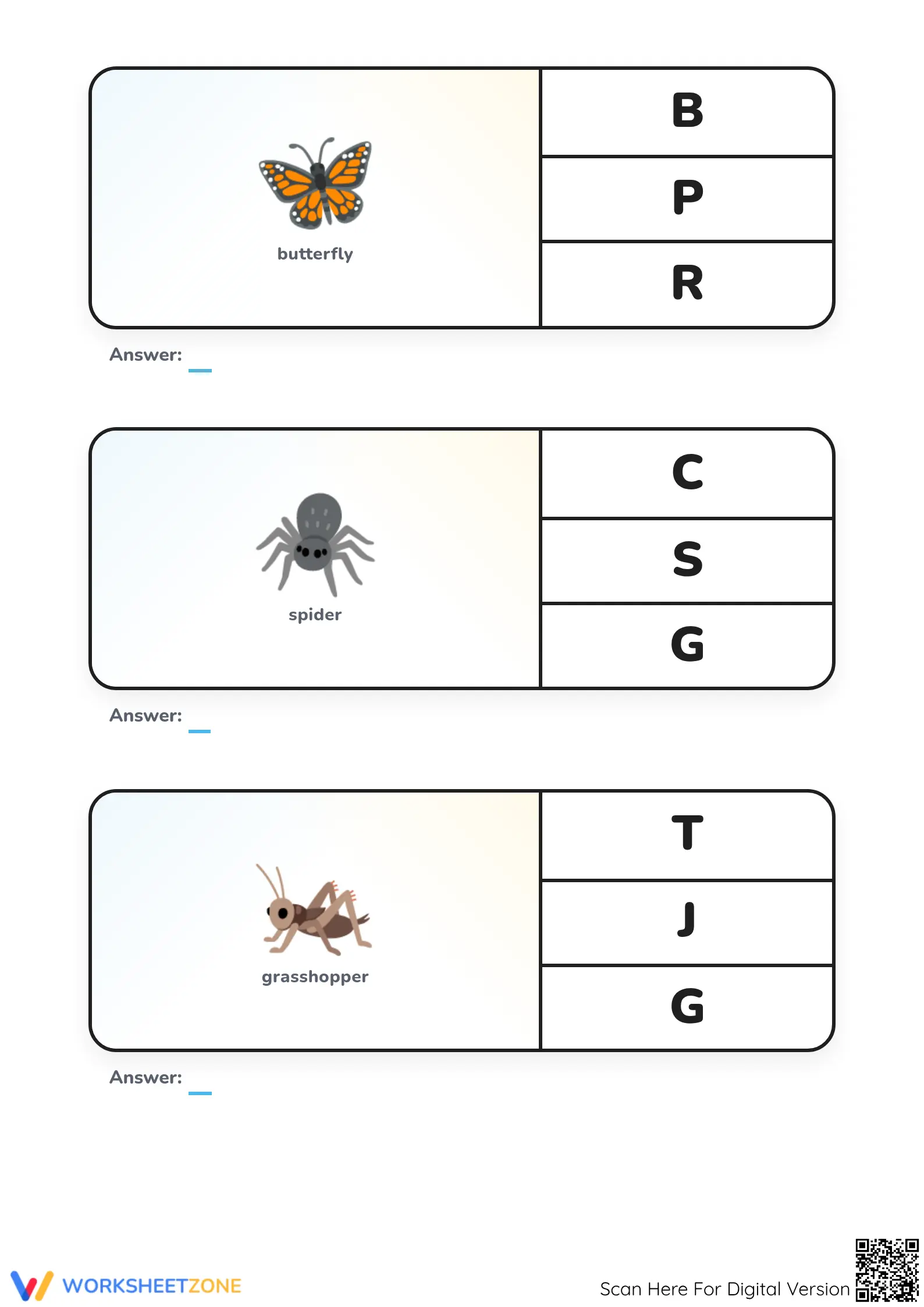
This resource contains two pages featuring four distinct task cards. Each card presents a high-quality illustration of a common animal, such as a bee, butterfly, spider, or grasshopper. Students are provided with three letter choices for each image to encourage discrimination. The layout is spacious and clear, designed specifically for young learners with developing fine motor skills. A comprehensive answer key is provided to facilitate rapid grading or student self-checking.
Zero-Prep Workflow
Teachers can implement this resource in three easy steps. First, print the two pages (30 seconds). Second, distribute the sheets with the instruction to "say and circle" (30 seconds). Third, review using the answer key (30 seconds). This entire workflow requires less than two minutes of teacher preparation time, making it ideal for emergency sub plans, morning work, or transitional periods.
Standards Alignment
The primary alignment is `CCSS.ELA-LITERACY.RF.K.3.A`, which requires students to demonstrate basic knowledge of one-to-one letter-sound correspondences by producing the primary sound for each consonant. Additionally, this practice supports phonological awareness goals by requiring the isolation of initial phonemes in multi-syllabic words. Both standard codes can be copied directly into lesson plans, IEP goals, or district curriculum mapping tools.
How to Use It
Use this as a warm-up before a direct instruction lesson on consonant sounds. Circulate and listen for students whispering word names; this provides a formative-assessment moment to see if students are correctly segmenting sounds. Alternatively, assign this as an exit ticket to verify mastery after a small-group phonics session. Completion time is approximately 10 minutes for most early primary learners.
Who It's For
This resource is designed for Kindergarten and Grade 1 students, though it is suitable for advanced preschool learners. It is particularly effective for English Language Learners who benefit from visual cues. Pair this worksheet with a phonics anchor chart or a letter-sound manipulative activity to reinforce vocabulary and sound recognition simultaneously in a literacy station.
Mastering letter-sound correspondence is a critical milestone in early literacy development, as identified in the RAND AIRS 2024 report on foundational reading skills. This worksheet targets the specific ability to map auditory phonemes to visual graphemes, a process that Fisher & Frey (2014) highlight as essential for developing decoding automaticity. By isolating the beginning sound in words like "butterfly" or "spider," students practice the phonological segmenting required for later orthographic mapping. Research in ScienceDirect TpT Analysis suggests that high-utility, visually supported practice sheets like this one significantly reduce cognitive load for emergent readers, allowing them to focus entirely on the phonetic task. The alignment to `RF.K.3.A` ensures that students are meeting core benchmarks for producing primary consonant sounds. This zero-prep resource provides the structured repetition necessary for students to move from phonemic awareness to independent reading proficiency.


