


























Views
Downloads
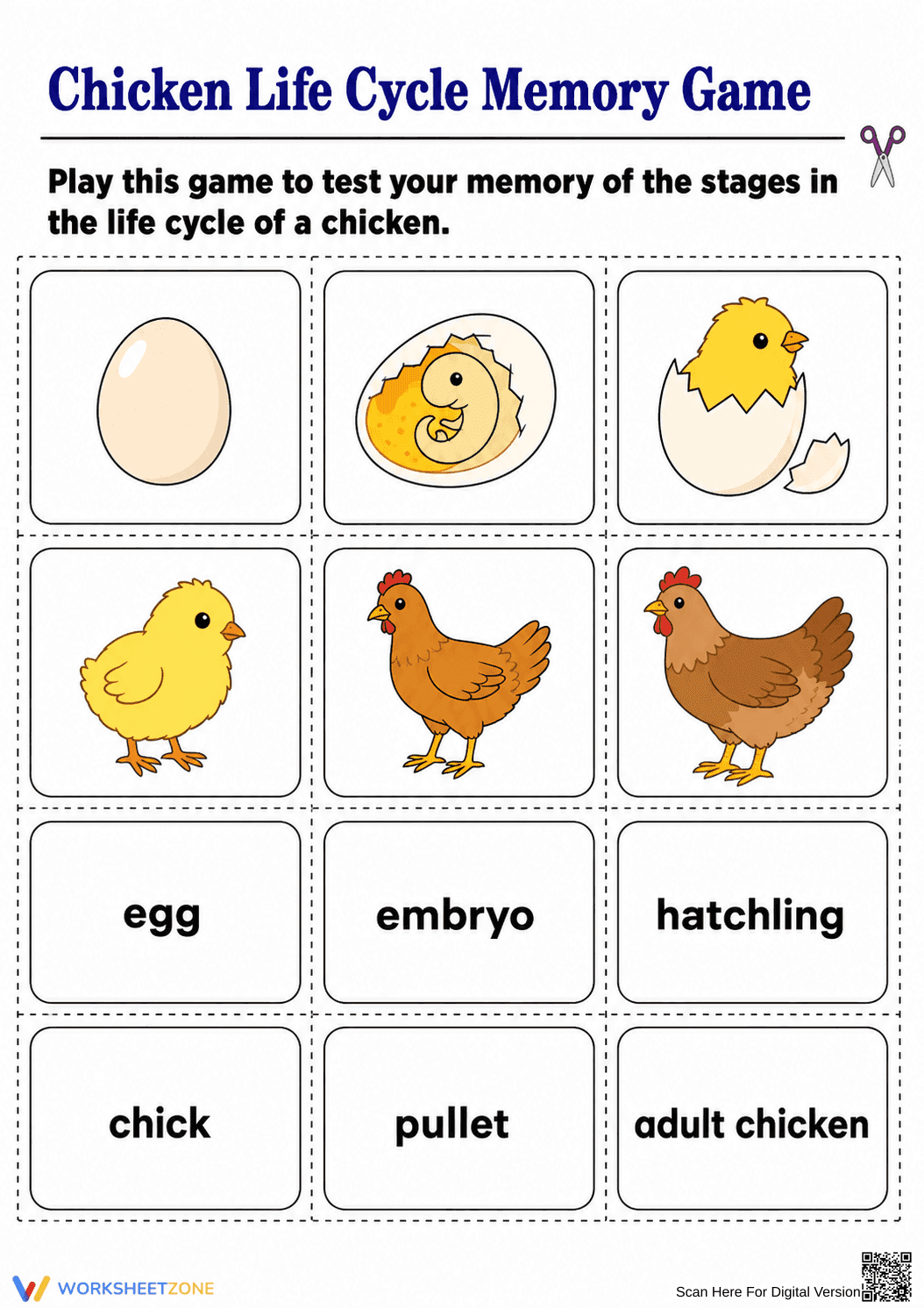

Grade 3 Chicken Life Cycle — Printable Memory Game
Paste this activity's link or code into your existing LMS (Google Classroom, Canvas, Teams, Schoology, Moodle, etc.).
Students can open and work on the activity right away, with no student login required.
You'll still be able to track student progress and results from your teacher account.
This interactive memory game helps students master the stages of a chicken's life cycle by matching visual representations with their correct vocabulary terms. By pairing images of an egg, embryo, and hatchling with corresponding text cards, young learners actively reinforce their understanding of biological growth and development.
At a Glance
- Grade: 3 · Subject: Science
- Standard:
3-LS1-1— Describe that organisms have unique and diverse life cycles- Skill Focus: Identifying life cycle stages
- Format: 1 page · 6 matching pairs · No answer key · PDF
- Best For: Science centers and review
- Time: 15–20 minutes
This single-page resource features twelve cut-out cards for a classic memory matching activity. The top rows provide six full-color illustrations depicting the progression from egg to adult chicken. The bottom rows contain six corresponding text labels, including scientific vocabulary like embryo and pullet. Dashed lines guide users in quickly preparing the game pieces.
This resource is designed for immediate implementation with a simple three-step workflow:
- Print (1 minute): Generate enough copies for small groups or individual science centers. The layout prints beautifully on standard paper.
- Distribute (1 minute): Hand out the sheets along with scissors. Students can cut along the dashed lines themselves.
- Review (15 minutes): Students place cards face down and take turns flipping them over to find matching image and text pairs.
Total teacher prep time is under two minutes, making this an excellent addition to a science substitute plan or a quick transition activity.
This activity aligns directly with 3-LS1-1, requiring students to develop models to describe that organisms have unique and diverse life cycles but all have in common birth, growth, reproduction, and death. By sequencing and matching the specific stages of a chicken, students build a foundational understanding of avian biology. Both standard codes can be copied directly into lesson plans, IEP goals, or district curriculum mapping tools.
Deploy this memory game during independent practice. It works exceptionally well as a collaborative station activity where pairs discuss visual differences between a chick and a pullet. For formative assessment, observe students as they match the cards; if a student consistently confuses the embryo and hatchling stages, you can provide immediate, targeted redirection. Expect the cutting and gameplay to take approximately fifteen to twenty minutes.
This worksheet is primarily designed for third-grade science students, though it serves as an excellent review for fourth graders studying broader animal classifications. To support English Language Learners, teachers can pre-teach the vocabulary words before the matching game begins. Pair this activity with a non-fiction reading passage about farm animals or a direct instruction lesson on bird reproduction to maximize student comprehension.
Integrating hands-on matching activities into elementary science instruction significantly reinforces vocabulary retention and conceptual understanding of biological processes. This resource targets 3-LS1-1, helping students describe that organisms have unique and diverse life cycles through active recall. According to Fisher & Frey (2014), providing students with structured, interactive tasks that require them to pair visual stimuli with academic language increases their cognitive engagement and long-term memory consolidation. By physically manipulating the cards and discussing the specific stages from egg to adult chicken, learners move beyond passive observation into active knowledge construction. This tactile approach ensures that foundational science concepts are firmly established, preparing students for more complex biological studies in subsequent grade levels. The memory game format specifically leverages spaced repetition and immediate feedback, which are critical components of effective science education.


