


























Views
Downloads
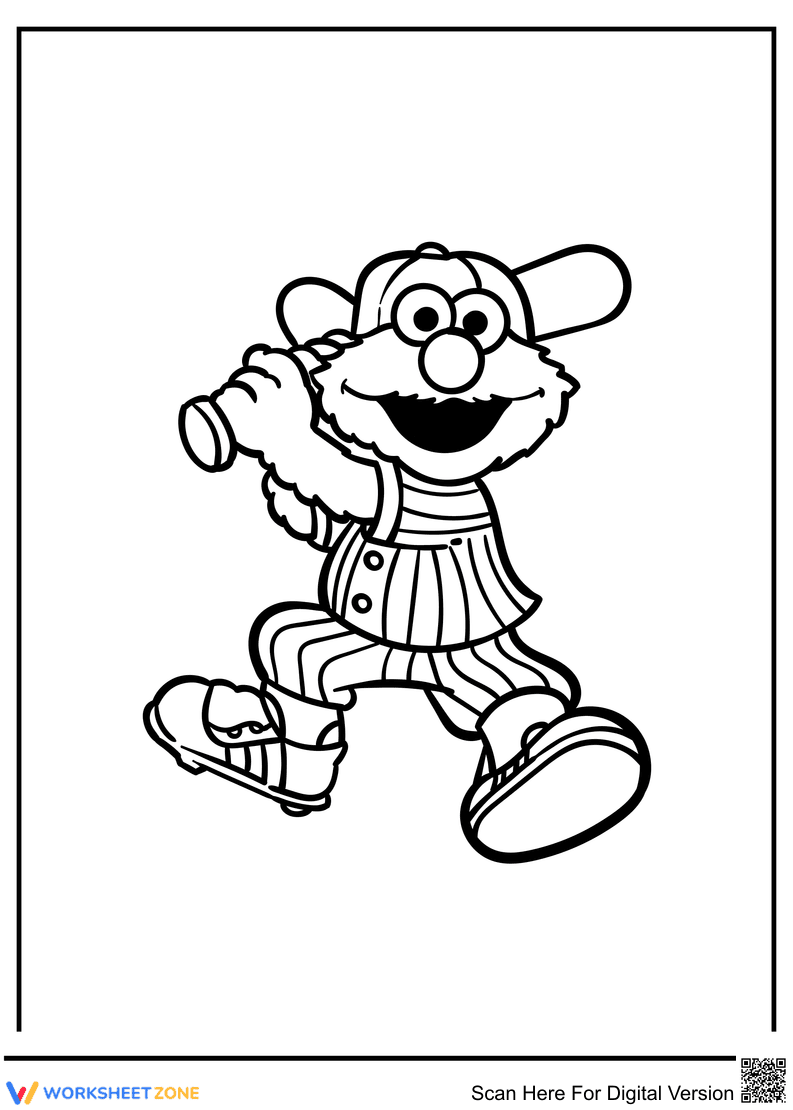

Printable Elmo Baseball Coloring Page | Grade K-2
Paste this activity's link or code into your existing LMS (Google Classroom, Canvas, Teams, Schoology, Moodle, etc.).
Students can open and work on the activity right away, with no student login required.
You'll still be able to track student progress and results from your teacher account.
This printable Elmo coloring page provides early learners with a creative outlet to practice fine motor control and color recognition. By engaging with a familiar character in a baseball uniform, students develop the hand-eye coordination necessary for future writing tasks. It offers a simple yet effective way to integrate art into the school day.
At a Glance
- Grade: Kindergarten · Subject: English
- Standard:
VA:Cr1.1.Ka— Engage in exploration and imaginative play with artistic materials and tools- Skill Focus: Fine motor development
- Format: 1 page · 1 task · Answer key not applicable · PDF
- Best For: Morning work or transition periods
- Time: 15–20 minutes
This resource features a single-page, high-quality line art illustration of Elmo ready for a baseball game. The clear, bold outlines are designed specifically for younger children who are still mastering their grip and spatial awareness. No additional materials are required beyond standard coloring supplies like crayons, markers, or colored pencils.
The zero-prep workflow for this worksheet is designed for maximum efficiency: 1. Print (30 seconds) — select the single PDF page and send to your local printer. 2. Distribute (1 minute) — hand out the sheets along with a set of primary colors. 3. Review (1 minute) — observe student grip and color choices as they work. Total teacher preparation time is under 3 minutes, making it an ideal choice for sub plans or rainy day activities.
Standards Alignment: `VA:Cr1.1.Ka` — "Engage in exploration and imaginative play with materials." This worksheet encourages students to explore color combinations and artistic expression through a structured medium. While primarily an arts standard, the activity supports `CCSS.ELA-LITERACY.L.K.1.A` by strengthening the small muscle groups required for legible handwriting. Both standard codes can be copied directly into lesson plans, IEP goals, or district curriculum mapping tools.
Use this as a "morning work" activity to settle students as they arrive in the classroom, or as a reward for completing a reading unit. During the activity, observe how students hold their coloring tools; this provides a formative assessment of their fine motor development. Expected completion time is 15–20 minutes depending on the student's detail level.
This worksheet is designed for Kindergarten through Grade 2 students, particularly those who benefit from familiar characters to increase engagement. It is an excellent pairing for a physical education lesson about baseball or a Sesame Street-themed literacy unit. The simple design ensures that students with varying motor abilities can find success.
According to Fisher & Frey (2014), the integration of visual arts and fine motor practice in early childhood education is essential for developing the neural pathways associated with literacy and writing. This worksheet addresses the VA:Cr1.1.Ka standard by allowing students to engage in imaginative play with artistic materials. Research from the NAEP indicates that students who participate in regular artistic activities show higher levels of engagement and improved spatial reasoning. By providing a structured yet creative task, this resource helps bridge the gap between play and academic skill-building. The use of familiar characters like Elmo reduces cognitive load, allowing students to focus entirely on the physical act of coloring and color selection. This 1-page printable is a reliable tool for any early elementary classroom looking to support holistic student development through simple, effective artistic practice. It provides a clear path toward fine motor mastery while maintaining high student interest through recognizable media figures.


