


























0
Views
0
Downloads

0.0
0
Save
0 Likes
Share
Cell Graphic Organizer Worksheet
0 Views
0 Downloads
Paste this activity's link or code into your existing LMS (Google Classroom, Canvas, Teams, Schoology, Moodle, etc.).
Students can open and work on the activity right away, with no student login required.
You'll still be able to track student progress and results from your teacher account.
Information
Description
What It Is:
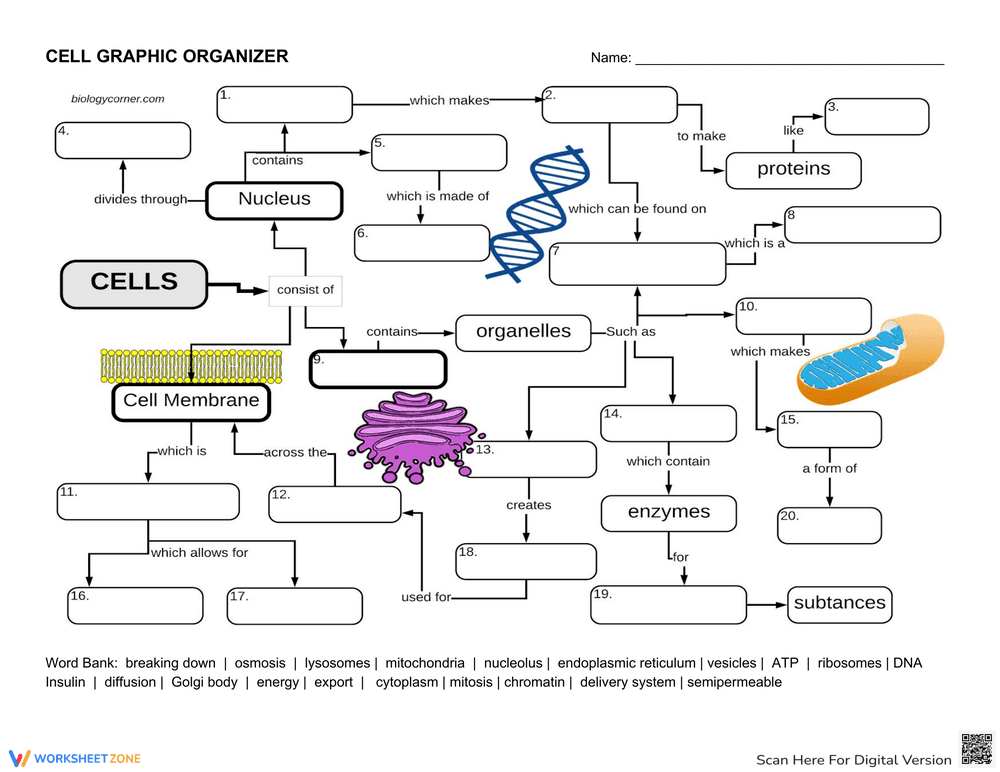
This is a science worksheet featuring a graphic organizer about cells. The organizer uses arrows to connect different cell parts and their functions, including the nucleus, cell membrane, organelles, DNA, proteins, enzymes, and substances. There are fill-in-the-blank spaces for students to complete the connections. A word bank is provided at the bottom with terms like 'nucleus,' 'mitochondria,' 'DNA,' 'ribosomes,' 'cell membrane,' 'osmosis,' and 'diffusion.'
Grade Level Suitability:
This worksheet is suitable for grades 6-9. The complexity of the cell structures and functions, along with the vocabulary, suggests it's appropriate for middle school life science or introductory biology. The graphic organizer format makes it accessible for visual learners.
Why Use It:
This worksheet helps students understand the relationships between different parts of a cell and their functions. It promotes critical thinking and vocabulary development in cell biology. The graphic organizer format aids in visual learning and helps students organize their knowledge of cell structure and function.
How to Use It:
Students should use the word bank to fill in the blanks in the graphic organizer, connecting cell parts to their functions. They need to follow the arrows and read the provided text to determine the correct terms to use. It can be used as an in-class activity, homework assignment, or review sheet.
Target Users:
This worksheet is designed for middle school and early high school students learning about cell biology. It's beneficial for students who learn best through visual aids and graphic organizers. It can also be helpful for students who need additional support with vocabulary and understanding the relationships between cell parts.
This is a science worksheet featuring a graphic organizer about cells. The organizer uses arrows to connect different cell parts and their functions, including the nucleus, cell membrane, organelles, DNA, proteins, enzymes, and substances. There are fill-in-the-blank spaces for students to complete the connections. A word bank is provided at the bottom with terms like 'nucleus,' 'mitochondria,' 'DNA,' 'ribosomes,' 'cell membrane,' 'osmosis,' and 'diffusion.'
Grade Level Suitability:
This worksheet is suitable for grades 6-9. The complexity of the cell structures and functions, along with the vocabulary, suggests it's appropriate for middle school life science or introductory biology. The graphic organizer format makes it accessible for visual learners.
Why Use It:
This worksheet helps students understand the relationships between different parts of a cell and their functions. It promotes critical thinking and vocabulary development in cell biology. The graphic organizer format aids in visual learning and helps students organize their knowledge of cell structure and function.
How to Use It:
Students should use the word bank to fill in the blanks in the graphic organizer, connecting cell parts to their functions. They need to follow the arrows and read the provided text to determine the correct terms to use. It can be used as an in-class activity, homework assignment, or review sheet.
Target Users:
This worksheet is designed for middle school and early high school students learning about cell biology. It's beneficial for students who learn best through visual aids and graphic organizers. It can also be helpful for students who need additional support with vocabulary and understanding the relationships between cell parts.


